
 Access Backstage Pass




As U2's innovative guitarist, The Edge is no stranger in taking risks. Here, he reflects on his 25 years with rock's most musically adventurous and life-affirming band.
It's hard to tell if the Edge is having a midday or midlife crisis. “Why am I here?” the U2 guitarist asks inscrutably, rubbing his salt-and-pepper chin stubble and staring at the tranquil vista of the Hudson River and, beyond it, the banks of New Jersey. We’re standing in the penthouse of Manhattan’s airy, swanky M Studio, taking in some ephemeral sun on an otherwise resolutely cloudy afternoon.
Just as I’m about to go for some high-minded response like, “Well, Edge, we’re doing a photo shoot, and then an interview,” he abruptly expands on his thoughts: “Starting a band is the easy part. Once you’ve formed the band you have to tell a story, and that story requires songs. And not just good songs, but great songs. After a while, great songs won’t do—they have to be the best. Success doesn’t make it any easier. Each time I start a new record, it’s a brand-new search.”

Occurring now at roughly four-year intervals, the U2 album/tour cycle is an important opportunity to convince past allies that it’s still the same band, with the same passion and beliefs, even if the music is totally different. The Edge considers this contention, chuckling with embarrassment. “That sounds like doublespeak, but the new album is proof enough.” He is referring, of course, to How to Dismantle an Atomic Bomb, the group’s latest album, released late last year. Its stripped-back arrangements and production recall the U2 of old, before dance beats, synthesizers and club music trappings engulfed their music in the late Nineties. In that respect, the album is nothing so much as an extension of the back-to-basics endeavors of its predecessor, 2000’s All That You Can’t Leave Behind.
“Soundwise, it’s us completing a circle,” says the Edge, “but by no means are we talking about only one circle. By referencing our past, by allowing ourselves to sound like the ‘old U2’—the Eighties U2—we’re not in a box anymore. Now we’re free to sound any way we please. It’s very liberating.”
To many longtime fans, the very notion of confinement runs counter to everything they hold dear about “Eighties U2.” And there is much they hold dear: Bono’s towering vocals, matched with the raw, naïve immediacy of his lyrics; the rousing percussive force of the bassist Adam Clayton and drummer Larry Mullen Jr.; and, of course, the Edge’s guitar sound, among the most distinctive in rock music.
Chimerical and chiming, echoey and evocative, it came into existence with no evident beginning. Even on U2’s debut, 1980’s Boy, the Edge’s cascading guitar textures are in full bloom. Armed with just a Gibson Explorer and a Memory Man echo unit, the guitarist lashed out at parochial attitudes about what rock should sound like and what it could communicate. On a series of dizzyingly iconic albums throughout that decade, the Edge created an entirely new language for the instrument, one of harmonic squalls and ringing ostinatos, by turns space-age and rural. Nothing seemed beyond his reach. Even while jamming with the redoubtable B.B. King on “When Love Comes to Town,” from U2’s 1988 album Rattle and Hum, he was no apprentice, dispensing pure sound (and fewer notes than B.B.) with an exactitude and delight still unsurpassed by any other guitarist.
To acknowledge one’s heritage is not necessarily to approve of it, and during much of the Nineties, U2 set about fixing what many saw as not being broke. In the band’s view, the Edge’s sound had become part of its overblown image and sound, a pretension to be dispensed in small doses, if at all. As U2 entered the next phase of their career, ironic self parody ruled the day, and on such adventurous albums as Achtung Baby!, Zooropa and Pop, the guitar revelries so intrinsic to U2’s success were replaced by anything the band could think up. “Our M.O. at the time was simple,” recalls the Edge: “ ‘If it sounds like U2, it goes. If it sounds like anybody else, it stays.’ And yet, somehow we sounded like us all the same.“
In artistic terms, the albums were triumphs, but commercially U2 began to fall out of favor. Pop, a metaphysical potpourri of trance and dance electronica, veered further away from their classic sound than most fans cared to follow. So it was a no small relief when they issued All That You Can’t Leave Behind and threw their arms around themselves again, allowing the anthems—and the Edge’s guitar—to fly once again. “ ‘Beautiful Day’ got us to thinking it could work again,” says the Edge. Any doubts they had were certainly dispelled by the time U2 settled down to record How to Dismantle an Atomic Bomb. Its singles “Vertigo” and “Sometimes You Can’t Make It on Your Own” recall nothing as much as prime U2, with their “big” vocals and guitar sounds. Yet, for all the familiarity of the music, it’s evident in the new songs that U2 aren’t merely rehashing the past but rather exploring it with fresh senses.
“Just as a comedian doesn’t want to tell the same jokes over and over, we don’t want to play the same songs the same way,” says the Edge. “On the other hand, we’ve now come to a place where we’re comfortable admitting we have our own style and we can do what we want with it. It’s our sound. We made it, and we can break it if we want. Of course, we’re the only ones that know how to put it back together again, too. All it takes is lots of arguing.”
Things are never Swiss-timed in U2-land, especially on tour. Today’s activities are sandwiched between sold-out shows at New Jersey’s Continental Airlines Arena and New York’s Madison Square Garden, which means every minute counts. The Edge’s entourage of handlers field calls and negotiate last-minute schedule changes. At one point, food is ordered, cancelled, then reordered. The one-hour photo session requires twice the scheduled time. But Curtis Mayfield is pumping on the stereo (“great choice,” the Edge remarks), and after exhausting his impressive array of cover boy faces, U2’s guitarist is feeling suddenly spry. He turns down an offer of green tea in favor of strong black coffee, then settles back to ponder and scrutinize his career. Belying his bookworm-like, taciturn reputation, the Edge holds forth and laughs easily, buzzing with an agile sense of humor and an instinct for punchy ripostes. Several times during our conversation, I’m tempted to check his coffee for traces of Guinness.
GUITAR WORLD There are hallmarks of your guitar sound—drone notes, piercing highpitched tones, lots of wide spaces—that are distinctly Irish. Although you’re Welsh, you grew up in Ireland. Did you listen to much Celtic music?
THE EDGE I hear where you’re going with that, and I think it’s valid. When I was a child, I’m sure my ears picked up sounds and stored them away, to be used at a later date. The biggest thing for me, though, has always been how I hear music—or how I want to hear it. I’ll do anything I can to avoid being cliché. So if I do stand out in any way as a guitarist, it’s because I steadfastly refuse to travel down a well-trodden path. I want to bring a new perspective to what I play. It’s hard to do, but that’s what gets me off.
GW At what point did you discover that you had some sweet skills with the echo pedal?
THE EDGE We were cutting some of our early demos when we got our first Memory Man echo unit. By then we’d been playing together for a couple of years and were looking for ways to colorize the sound, to bring something more than just the flat aesthetics of the band playing together. Within minutes, I was drawn not only to the textural qualities of the echo but also the rhythmic possibilities that it suggested. As we are essentially a three-piece outfit with a lead singer, it was very useful to be able to create multiple rhythms.
GW Traditionally, the bassist and drummer set the rhythm for the rest of the band to follow. Did you start to feel as if the echo unit was turning you into the band’s timekeeper?
THE EDGE Oh, yeah, but I think it was more that Larry and I became the rhythm section, which allowed Adam to be more creative. Up to that point we were pretty punk rock—a lot of straight 4/4 rhythms—and Adam would just barrel along. One cool result of playing with echo is that it makes you more precise in your timekeeping and rhythm playing. It’s like playing tennis against a brick wall: the ball’s going to fire back at you the same way every time; it isn’t going to waiver. You find ways to groove with it, to anticipate the way the sound is going to come back at you. Echo has made me a tighter player.
The creative aspect of it is exciting, too: echo takes a guitar part somewhere else. It’s like what Andy Warhol did to art with his silk-screened prints of soup cans and photos. He played with art; he turned it upside down. The conventions that were supposedly sacred about imagery are the ones he threw away. I draw on that aesthetic decision. Weirdly enough, if I’m having trouble with a guitar part—not the playing of it but the writing— I’ll mess around with echo and other effects, just turn everything up and make it as crazy as can be, and it winds up taking me somewhere. I’ve found so many guitar parts from echo. It’s limitless.
The biggest difference between me and other guitar players is that I don’t use effects to color my guitar parts. I create guitar parts using effects. They’re a crucial element of what I do. And I don’t consider effects a crutch. Using them doesn’t constitute “cheating,” as some people have said. They’re part of the art.
GW Onstage you use a short delay and a long delay together. What’s the story behind that combination?
THE EDGE They work together to become part of one delay sound. When I use two delays, I like to mess with the pitch modulation of the delay signal. It increases the depth of the sound and gives it a tremendous 3-D sensation. But straight slapback echo with no modulation isn’t very inspiring; the shape of the sound doesn’t change.
GW One or two tours ago, it looked as if Dallas [Schoo, the Edge’s guitar tech] was triggering most of your effects. When I saw you play the other night, however, you were tap dancing on your pedals like it was 1985 again.
THE EDGE Dallas has the same rig underneath the stage that I have onstage. As the tour progresses and he gets to know what I’m doing, I’ll have him take over on some things. It can be quite handy, depending on what I’m playing, and especially if I’m singing. And while it’s nice to have that option, I still feel assured knowing that I’ve got everything right where I need it. The set changes a lot, so there’s not a script to follow.
GW When it comes to playing, you’ve always been a “less is more” kind of guy. But have you ever felt that more is more? “Three chords and the truth” has long been U2’s slogan. But why not 10 chords and the truth, or 25 chords, for that matter?
THE EDGE [laughs] It’s got a ring to it, I think. I’ve never been one to bash around the guitar for the hell of it; I’m always looking for a more economical way to get a point across. Great songs, riffs, ideas—these are the things that get me off. Running my hands really fast up and down the fretboard…I mean, anybody can do that. It’s the Guitar Olympics, and I can’t think of anything more pointless.
GW However, on Achtung Baby! you were jamming the hell out of songs like “The Fly.” It was a total blast to hear you wail away on that crazy wah-wah solo.
THE EDGE [smiles, nods] That was fun, sure. What can I say? It felt right there, but not everywhere. Again, I was after a sound, and I’ll do anything it takes to get the sound I want. But it’s never about showboating my impressive skills. Chops don’t interest me. “Look what I can do” never enters my mind.
GW Sonically, however, you were going after “more is more” on Achtung Baby! The guitars are blurred; they weave in and out of the mix and move in and out of focus. It’s clutter, but in the nicest way possible. “Waiting for the End of the World” is a whirlpool of guitar.
THE EDGE That’s fair to say. The material demanded that. I keep going back to the search for maximum effect with minimum… effort. [laughs]
GW So, now it comes out: you’re lazy.
THE EDGE Could be. No, look, I realize that sometimes you have to give the guitar a good whirly, and I’m totally cool with that. But choose your moment, you know what I mean? So many guitar players don’t know when to apply the brakes.
GW What about songwriting? A lot of your well-known songs—“Bad,” “One,” “I Will Follow”— are based around one or two chords. Three, tops.
THE EDGE That has tremendous appeal to me. Powerful ideas are usually the simplest. “One” is a two-chord progression with only the slightest variation. It’s an inarguable piece of work. If we put anything more into it, it would suffer; it wouldn’t get better. The same thing with “Bad”: I remember working with Brian Eno, and the idea was to keep this two-chord mantra going, keep it going, keep it going, as long as we could stand it, and then bam! We made this chord change, and it was dramatic. Songs like that fascinate me.
GW Starting with the last tour, U2 have been dialing down the irony.
THE EDGE Oh, yeah. We pushed that just about as far as it could go with Popmart [U2’s 1997 tour].
GW And in addition to getting back to more heartfelt rocking, the band has gone back to a more politically aggressive stance. The other night in New Jersey, Bono was as in-your-face as he was in 1983.
THE EDGE Yeah, he’s… It’s very hard to boil it down to any one thing. The biggest thing for Bono, and for all of us, is that this tour should be about something. When you look at our history, it’s what we’ve always done: ZooTV was this grand concept. We were drawing on a very general idea of what was happening in the world of media and digital technology, and God knows what else, and we put the whole thing in a blender. Popmart, similarly, was a high-concept concoction. When we started talking about this tour, the first thing we asked was: What’s the point? What’s the thread? A tour should be about something. It’s probably safe to say we are in some ways continuing to present ourselves and our songs the way we did on the All That You Can’t Leave Behind tour, where the emphasis is on just us and our songs.
The work that Bono’s been doing outside of the band is his thing, but it draws on what we’re doing, and have always been doing, as a band. The issues of the moment are folded into our work. The biggest difference is that, now, instead of standing outside a meeting with a placard, Bono is actually inside the meeting, beating everybody up with his statistics and knowledge of the issues. As a person, he’s in a much different place than he was years ago, and what we do is we draw that back into the band and give it a rock and roll context.
Musically, however, our show is informed by the songs, always. The songs direct the show. That said, I think it would’ve been weird, given what’s going on in the world since our last tour, if there hadn’t been any references to politics. Our music reflects what’s going on around us and what’s happening on a personal level. Politics, spirituality, sexuality, fashion—it’s all in the mix.
GW It was cool to see you change some of the more familiar songs around onstage. On “Bullet the Blue Sky,” Bono turned the last half of the song over to you for a straight-ahead blues solo.
THE EDGE We don’t want to repeat ourselves, even with the songs people know really well. The songs get worn out if you play them the same way night after night. I realize that people want to hear a song a certain way, but I think they get off on seeing us attack a tune and have some fun with it.
GW The group has been diving deeper into its catalog than it did on previous tours. Is there any coincidence that in the same year you were inducted into the Rock and Roll Hall of Fame you’re playing “The Electric Co.” and “I Will Follow,” songs that are 25 years old?
THE EDGE [smiles, considers] There’s two things: First, it’s in recognition that we’ve got a lot of people coming who have seen us recently. We don’t want to do a greatest-hits set; we want to mix it up a bit so that we cover all the phases in the band’s development. In addition, some of those songs, including “The Electric Co.” and “Gloria,” are starting to sound current again.
GW Dude, the Eighties are back.
THE EDGE So I hear. But I don’t think I’ll be wearing the mullet again.
GW Why not? You and Bono had some serious mullet action around ’83, ’84.
THE EDGE [groans] You’re not wrong. We can’t take credit for inventing the mullet, but we can certainly lay claim to extending the envelope for what the mullet can mean.
GW What does the mullet mean?
THE EDGE [laughs] I don’t know! Nobody knows. Although Bono committed the more egregious crimes against fashion with his Live Aid hair. [closes his eyes, shakes his head] Out shining moment in mullet lore. No, I don’t think we need to relive everything about the Eighties.
GW What’s involved in dusting off some of the older songs? Do you have to listen to the old records and try to get back into the mindset of the Edge at 20?
THE EDGE The music draws you in. When I approach an older song, when I go back and listen to something I recorded a long time ago, it’s like I’m trying to unlock a secret code. Oftentimes I find that I have no memory whatsoever of what I did back then, but once I go through the process, something happens and I’m able to play completely on instinct. The song directs me; it takes me back in time. That’s what’s amazing about a good song: it can be prescient. There are times when we play the old songs onstage and they feel completely current; they’re right on the pulse. I’m amazed at the enduring quality some of these babies have. It’s not a “retro” thing.
GW Have any of the old songs proved difficult or impossible to revive?
THE EDGE Certain songs get worn down by repetition and start to lose their potency, and if that happens for us we know it’s going to happen for people in the audience. We didn’t play “Sunday Bloody Sunday” for the longest time because we were just at a dead end with it, so we tabled it for a time. You have to wait, though; songs come back when they’re meant to come back.
GW By the same token, are there some songs that just can’t be denied, that are unbreakable? “Pride (In the Name of Love),” for example: U2 have played it on every tour I’ve seen.
THE EDGE “Pride” is a good example. We weren’t playing it at the start of this tour, but we put it back in because we found a place in the running order and it seemed to call out to us. I wouldn’t say anything’s really unbreakable, but you can wear songs out. We’re not doing “With or Without You,” for example, as well as a few other hits, because they don’t feel right in the set.
GW You guys have too many good songs, that’s the problem.
THE EDGE [laughs] It’s a good problem. I’ll take that problem any day. But you know what I’m saying—we have to keep ourselves awake. There has to be a reason for us to do a song. True, the audience wants to hear them, but we have to be able to give them the song 100 percent. Like I was telling Bono: “We can’t overrehearse. Otherwise, we won’t make any mistakes.” And mistakes are a big part of what people love about U2. There’s still this element of jeopardy. You’re not going to see a band that’s so polished, where every night is a repetition of the previous night. We’re up there and we’re giving it everything we have. Sometimes we overreach and we make a mess of things, but I think that’s fine. The last thing we want to be is professional. [laughs] We don’t want to be one of those bands that turns up and becomes like wallpaper. If we screw up, fine, but it won’t be for lack of effort.
GW U2 have a reputation for amazing live shows. Does the pressure to perform ever get to you? It must feel at times as if you’re battling your own legacy.
THE EDGE Not just our legacy—everything. When we’re onstage, so much is at stake. I remember the first three live shows I ever saw: Stiff Little Fingers, Rory Gallagher, the Clash.Talk about having your mind blown. I felt the same way when I saw Springsteen for the first time. It was like having my eyes opened for the first time. It was a catharsis, and that’s what we try to bring to every show we play. We never want to forget what a live show should mean. We don’t always pull it off; some shows are better than others, and that’s inevitable. But we always try.
GW In consideration of U2’s induction in the Rock and Roll Hall of Fame, what image from your past stands out the strongest: performing in the fog and rain at Red Rocks, walking out of a giant lemon on the Popmart tour or performing on a flatbed truck through the streets of Manhattan?
THE EDGE [smiles] Probably all of them in different measures. See, that’s something people sometimes forget: that we’ve always played with theatricality. Even as a young band in Dublin, we knew rock and roll was a show. David Bowie was a big influence on us. He had amazing songs, but what a performer! Putting it all together is what keeps us going. We constantly ask ourselves, How can we put on a great show but still be a big garage band? It’s funny you mention Red Rocks. Looking back on that footage—and not just how fashion-challenged we were [laughs]—it’s amazing how many mistakes we made onstage. Some of it makes me cringe. Of course we were nervous as hell; it felt like a big gig. But despite the mistakes and everything going wrong, you can’t argue with the commitment we brought to the stage.
GW What about Red Rocks makes you cringe?
THE EDGE Bono waving the white flag. It became such a symbol for us. But the thing is, it’s something we took from our audience; it isn’t something Bono went out to do intentionally. Lots of people would bring flags and banners to the shows, and Bono just went with it.
GW U2 have never shied from being “big.” Your sound was big, your ideas were big, the way you approached live performing—big… Has “big” ever felt like a burden?
THE EDGE In a word, no. We grasped early on that this is what we want to do. We wanted our music to get everywhere. When we grew up, it was always a thrill if one of our favorite bands got on the radio or Top of the Pops, ’cause most of the time they weren’t. When punk rock broke on a mass level, when the Sex Pistols and the Jam got on Top of the Pops, the impact was huge. It was like, “Look, our heroes are next to the enemy!” So right away, we knew we wanted to be a band that has the reach to become successful on a global scale, to get on TV and to be played on radio, but also to be the musical exception rather than the norm. We never felt embarrassed about our aspirations. We couldn’t do what we wanted without getting big. We were always very upfront about wanting…everything. [laughs]
GW Even so, did you feel as if you were, to some degree, outsiders? The ethos of Seventies punk rock was so anti–rock star—antibig.
THE EDGE It wasn’t so much anti–rock star as it was anti–shite music. Punk rock was a response to all the boring, pretentious bands. It was about getting back to essentials and remembering what rock and roll was all about—that it should be political, it should have passion; that it should play a social role in the community, and that it affects people’s lives. It sure affected my life. I’m convinced that the worst thing musically that ever happened to rock was the whole Seventies progressive-rock, jazz-fusion period. Music got so up its own arse. No passion. It was real navel-gazing crap.
GW What bands are we talking about?
THE EDGE I don’t even want to name bands, although, come on, it’s so clear who I’m talking about. Bands that made these ridiculous progressive musical excursions that ultimately took you nowhere. Again, where’s the passion, the life? You see, rock and roll isn’t a career or hobby—it’s a life force. It’s something very essential. We didn’t go into this because we thought it’d be a good way to put our kids through college. Rock and roll is just something I have to do. It’s my raison d’être on every level. Great music changes your life. That’s the kind of music I want to listen to, the kind of music I want to make. I don’t want to make interesting wallpaper. I need to make something that’s challenging, I don’t want to make…
GW You don’t want to make product.
THE EDGE “Product.” See, that’s a record company term. No band thinks about making product. But I do think that, all too easily, bands get caught up in the trap of trying to please the industry, and that’s the kiss of death. The only way to make something pure and unique is to ignore what is going on, what’s hot this minute and the next. After you’ve made your record, sure, then it’s entirely appropriate to think about where it’s going to go in the marketplace and what steps have to be taken.
GW But the industry should follow the music, not vice versa.
THE EDGE Absolutely. A lot of people forget that one.
GW In a recent interview with Time magazine, you described songwriting and making records as “painful and laborious.” You also said that Adam and Larry were particularly tough on you and Bono during the writing sessions for How to Dismantle an Atomic Bomb.
THE EDGE They can be very tough gatekeepers, it’s true. See, I get so involved in writing and recording that I’m probably the first one to lose all objectivity. Adam and Larry aren’t as involved in that process, so it’s that distance that enables them to come in and go, “Hey, Edge, you might think we’re done, but we’re not. In fact, we’re far from done.” [laughs] That’s what happened with what I call “phase one” of this record, the stuff we did with Chris Thomas.
GW Let’s talk about “phase one.” Did you originally set out to make a record only with Chris Thomas?
THE EDGE Yeah. We were on the final lap of finishing an album with him. I’d say we had two or three songs that we felt were done and ready to be mixed and five or six that were almost ready. At one point we were a couple of months away from finishing an album, but then it became apparent that we weren’t there. The record felt finished one day and then, suddenly, it wasn’t finished. So that’s when we asked Steve Lillywhite to come in and help us figure it all out. It’s such a hard process. I always think it’s going to get easier.
GW But Steve wasn’t the only producer to jump onboard. In fact, the new album resembles a who’s-who of every producer who’s worked with the band: Brian Eno, Daniel Lanois, Flood…
THE EDGE Our records get made over extended periods of time, and oftentimes we utilize different people for different periods of a record. On the Pop album we used Flood, Nellee Hooper, Howie B.—it’s not unusual for us to work that way. I think what’s different with this record is that, near what we thought was the end of the record, we had a substantial amount of rethinking to do—and rerecording. Going back to the drawing board in such an extreme way felt a little odd at first. You tell yourself, “Nothing like a fresh start.” You have internal pep talks and all that jazz. But it’s hard not to feel a little defeated, like you’re going around in circles.
GW Sounds like a musical Gordian knot.
THE EDGE It’s exactly that. A few of them at the same time, in fact. The biggest lesson I try to learn is to not be so rigid. Records are organic, fluid—the songs tell you where to go, and you have to keep your ears open to hear what they’re saying. Every song is a gift. That sounds cliché, but I really do believe that. And they can be brutal gifts, as well. Some songs come so fast you can’t believe it, and you start to think, Wait a minute. That came so quickly, it can’t be complete. Other songs—the majority of them—take a long, long time. Those are the brutal ones. But again, the guys in this band are very tough. Generally we’ll kick the hell out of a song—rewrite it, rethink it, throw it up and down, beat it to death. But beating a song into submission helps you figure out its essence, and to that end we attack every element—hook lines, riffs, tempos, lyrics, bridges, verses, chorus, outros… At least I think that’s everything. [laughs]
GW Can you give me an example of a brutal gift? What song that took an inordinate amount of time?
THE EDGE “Sometimes You Can’t Make It on Your Own” was slow to come about. We began working on it during the All That You Can’t Leave Behind sessions—before Brian and Danny [Daniel Lanois] arrived, now that I recall. We did a demo—or should I say demos—of it. We really chased it around through different guises. The verses weren’t happening, so I reworked them. Then I reworked them again, and again. It was a very frustrating song, deceptively, maddeningly so. No matter what we tried, it kept sounding too traditional. And there’s a danger there because you don’t want to make some reverential pastiche, which is what we kept battling. Anyway, we ended up tabling it, but we brought it out of retirement while working on the new record. Some songs don’t want to die, and that’s one way of identifying the good ones.
GW What did you ultimately do differently to the song to make it work?
THE EDGE Bono changed a chord. [laughs] Something so minor! He changed a chord in the verse and the whole tune just blossomed. But the saga didn’t end there. We recorded it with Chris Thomas, and we made a very good recording, but it didn’t gel. Frustrating. So we tabled the song again, and then it wasn’t until Nellee and Steve Lillywhite came in that we got it to the point where we could all be happy with it.
GW The song definitely has a laidback Memphis soul vibe. Going back to The Unforgettable Fire, but particularly on Rattle & Hum, U2 has been fascinated by the American South and its music. Only now you’re not merely dabbling in genres—the music’s clearly absorbed into the band’s DNA. You can do a song like “In a Little While” [from All That You Can’t Leave Behind] without sounding as if you’re trying on somebody else’s clothes.
THE EDGE That’s a good way of putting it. I think we’re better versed in our influences than in our early days. Rattle & Hum is sort of this musical exposition of our exploration of American music. It was us going, “Here are the songs that resulted from our interests.” You have to remember, growing up in Dublin we weren’t exposed to American music beyond the punk groups that we loved. To us at that time, America was Lou Reed, it wasn’t, you know, Creedence Clearwater Revival.
But that’s more of a generational thing. It wasn’t a reflection on our view of the music— we just weren’t exposed. And I hope we do sound natural and authentic as we draw on other styles and influences. The worst thing would be for us to be this crappy parody of American music, trying on other people’s clothes, as you say. There’s a place for reverence, obviously, but not at the expense of new ideas.
GW Tell me about “Vertigo.” How’d that one come about?
THE EDGE Ah, “Vertigo”! Now that’s a song that happened [snaps fingers] one, two, three.
GW Don’t you mean “unos, dos, tres, catorce”?
THE EDGE [laughs] Right! How could I forget? These are the important elements of songwriting—the correct way to count off. I wrote “Vertigo” during one of the first sessions I did to come up with ideas for the new album. I was playing along to some loops that Larry had made, and within minutes I laid down a scratch guitar part, and there it was—“Vertigo.”
GW Lucky!
THE EDGE You gotta savor those moments when riffs just appear—good riffs, obviously.
GW Do you stockpile riffs? What do you do with a killer riff that can’t seem to find a song?
THE EDGE Like you said, I stockpile them. I have loads of riffs. They’re great things to have because they’re going to become songs at one point. Some we have a go at, some we don’t. They all seem to have their time. You just have to wait for their time to come.
GW “Love and Peace…Or Else” is a pretty cool track. What are you doing to get that sound right before the solo? It almost sounds like you’re underwater.
THE EDGE The whole track is going through a filter, so it’s not just the guitar part. Yeah, the idea was one of rising to the surface. When it came time for the solo, though, I was careful not to be cliché. Playing a bluesy solo is loaded with clichés. I ended up using an acoustic guitar with a slide.
GW That’s an acoustic?
THE EDGE I swear to you. I tried playing it with an electric and it sounded so off-the-shelf. But miking up the acoustic really made the part stand out in a jarring way.
GW What kind of acoustic is it?
THE EDGE I believe it was an old J-200 Gibson. Very cool sound. I’m pretty proud of that.
GW Take this the right way, but your solo in “All Because of You” is pretty straightahead classic rock. Do you listen to that kind of music?
THE EDGE Nope. Well…the Kinks.
GW Let’s talk about some of your guitars. Back in the day you played a Gibson Explorer. What made you go with that one?
THE EDGE It was the only guitar I had! [laughs] You should’ve seen us in the studio when we recorded Boy. Steve Lillywhite was aghast when I took the Explorer out of the case. He just looked at me and said, “Uh, what else you got?” and I put my finger up and said, “I got one guitar and you’re looking at it.”
GW Did he bring in any other instruments?
THE EDGE We borrowed an acoustic… [thinks] We didn’t have any keyboards so we used a guitar tuner as a keyboard. During the opening of “Shadows and Tall Trees,” you can hear it—“doo-doo-doo-doo”—some amazing keyboard stuff there.
GW How did you come to buy the Explorer?
THE EDGE I was on a trip to New York and I went to a guitar shop. I didn’t go with the intention of buying an Explorer. A Rickenbacker six-string was what I was after. But when I picked up the Explorer it felt really, really good. I wasn’t expecting it, but the guitar seemed to talk to me. There are some songs in this, I said to myself.
GW Visually, the Explorer is a tricky guitar. How did you think you looked when you strapped it on?
THE EDGE I was a little nervous about that. When I went back to Dublin and took it out of the case in front of the band, I was thinking, How is this going to go over? It was so off people’s perceptions of what I might go for. There might have been one or two comments at first, but it clicked pretty quickly—the look, the sound. It felt natural.
GW I tried to count the number of guitars you were using onstage the other night. You played an SG, a Tele, a Les Paul, a Strat…
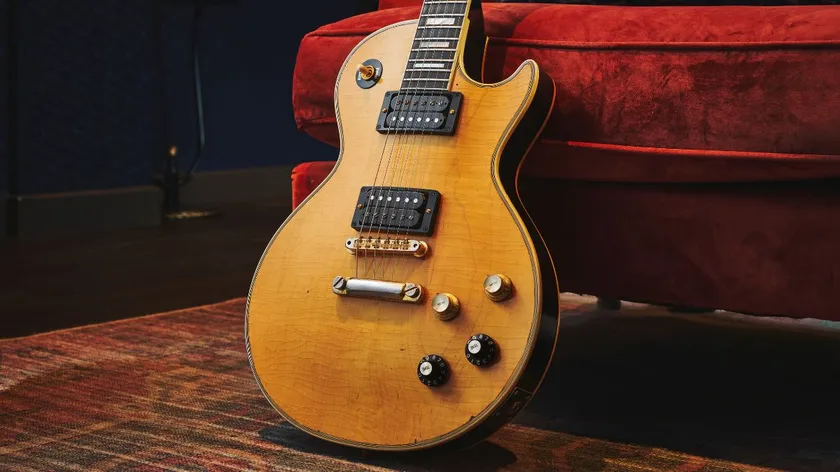
THE EDGE They all do different things. I’m always trying to get the best version of the sound as possible onstage, the sound as closest to what I recorded, but obviously I can’t drag every guitar I own around the world. And I still use 17 of them onstage! I make some compromises. For instance, the Tele I play onstage, it’s not the Tele. That would be a blue Sixties Telecaster with a Bigsby. I played it on the original demo for “Vertigo” and I’ve never been able to fully recreate the sound. I get close, but the moment when you’re inspired and something happens, you can never get that again. Unfortunately.
GW Let’s talk about your relationship with Bono. Obviously, he’s a big wheel in the world arena in a way he never was before. How does that play within the band musically? Does what he’s doing make it harder to rock with him, or does he rock harder?
THE EDGE I think he rocks harder. He’s got more to prove. He has to show everybody that he hasn’t gone soft. Music is still his main thing, so it’s not like he’s got another day job and music is something he does on the side. Put it this way: he wouldn’t be in the meetings he’s in, meeting the people he’s meeting, if it weren’t for the band. And he knows that. He knows he’s pushing his luck talking to all these politicians and beating them up for money.
In certain other ways his extracurricular activities have helped. He’s out of the studio more, but when he’s in he’s in—100 percent. We have his full attention now, whereas in the past he might have been with us in the studio, kicking ideas around, but in the back of his head he was elsewhere. It’s better this way. We don’t want a distracted Bono; we want U2 Bono all the way.
And there’s another thing that’s come from Bono doing this other work: it’s helped me try to figure out why I want to keep doing this. Why do I want to be in a band still? Why do I want to tour?
GW To meet girls, right?
THE EDGE [laughs] Beyond the obvious reasons! Going back to what I said before, it’s about getting those early feelings back. I remember my first rock shows. I remember the feelings. I remember my listening to the first records that excited me. Those feelings are important, and I never want to lose them.
GW I know what you’re saying, but is it always possible to keep that excitement? As you get older, your relationship with music changes.
THE EDGE Sure, but that’s why you have to change the music. On Achtung Baby! It was a matter of us defiling our sound. We wanted to rethink everything that U2 was, and we successfully did that. On this new record, it meant stripping it right back to that spare, skeletal sound of our early days. The music on “Vertigo” was, with the exception of one guitar overdub toward the end, recorded in one take—guitar, bass and drums. And it sounds like one take. Being able to make that kind of racket at my age is very exciting.
GW Are you still using Herdim picks, the ones with the dimpled tops?
THE EDGE Absolutely. They’re these really cool nylon picks. I just like the way they sound. They make a blue and a red one, but I like the way the blue ones sound. I hold ’em upside down, too. I never analyzed why, they just sound better.
GW Could it have something to do with your approach to delay?
THE EDGE Maybe. Anything I can do to get some extra texture. When you get right down to it, pure sound is pretty boring. This perception that a lot of studio people have about fidelity and purity, that it’s what everybody wants—it’s a load of rubbish. You want something to sound incredibly exciting. What I like about using the pick upside down and hitting the strings with the rough edge is how it sounds to be like the resin in a violin bow. I like that fight it gives me.
GW You’ve never endorsed any one particular guitar. Any reason?
THE EDGE I’d really, really have to believe in the thing. I don’t want to be that guy on the posters: “Buy this guitar” and all that crap. I’ve talked to a few companies over the years. Plus, I’ve had a lot of people do custom stuff for me—that’s different. Again, I don’t want to be a poster guy in music shops.
The closest thing I’ve done to endorsing something is with the U2 iPod. To me, though, that’s a medium for selling music. As technologies go, it’s really important and useful. And the timing couldn’t have been better. If something didn’t come along to help bring music back into people’s lives, I could see music being in serious trouble very soon. It was almost upon us.
GW I have to imagine that, as a teenager, you liked going to the record store and flipping through the albums. What are your thoughts on how technology has changed that experience?
THE EDGE There’s a lot of added convenience to getting your music from your computer or your iPod. When we were teenagers, as you remember, listening to a record was a formal thing. I remember there was one place in the house and that’s where we had the record player, so if I wanted to listen to a record I could only be in one place.
GW Plus, the very nature of a record, it had side A and side B. You had to pick which side you wanted to listen to.
THE EDGE It demanded your attention. Plus, you had the artwork to add to the experience. You’d think with music being all pervasive nowadays, it’s available everywhere, that it’d be a good thing. I think, if anything, the commodification of music has stripped it of its sacred qualities. You want water from your tap, you turn it on. You want music, you turn on your computer. There’s a point of oversaturation, and I think we’re there. But I can’t run away from what’s happening. I can embrace technology and work with it, and work for quality over quantity.
GW So what’s in your iPod?
THE EDGE Good question. Everything from the Killers to Kings of Leon, the Yeah Yeah Yeahs, R.E.M., Interpol… I listen mostly to new stuff; I’ve already heard the older stuff.
GW Your sound is so identifiable, which is something few guitarists achieve. But has it ever become an albatross? Have you ever gotten sick of being known as “the delay guy”?
THE EDGE No, never. It’s something I worked hard to achieve, so why would I disown it? Which is not to say we don’t want to evolve as a band. There’ve been times we wanted to sound anything like our previous record. I think in the past few years we’ve gotten more comfortable with referencing the past. Certainly on “Beautiful Day” we said, “We’re going to do the classic U2 sound here,” and it was fine; the song needed it. No, I don’t mind if that’s how people see me, but I always want to change. I always want to remember why I’m in a band.
