Access Backstage Pass




GOLD AWARD
In a relatively short period of time, the wizards of Boss Waza Craft have done many rather remarkable things.
First, Boss issued a pair of Waza Craft pedals—the BD-2w Blues Driver and SD-1w Super Over Drive—that were hot-rodded versions of popular stomp boxes. But Waza Craft also resurrected a variety of long-discontinued effects with the DM-2w Delay (analog delay), CE-2w Chorus, and VB-2w Vibrato, each with a dead-accurate Standard mode that replicates the classic sounds plus a Custom mode that expands the sonic capabilities of the original effects.

This was simply unheard for a company that previously steadfastly refused to reissue products, preferring instead to move its technology forward than look back (after all, the motto of Boss’s parent company, Roland, is “we design the future”).
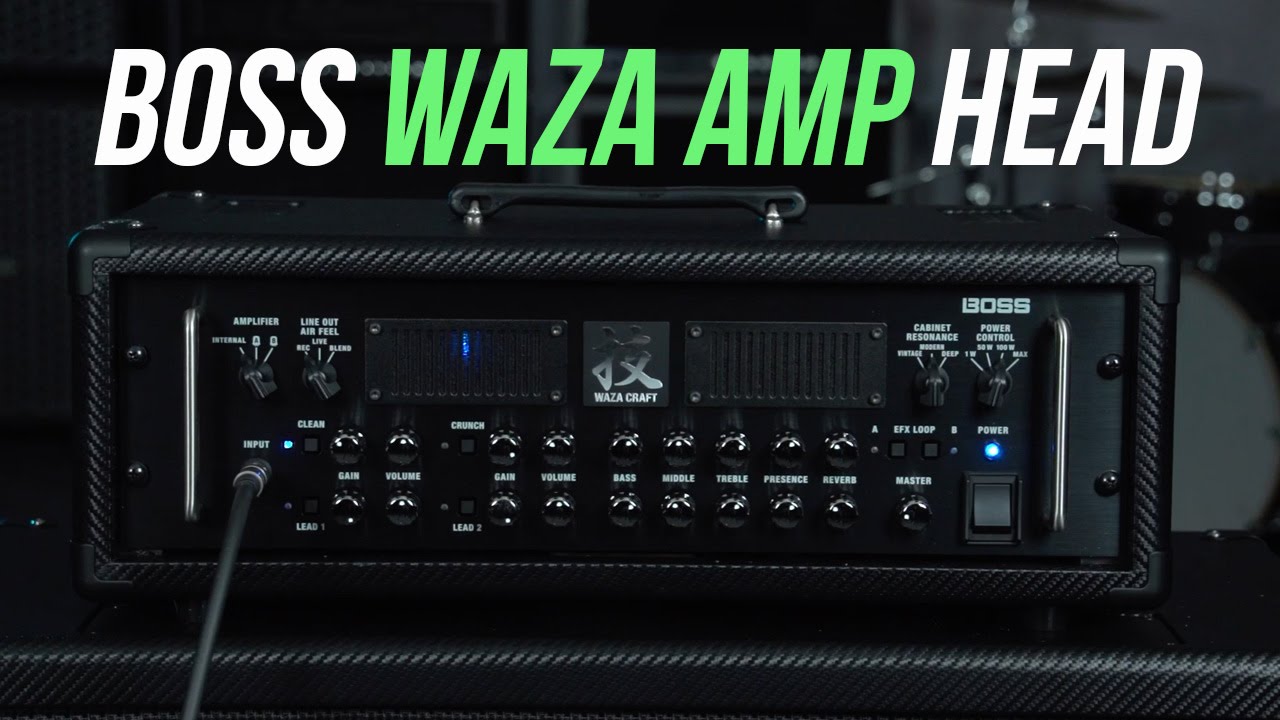
Now Waza Craft has taken yet another left turn with the introduction of the Boss Waza Amp Head. While the handful of amps that Boss offered in the past were inexpensive practice devices like the MG-10 and JS-10 eBand Audio Player, the Boss Waza Amp Head is a versatile, professional-quality amp that even manages to upstage Roland’s stalwart Jazz Chorus and Blues Cube amps.
FEATURES
The Boss Waza Amp Head is a 150-watt, solid-state (tube purists, stay with us please—it’s worth it) guitar amp head with numerous unique and distinctive features unlike anything else out there. At its core are three “amp character” settings—the internal “legendary rock” circuit and two slots for Tone Capsule modification circuits. The Waza Amp ships with a pre-installed “Waza Brown Sound” capsule in the Amplifier A position, and an optional Steve Vai Legacy Tone Capsule is the first of many pop-in modification circuits to come.
Each of the three “amp character” settings has four switchable channels: Clean, Crunch, Lead 1, and Lead 2. Each of the four channels has its own Gain and Volume controls, but the Clean/Crunch and Lead1/Lead2 channels each share their own sets of Bass, Middle, Treble, Presence, and Reverb controls.
Rotary switches on the front panel provide further tone-shaping and performance capabilities. Output can be set to 1-watt, 50-watts, 100-watts, or Max (150-watts); cabinet resonance provides vintage, modern, and deep settings; and the line out “Air Feel” feature provides cabinet simulation ideal for recording, live performance, or a blend of both. Rear panel features consist of a pair of effect loop send and return jacks that can be set to series or parallel, a 1/4-inch headphone output, MIDI In, a USB recording output, balanced XLR and 1/4-inch line outputs, 8- and 16-ohm speaker outputs, and a 1/4-inch stereo jack for the included foot controller, which provides six footswitches for selecting channels and EFX loops plus a pair of expression pedal jacks for adjusting master and volume settings with optional expression pedals.
PERFORMANCE
While the Boss Waza Amp Head is priced in the same range as the Fractal Audio AxeFX and Kemper Profiler, it is really designed more as competition for the various 100-watt multi-channel tube heads in its price range.
Please ignore any past conceptions you may have had of solid-state guitar amps—players who listen with their ears instead of their eyes will not be able to distinguish between the harmonically complex tones and responsive feel of the Waza and a tube amp. The distortion tones are impressively aggressive, with a low-end punch that rattles walls and incredibly musical clarity and definition. The amp can dial in a variety of the most desirable classic and modern tube stack tones, as well as ballsy clean tones and lead settings with seemingly endless sustain.
With an optional Tone Capsule installed, the Waza Amp performs as three separate four-channel heads. While the built-in digital reverb sounds incredible (Roland’s reverb effects still rate among the best), I do wish they included one extra footswitch for disengaging the effect when playing live. I tried the amp with several different speaker cabinets, but the Waza Amp Cabinet 212 sent for review was the best match (a Waza 4x12 is also available), providing the ideal balance of clarity and natural-sounding distortion. The 1-watt setting is perfect for low volume recording and practice, while the 50-, 100-, and 150-watt settings could probably be relabeled loud, louder, and loudest. Suffice to say, the Boss Waza Amp is ready for the biggest stages.
LIST PRICES: $2,499 (amp head); $999 (cabinet 212); $1,399 (cabinet 412)
MANUFACTURER: Boss, bossus.com
•Three “amp character” settings provide the tones and performance of three independent four-channel amp heads.
•The “Waza Brown Sound” Tone Circuit module is included with the amp, and one slot is available for an additional optional Tone Circuit.
•The line out “Air Feel” settings let users choose speaker simulation that is ideal for live performance, recording, or both.
•The Waza Cabinet 212 features a pair of custom Boss Waza 12-inch speakers designed to perfect complement the amp’s tones and massive power output.
THE BOTTOM LINE: The Boss Waza Amp Head offers an attractive alternative to a tube head for its incredibly expressive tones, expandability, reliability, and enhanced versatility for the studio, stage, and beyond.