


Sponsor Content Created With

“These are pieces conceived to be contemplated, not gear for a rock player to throw over his shoulder”: Meet Fabrizio Paoletti from Paoletti Guitars – the Italy-based luthier turning Renaissance art and architecture into one-of-a-kind electric guitars

Crafting guitars from scratch is not merely a passion but a lifelong vocation. As Fabrizio Paoletti, the man behind the Tuscany-based Paoletti Guitars, divulges, “What the journey shaped in me is this: the conviction that doing things by hand, with patience and without compromise, can take you all the way to the highest places.”
After what he deems as a “whole first life as an electrician,” Paoletti took a page from his ancestors’ book and his family history of producing Chianti red wine, and went back to his roots by learning how to build guitars using reclaimed old chestnut wine barrels.
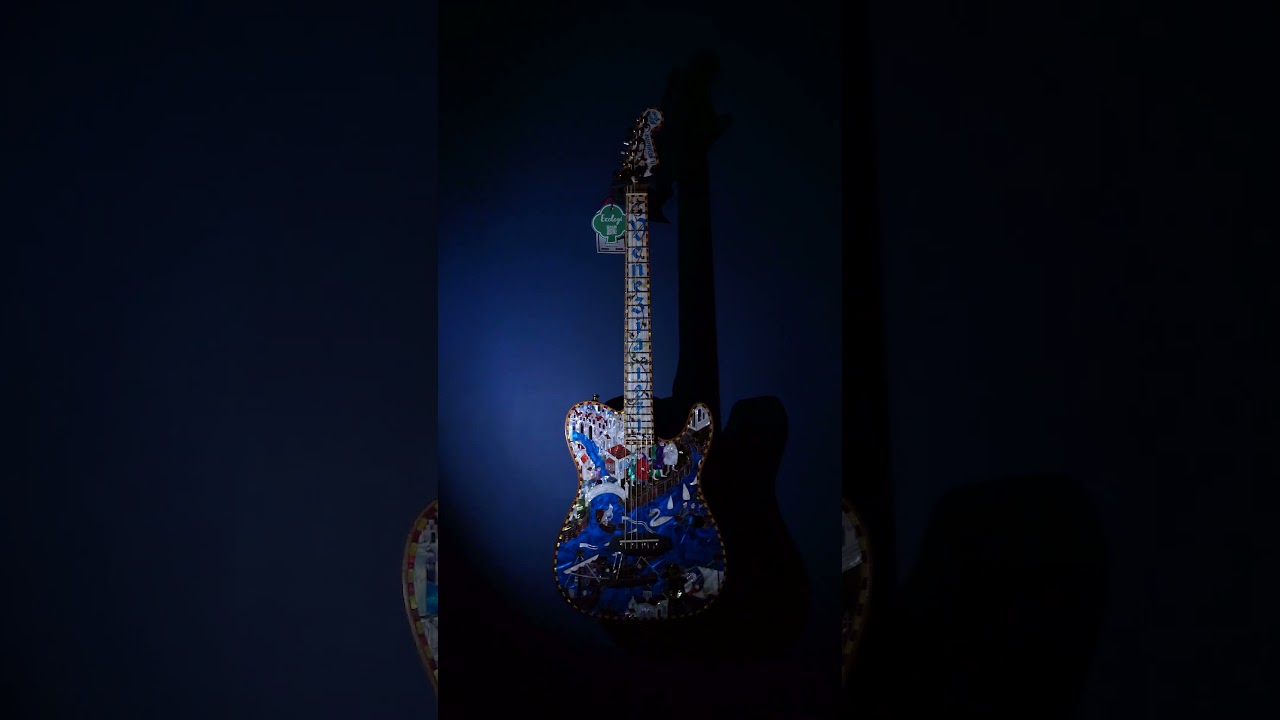
Starting from a small workshop and flourishing into a custom shop with a team of artisans, Paoletti is now more than ready to embark on his next chapter – namely, The Eye of Florence, a guitar-meets-art collection of eight one-of-a-kind electric guitars, each inspired by one of the eight stained-glass windows crowning Brunelleschi's Dome at the Cathedral of Santa Maria del Fiore in Florence.

As Paoletti finds himself inside the Cathedral of Santa Maria del Fiore, rubbing shoulders with the custodians of the cathedral, it’s easy to mistake this as the story of a country craftsman who happened to wander in and gain access to such a prestigious institution.
Rather, it’s the culmination of years of dedication and a series of projects that have turned the likes of Sting and Johnny Depp into fans and collectors. Or, as Paoletti puts it, it’s “the natural arrival point of a road I have walked seriously for many years.
“The ambition grew. The way of working never changed,” the artist asserts. “What this project has shown me is that a guitar can leave the world of the instrument almost entirely and live as a work of art. These are pieces conceived to be contemplated, not gear for a rock player to throw over his shoulder.”


When did The Eye of Florence stop feeling like an idea and become something much bigger?
Paoletti: The first spark came in 2024, in Venice, at the presentation of the Marco Polo collection [one of his other guitar collections].
Seeing those ten guitars received the way they were, and feeling what that kind of project could mean... something changed. That was the night I started thinking about what could come next, something even more ambitious, more deeply tied to the art and history of my own country.
From there, the idea began to take real shape. We approached the Opera di Santa Maria del Fiore to work on the drawings of the eight oculi of the Dome, and the moment they came on board, everything changed scale.
It became a true collaboration with the people who guard one of the most important monuments in the world.
Why were the Dome's stained-glass windows the right inspiration for this collection?
Paoletti: Because they sit at the very top of the most ingenious building I know. The oculi themselves were designed by the great masters of the age – Donatello, Ghiberti, Paolo Uccello, and Andrea del Castagno – and they are held in the sky by Brunelleschi’s Dome, which, in its own time was called impossible.
So when I look at those windows, I see two kinds of genius meeting in one place, the masters who painted the light, and the architect who lifted it that high.
True inspiration is never just something beautiful, it has to carry a spirit, and these windows carry the courage to attempt the impossible
Fabrizio Paoletti
That is the first reason they were right for me. True inspiration is never just something beautiful, it has to carry a spirit, and these windows carry the courage to attempt the impossible.
And there is a deeper reason. Circles of glass and light, five and a half metres across, placed so high that almost no one can really see them. All that Renaissance genius, hidden in plain sight. I felt these works deserved to be brought into a form you can stand in front of and study up close.
What drew you most deeply to the history and symbolism of the Dome?
Paoletti: The way the windows speak to each other. They are oriented to the cardinal directions, and they are paired. Opposite windows answer one another, like a conversation across the empty space under the Dome.
There is the Flower’s Bloom, the Flower’s Fading, the Flower’s Purpose... the whole arc of a life told in glass.
Everything in that building speaks of love given to the world, and the more I studied it, the more I realised these were not eight separate images but one single design, thought through to the last detail. That depth is what drew me in.


What was the hardest part of translating Renaissance artworks onto guitars?
Paoletti: Scale and honesty. To shrink that much detail without it turning into mush – that took years of study. I did not want to make a pretty version of the windows. I wanted them faithful, down to the cracks. The real glass carries six hundred years of cracks, and I reproduced those too, because they are part of the truth of the object.
And then there is the simple, brutal fact of the work itself: thousands of tiny mother-of-pearl tiles, all cut and set by hand, one by one. One slip, and you have ruined hours, sometimes days of work.
Can you give us a rundown of the guitars’ specs?
Paoletti: Of course. The body is carved from centenarian-aged chestnut. Chestnut is the icon and the trademark of Paoletti Guitars. It is where everything began for me.
Then comes the mosaic, and here the real protagonist is the Venetian mother-of-pearl.
I work with different shells, each one giving its own colour and its own shade, so that the light moves across the surface the way it moves through the real glass of the oculi.
At the centre of the back sits the most precious detail of all – an authentic fragment of marble from Santa Maria del Fiore, set into its own housing carved directly into the chestnut, stone resting in wood, the Cathedral resting inside the guitar.
Nothing is chosen by habit. Every element is there either for the beauty of the material itself or for the truth of the story it carries
Fabrizio Paoletti
As for the rest of the build, it is still a guitar, and a real one. Select Canadian roasted maple neck, twenty-two frets, a twelve-inch fretboard radius, a twenty-four and three-quarter inch scale, a hand-carved exotic ebony bridge, and twenty-four karat gold coated strings.
At this level, nothing is chosen by habit. Every element is there either for the beauty of the material itself or for the truth of the story it carries. Nothing is decoration for its own sake.
What did it mean to work directly with the Opera di Santa Maria del Fiore on a project like this?
Paoletti: It was the greatest honour and the greatest responsibility of my life. The Opera has cared for that Cathedral since the late thirteenth century.
These are people who have devoted their lives to protecting one of the most important monuments in the world, and they do not open those doors easily.
To be allowed to study alongside them, and then to work on centuries-old marble from the Cathedral together with their own master artisans, is not something that is granted to anyone who simply asks.
It is earned, slowly, through years of trust and a vision they came to believe in. That they chose to give that trust to me is something I will carry for the rest of my life.
Filippo Martini, Managing Director: What the Opera granted here is genuinely exceptional. This is one of the most protected cultural institutions in the world, and they do not hand out fragments of the Cathedral, or place their master artisans beside an outside maker, as a courtesy. It happened because the project earned its place, on merit, over years.
The result is documented, the collaboration is officially entered into the Cathedral’s historical archives, alongside names like Leonardo and Michelangelo. That is not a marketing line – it is a matter of record.
The Eye of Florence has been in the works for some time now. Can you walk us through the journey of the project so far?
Martini: The project was officially launched on the global stage in Dubai, with our partner Art of Guitar, [and it was] the moment that opened The Eye of Florence to the world and to international collectors.
From there, it has lived as a project unfolding in real time, not a product dropped on a shelf. Reservations opened, and interest in the individual pieces began almost immediately, so the collection is already moving, even as the guitars are still being completed in Fabrizio’s atelier.
Since then, we have carried it through some of the most significant stages in the luxury and collecting world. It was presented at the Monaco Yacht Show, within the House of Robb Report Monaco, and the project’s presence in Monaco continued through the Goodwill Ambassador circle.

The Eye of Florence was also exhibited at the NAMM Show in 2026, [marking] its first appearance on the global industry stage.
All of this is leading to one defining moment. In the fall of 2026, in Florence, the entire collection will be revealed together for the very first time, in the presence of the highest authorities of the Cathedral, future owners, and collectors from around the world. Everything we are doing now is building toward that unveiling.
Why do you think collectors are increasingly drawn to one-of-one instruments nowadays?
Martini: The Jim Irsay Collection sale at Christie’s this past March was a watershed moment for the whole field.
Serious collectors and high net worth individuals are increasingly looking at exceptional guitars the way they look at art or rare watches
Filippo Martini
What that did, publicly and undeniably, was confirm that the finest guitars are not gear. They are blue-chip cultural assets, a genuine store of value, in the same conversation as fine art and rare manuscripts.
That is the real shift. Serious collectors and high net worth individuals are increasingly looking at exceptional guitars the way they look at art or rare watches, as objects that hold their worth and tend to appreciate over time, while carrying a story and a beauty that a financial instrument never could.
Now, the Irsay guitars were valuable because of who played them. What Fabrizio is doing is something complementary and, in a way, rarer still – creating instruments that are born as one-of-one masterpieces, with documented provenance written in from the very first day, tied to Brunelleschi’s Dome and recorded in the Cathedral’s own archives.
The Irsay sale proved the appetite for objects like these. The Eye of Florence is built precisely for it.
Why was Art of Guitar the right partner for launching this collection globally?
Martini: It was less about choosing a partner and more that we recognised each other. With Art of Guitar in Dubai, we found a real synergy and decided, together, to carry this project out into the world.
They treat guitars the way a gallery treats art. They are consistently ranked among the top hundred dealers on the NAMM world list, and they have a real history in high-end, collection-level work, earning the trust of some of the most discerning collectors in the world.
We held the world premiere in Dubai in May 2025, and the collection was later shown in exclusive preview at the Paoletti Guitars booth at NAMM 2026, as well as within the House of Robb Report Monaco at the Monaco Yacht Show. They are the exclusive global sales partner, and every acquisition is handled privately and confidentially through them.
How do you balance the idea of a guitar as both an instrument and a work of art?
Paoletti: With this collection, I do not really try to balance the two; I let the art lead.
They are not sculptures pretending to be guitars. Underneath the mosaic, everything is real. The chestnut body, the neck, the ebony bridge, even a hidden ceramic pickup, all of it complete, all of it genuine.
So the guitar is fully present. The instrument is there as truth, not as a function. I think that is the real meeting point of instrument and art.
And lastly, if you could choose any guitarist, past or present, to play one of the Eye of Florence guitars, who would it be?
Paoletti: Let me answer it slightly differently, because these pieces are not really made to be played; they are made to be contemplated.
Many great names have honored my work over the years, and I am grateful to all of them. Richie Sambora was the very first to fall in love with chestnut, long before anyone knew the name Paoletti, and I will always owe him for taking a chance on a guitar from a small workshop.
What strikes me is not the price; it is what people responded to, a sense of restraint, of light and space, of something held still and sacred
Fabrizio Paoletti
But for a collection like The Eye of Florence, I do not want to lift one musician above the others. What matters to me is the sensibility of an artist deeply connected to art.
If I give one example, only as an example, think of this year and David Gilmour’s Black Strat becoming the most expensive guitar in history. What strikes me is not the price; it is what people responded to, a sense of restraint, of light and space, of something held still and sacred.
That is the sensibility The Eye of Florence speaks to. An instrument like this belongs, in spirit, with artists of that depth, whoever they may be, people who would not simply own it, but truly understand what it is trying to say.
- For enquiries about The Eye of Florence and for more information, head to Paoletti Guitars.
