


Sponsor Content Created With

“They looked like an ancient instrument of torture. I thought, ‘There must be a better way’”: Why Sleep Token’s IV, Brandi Carlile, and Foo Fighters’ Pat Smear have all added G7th’s all-round premium capos to their rig

There’s a good chance you’ve spent considerably more time choosing your guitar than choosing the capo that sits on its neck. And yet, that little piece of hardware is in direct contact with your strings. Get it wrong, and you can introduce tuning problems, string buzz, and unnecessary tension – all before you’ve even played a note.
For G7th, that’s precisely why the capo deserves more attention. The British capo specialist has spent more than 20 years questioning the conventional design of one of the guitar world’s most overlooked accessories.
Its original Performance Capo launched in 2004 after founder Nick Campling, a design engineer and lifelong guitarist, identified what he saw as a surprisingly obvious problem: what many perceive as a simple accessory had barely evolved in decades.
As Campling himself writes, “One day I was playing my guitar; I looked at my left hand and my capo… and a little light flashed in my mind. The humble guitar capo had not been redesigned in around 25 years.

“They generally looked and operated like an ancient instrument of torture. I thought to myself, ‘There must be a better way than this…’ I wrote ourselves a design brief with my team (after all, we’re design engineers!) and began with brainstorming.”
G7th’s answer was to rethink how a capo applies pressure to the strings. Its patented Unique Tension Control system, found across the Performance range, allows players to intuitively squeeze the capo into position and control the amount of tension applied. The idea is simple: rather than relying on excessive spring pressure, the guitarist has much more direct control over how firmly the capo grips the strings.
That matters because excessive or uneven pressure is one of the main reasons a capo can pull a guitar out of tune. But G7th didn’t stop there.
In 2016, the company introduced what it describes as its biggest advancement in capo technology in 35 years: Adaptive Radius Technology, or ART. The patented mechanism sits beneath the string pad and responds to the curvature of the guitar’s fretboard, distributing pressure more evenly across the strings.
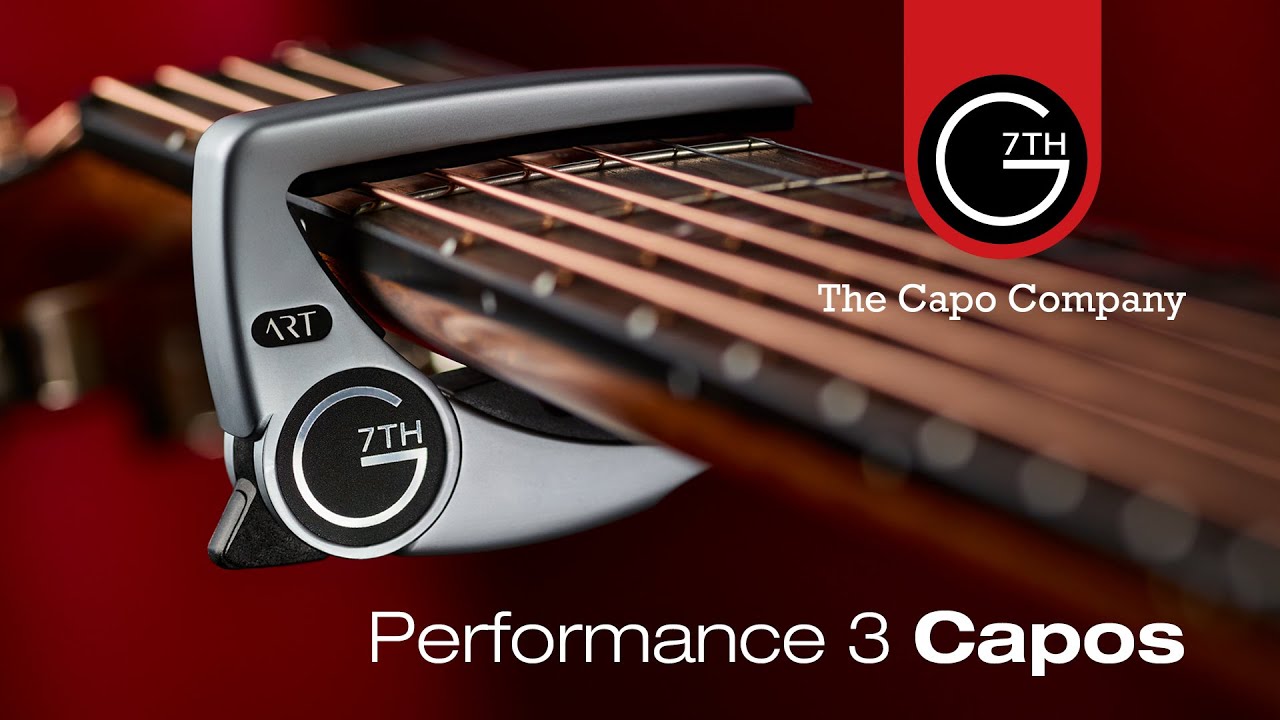
It’s the defining feature of the Performance 3, G7th’s flagship six-string capo. Rather than forcing a fixed-radius pad against different fretboards, ART mechanically adapts to the guitar’s actual radius and the strings’ gauges. The result, according to G7th, is maximum tuning stability with the minimum tension required – regardless of where the capo is positioned on the neck.
For players who move a capo frequently during a set, that can be particularly useful. The Performance 3 is designed for one-handed operation and can be moved between frets with practice almost as quickly as a conventional spring capo. It can also be parked behind the nut or on the headstock between songs, keeping it within easy reach.
And the technology isn’t limited to standard six-string acoustics. G7th has also tackled one of the capo’s trickiest assignments, also known as the 12-string guitar.
Anyone who has tried capoing a 12-string knows the problem. The instrument’s combination of bass and octave strings makes it particularly susceptible to uneven pressure and tuning issues.
G7th’s patented Compensated String Pad addresses this by using ridges in the pad to account for the different string gauges, allowing all 12 strings to be fretted simultaneously under the same tension. It’s available on the company’s Newport and Heritage 12-string models.

The Heritage takes things a step further by combining that Compensated String Pad with ART, creating a capo specifically designed to address the unique challenges of 12-string instruments.
There’s a reason these details matter beyond the bedroom or rehearsal room. G7th capos have found their way onto the rigs of professional players, including Mike Dawes, whose signature Performance 3 includes a personalized element by featuring artwork from his 2024 album Galactic Acid.
You can also spot G7th capos on the guitar necks of players as diverse as Radiohead’s Ed O’Brien, Foo Fighters’ Pat Smear, Sleep Token’s IV, and Brandi Carlile. For working musicians and guitar techs, anything that reduces the need to repeatedly stop and retune is more than a nice-to-have – it’s one less problem to solve.
What's more, G7th capos aren't exclusively made for your typical electric and acoustic guitar. Options are also available for classical guitars, ukuleles, banjos, and other small-fretted instruments, as well as partial capos for six-strings.
Ultimately, the capo may be one of the smallest pieces of gear in your rig, but its influence on your instrument is anything but insignificant.
Head to G7th’s official website for more information.
