




It’s hard to believe that Metallica’s original bassist, Cliff Burton, would be in his sixties today had he not died in a tour bus accident in September 1986. Fortunately we'll always have the classic basslines he threw down on Metallica's breakthrough album, Master of Puppets.
On the opening track, the thrash-metal classic Battery, he laid down the gauntlet with a breakneck metal riff that Burton not only copped with his superhuman fingers, but enhanced and slightly reharmonized along the way.
In a 2006 interview with a Swedish newspaper about the 20th anniversary of Burton's death, Metallica frontman James Hetfield credited him with expanding the band's harmonic horizons. “We never would have written guitar harmonies like that, or songs with very intricate melodies and orchestrations, without Cliff.”
Technically, the sheer speed of this track is the main area of concern. Not only does it clock in at 202bpm in some sections, but Burton plays everything fingerstyle including some impressive octaves. And with Robert Trujillo now holding down Metallica’s bass chair, all can see that it's not only possible to pull off Battery with just your fingers, the band actually prefers it.

Let's look at the physical technique first. The good news is you never have to leave the E string. The bad news is, your plucking hand needs to be in serious shape to play this line without a pick, as Burton did.
Start by striking the first note with your index finger, then get your gallop on by playing the two 16th-notes and following eighth-note with a three-finger rake: ring finger, middle finger, index finger. Repeat the gallop and return to regular plucking-hand fingering for the last three eighth-notes of bar 1 of the riff.
Can it be done with just two fingers? Sure, but the three-finger gallop gives it a sonic texture that's closer to the original intention. Plus, galloping is way more metal! Like anything, slower tempos are recommended for practice, especially as you build the Burton-level endurance necessary for the complete assault.

Inevitably, this particular style takes a long time to develop, and some of the faster octave sections will be a stretch even with the standard two-finger approach. You could leave out some of the 16th note rhythms to help you negotiate some sections, but you'll lose the drive so consider using a pick.
Harmonically, Burton tips off his awareness of the greater musical picture with just four notes of the line. The guitars and bass are essentially in single-note/power-chord unison the whole time except for the last three eighth-notes of bar 2 and the first eighth of bar 3, where the guitars play E minor 3rds.
Burton takes this opportunity to emphasize each interval's minor 3rd in the lowest register possible, propelling the riff in a subtle, but effective way. He was a classically trained pianist, and his knowledge of theory – combined with his fearsome bass technique and windmill-headbanging – helped shape Metallica into the multi-platinum monster it eventually became.
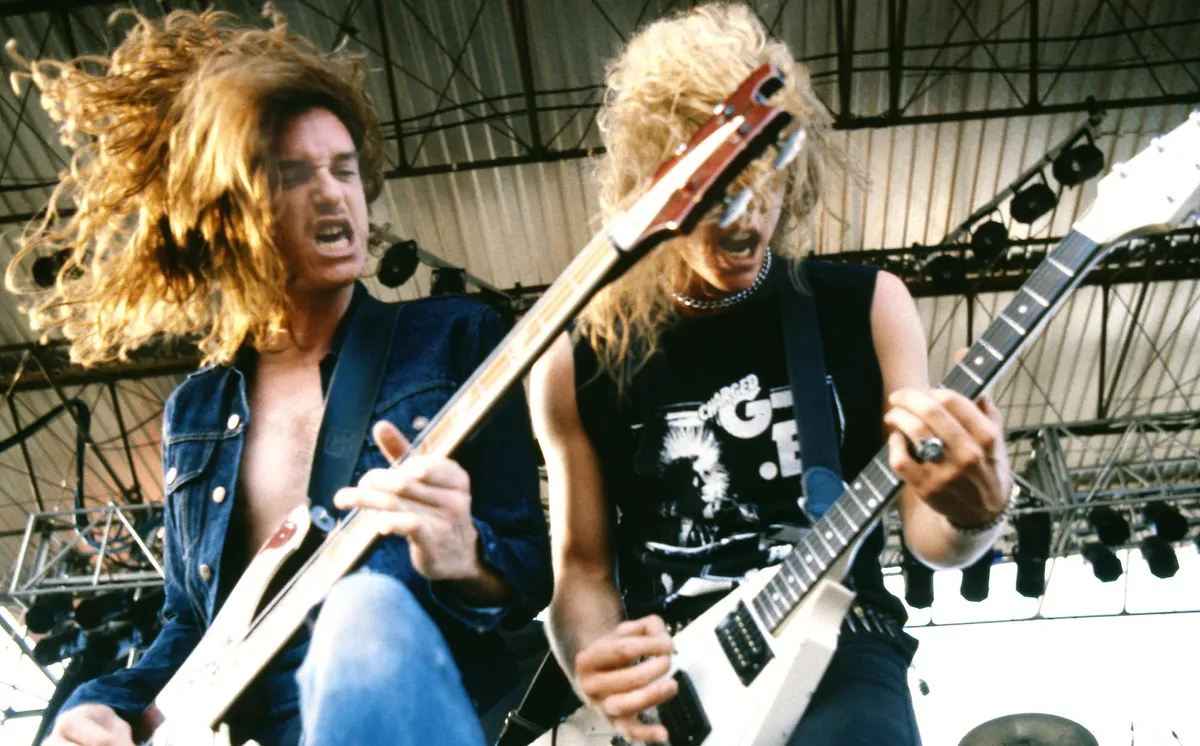
Burton played a Rickenbacker 4001 and an Alembic Spoiler, which was later stolen. His preferred Aria Pro II was likely used for this album, however. Burton also used Mesa/Boogie amps and a custom-built 115 cabinet.
