

“Chill the fuck out – stop playing so many fucking notes.” These were the pivotal words Russian Circles guitarist Mike Sullivan recalls hearing from drummer Dave Turncrantz during their first-ever practice in 2004. The pair attended high school together in St. Louis, Missouri, where they played in a punk band. Years later, when their respective projects eventually broke up, they got together again.
There was no grand manifesto for Russian Circles. “Just old friends playing together,” Sullivan recalls. “It was a blast. We didn’t go in with preconceptions of style or sound. We just jammed it out.” That first practice produced their first song, and the experience “informed the whole identity for the band” – hypnotic, cinematic, cataclysmic.
Now, after more than two decades of making loop-based instrumental post-metal with Russian Circles, Sullivan has developed a nuanced relationship with the natural instinct to complicate things. “We always want to get fancier,” he observes.
“Guitar players have an overactive mind. They’re always thinking: ‘The second time, I’ll deviate.’ Some things are fun to play, but they’re not fun to listen to. As guitar players, we tend to write things that are fun to play; we’re not writing music for guitar players.”
Russian Circles are built around repetition, dynamics and breathing room: riffs that sound heavier by simply leaving space around them. Latest studio album Nine prioritizes restraint over embellishment. Sullivan describes the writing process as stripping away the “funny business” and getting down to the “meat and potatoes.”

He often gravitates to “ignorant chugs” because “they’re particularly gratifying to play live” – yet there are moments on Nine that pull satisfyingly hard in the opposite direction. One of the most striking departures is Arlette, a delicate acoustic piece he calls his “first attempt at writing a classical song.”
He explains: “I’ve been drawn to that genre. It’s so expressive – you have multiple voices at once, and you don’t need your bandmates around to have several moving lines at once.”
He traces his fascination back more than 20 year, to classical guitarist John Williams and a piece that left a lasting impression. “His Mikis Theodorakis: Epitafios No. 3 is just a beautifully sad song.” But again, he isn’t interested in classical guitar as a vehicle for technical showmanship: “I just like to lean into the more somber melodies.”
That explains Sullivan’s attraction to dissonance. The song Empath uses uncomfortable intervals as a compositional tool to evoke a visceral response. “Dissonance is such an immediate, effective way of eliciting emotion,” he says. “Then it hits you even harder when the catchy riff comes back in.”
That philosophy is central to understanding Russian Circles: their music is not just something to listen to, but something to feel. They don’t create heaviness by turning everything up to 11; their carefully-crafted loops ensure every element has somewhere to sit and take hold.

While their soundscapes can be overwhelmingly dense, the beating heart behind the layers is clarity of tone. “Clarity is important,” notes Sullivan. “When you’re stacking loops and using a lot of distortion, it may seem like a paradox to have an articulate distorted tone.
“If something is too compressed from the pickups, the loops don’t seem to stack as well. It kind of crumbles – it gets muddy. My whole thing since day one is fighting muddiness. To this day I have not used the same pedalboard on two tours.” He’s days away from a North American tour, but says his current ’board is a mess.
“There’s a Metal Zone on there for the first time,” he enthuses. “I’m using its parametric EQ to find the one frequency that isn’t being hammered, and putting that forward so I can hear the line on top of the loops.” His also has a DigiTech Drop, Strymon TimeLine, T-Rex Image Looper, Whammy Ricochet, Strymon Dig and an Electric Eye Cannibal Unicorn distortion.
He’s always used super-high headroom amps, switching from the Verellen Meat Smoke to the Hiwatt DR103 after the bulk of the band’s gear was stolen on tour in 2021.

Using such a variety of tunings, you’d be forgiven for expecting him to take almost as many guitars as pedals on the road. But he explains: “I just bring one guitar and force it through every tuning possible. It’s easier. I’ll go through almost every song adjusting one string up or down. I use super-floppy strings, 11 to 58. That seems to work for me.”
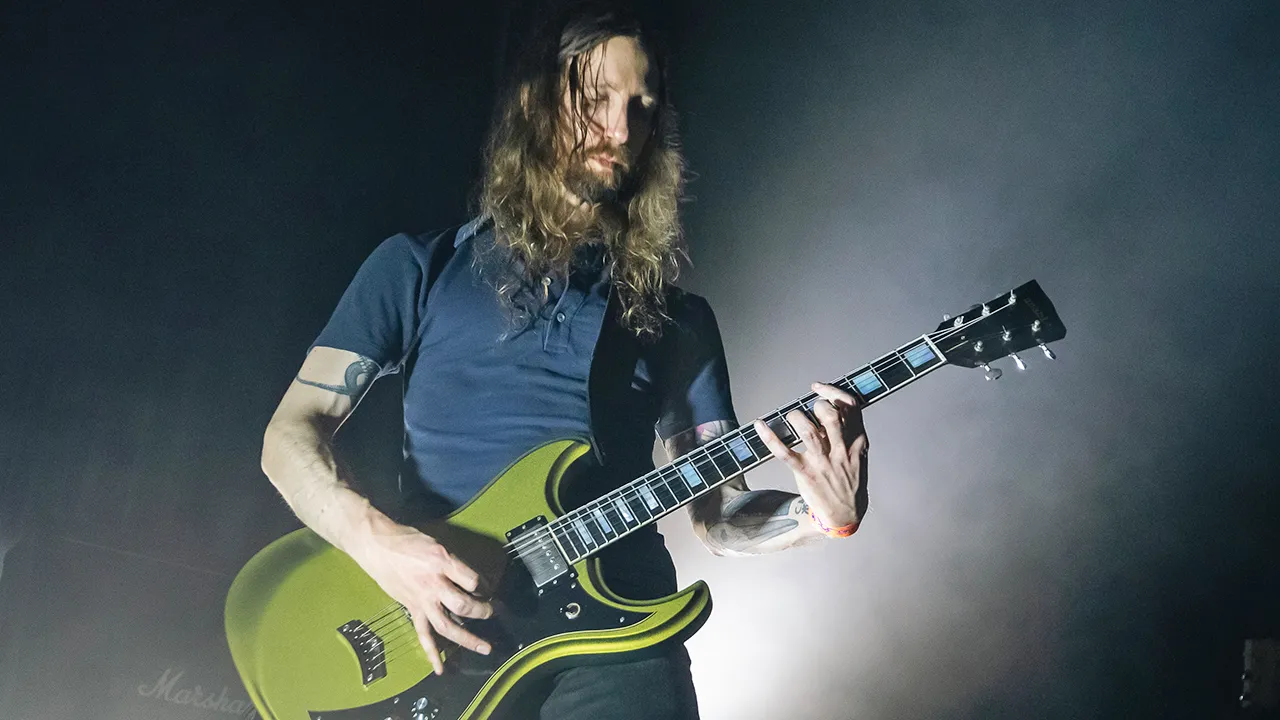
The guitar in question is a green Dunable Gnarwhal, with a Gibson-like scale comparable to his old Les Paul. It features a mahogany body and neck paired with a maple top, while its two DiMarzio humbuckers – a PAF 26th Anniversary and a Joe Duplantier Fortitude – can be coil-tapped.
I didn’t know the MH-2 would become such an iconic pedal. It was just good to crank it and drive my parents crazy
It’s quite a departure from his first guitar, a red Squier Stratocaster bought for him and his brother to share, but when his sibling later got an Ibanez with humbuckers, Sullivan immediately noticed the difference.
His fixation with pedals and pickups was born, leading him to his first effects pedal purchase, the celebrated Boss HM-2. “I didn’t know it would become such an iconic pedal in years to come,” he laughs. “It was just good to crank it and drive my parents crazy.”
Today he owns a host of clones rather than his original HM-2 – “You have to find what works for the song, not your ego,” he reflects. But as Russian Circles take their meticulously-crafted soundscapes back on the road, his mission remains exactly what it was in 2004: stripping away the unnecessary, embracing the clarity, and letting the music breathe.
“I love shredding,” he says. “There’s so many great guitar players that do it properly. But that’s not my lane, so I stay out of it.”
- Russian Circles are on tour until November 21.
