


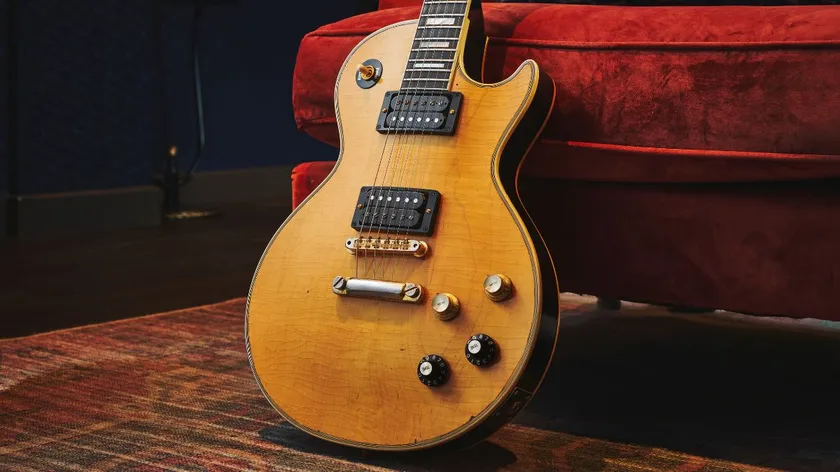



Jack White is one of the 21st century’s greatest guitar heroes. But like many true guitar heroes – from Hendrix, to EVH and Jimmy Page – he’s also obsessed with the tools that create the music.
White started out as a furniture upholsterer, hiding his own records between the folds – he cares about how things feel and how they look, and what that means for his playing. Now he’s taken that blue-collar mindset and applied it to every possible aspect of guitar gear via his own firm Third Man Hardware. The company has collaborated with everyone from major global firms Fender and Donner to boutique outfits Anasounds and 1981 Inventions.
The result is one of modern guitar’s most idiosyncratic rigs: nearly everything has been designed from the ground up to fulfil White’s every sonic desire. And now I find myself standing onstage at soundcheck, in front of his full pedalboard, and about to play through his entire signal chain, from his mind-boggling Triplecaster to custom pedals and astonishingly loud signature tube amps.
I met Jack’s guitar tech and chief Third Man Hardware collaborator Dan Mancini several NAMM shows past. Every year, I swung by the booth to check out which of Jack’s instruments was hanging out as the resident demo guitar. Once it was his original tour-ravaged Triplecaster prototype. The next it was the Tele he played at the Super Bowl with Eminem. No biggie.
But rocking up at Bristol, UK’s Prospect Building 30 minutes earlier to film a walkthrough of Jack White’s guitar rig, I still didn’t believe I’d actually get to experience the full rig at ear-splitting stage volume. I was about to be proven wrong.

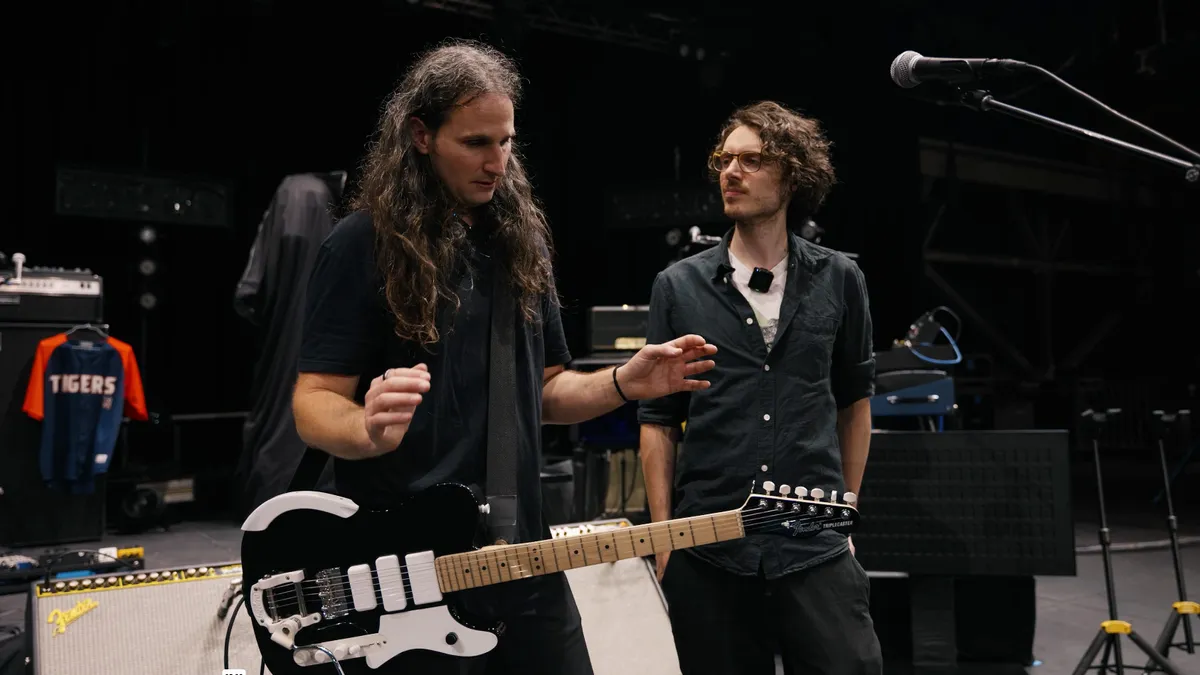
Dan is my tour guide, which is fortunate because he’s very encouraging. We start with the pedalboards. By my count, there are 20 stompboxes, not including switchers. He gives me a quick overview of the first half of the ’board. Then comes the question: “You want to try it?” Yes, Dan. Of course I want to try it.
As I sling Jack’s very own Triplecaster over my shoulder, the gravity of the situation hits me. Not only am I about to play through his rig at full blast in front of his guitar tech, sound tech and touring crew, I am navigating an unfamiliar setup. In a tight 20-minute window. And it’s being filmed. And on top of all that, the strap height leaves the guitar hanging nearer my knees than my naval. If I learn nothing else from this experience, I surmise, it’s that Jack White is a lot taller than you think.
At least I know the guitar. I’ve played various configurations of White’s Triplecaster build over the years. For this tour, Jack’s main squeeze is an American-made factory version, rather than a Custom Shop one-off. It has a B-bender fitted and a few aesthetic tweaks, but is otherwise fresh off the production line.
The action on White’s touring guitar is medium to low and the soft V-shape neck really doesn’t feel a world apart from many other modern Fender builds. In short, it is immediately and surprisingly familiar. White started collaborating with his guitars rather than fighting them years ago, and the Triplecaster is the culmination of his efforts. So far, I reassure myself, so good.
Then my eyes dart back to the pedalboard. There are six different types of fuzz alone. Even for the most acerbic of noise-rock guitarists, that would be considered overkill. But this is an interesting experiment. The Bumble Buzz is tight and spitty. The Black Squirrel smooth yet nasty. The Knife Drop… well, that’s like the universe imploding in on itself in an endless downward spiral.
Each time, Dan asks me, “How does that make you feel?” with a glint in his eye. And every effect makes me play differently. I’m normally something of a widdly player. But now, here with this ’board, I want to hear the splutter and fizz of every note, and that means slowing down. Bigger bends, dynamic intervals. Responding to the variations in rhythm as the note decays.
Aesthetics are everything in Jack White’s world. The trademark Third Man yellow and black color scheme is all over his pedalboard, right down to the custom Klon Centaur enclosure. He’s a painter, and the amps are his canvas. The pedals are the paint.
In the moment, you feel the way it’s been geared towards spontaneity. White’s gigs don’t have setlists. He plays what he feels each night. A bank of presets on a MIDI switcher is never going to work. He has to be in the moment and he wants every sound at his disposal.

So many touring rigs are reverse engineered from a starting point of ‘consistency’, but now I realize White has designed his to do the exact opposite. Switching to a different fuzz for a solo one night will make him play differently. It’s another way to guarantee a fresh experience for the next audience.
Thankfully for me, at this point in time, it’s also designed to be immediate. There’s no messing with menus. Each pedal offers an arcade-like instantaneous gratification. For my money, White’s collabs with Black Mountain are the pinnacle: the Roto Echo and (shhh) soon-to-be-announced Roto Trem have a massive rotary dial slap-bang in the center that you can roll with your foot.
The trem is what Dan is most excited for me to try, and it is an unreasonable amount of fun. The ratcheting chop-chop takes the modulation into unhinged territory, creating a sense of drama: “This solo isn’t just off-the-cuff. It’s dangerous.”
It occurs to me that, in my 14 years on the job, this is the first interview I have had to conduct with ear plugs in at all times. White’s 70W Fender Pano-Verbs are staggeringly loud. The vibrations literally move you. They make you want to do crazy things. And it’s easy to forget that feeling in today’s dB-monitored, DI-centric live arena.

Playing through Jack White’s rig is a seat-of-your-pants experience in the best possible way. The tones can lean on the futuristic, but the approach is resolutely old-school. It takes me back to my teenage years, before amp modeling and switching units took over. When your sounds were limited to what was what in your hands, at your feet and in your imagination.
Most of all, it’s exciting, and it makes me question my own rig. Should I re-embrace whammy bars? Ditch the presets? Heck, maybe I do need another couple of fuzz pedals. I resolve to reconsider doubling the size of my pedalboard.
Returning for that evening’s sold-out sweatbox of a show, I hear the setup in the hands of the player it was designed for. White is in astonishing form, darting through his back catalog and summoning devilishly wiry solos. Halfway through, he snaps a string on the very guitar I played. I feel a small twang of guilt. Did my slapdash picking contribute to the wear and tear on those wires?
But I also know that’s the sort of thing that doesn’t really matter to White. This is raw rock ’n’ roll, the likes of which you hardly see in a live setting anymore. It makes the show another one-off. White’s tones that night are unique. And test-driving his rig has given me an insight into just how far he goes in pursuit of that.

