



Emma Ruth Rundle is a restlessly creative musician, visual artist and poet. Across six solo albums and collaborations with Dylan Carlson of Earth, Chelsea Wolfe, Thou and others, she’s refined a dark, heavy and moving blend of folk, ambient noise and metal that’s all her own.
It’s hard to disagree when Rundle says she’s “come a long way as a player and an artist” since her folk-infused debut LP, Some Heavy Ocean (2014), which arrived followed the hiatus of her post-rock projects Red Sparrowes and Marriages.
But she found her way back to her atmospheric roots on Marked For Death (2016), On Dark Horses (2018), and two essential-listening collabs with Louisiana sludge band Thou – May Our Chambers Be Full and The Helm of Sorrow from 2020 and 2021.
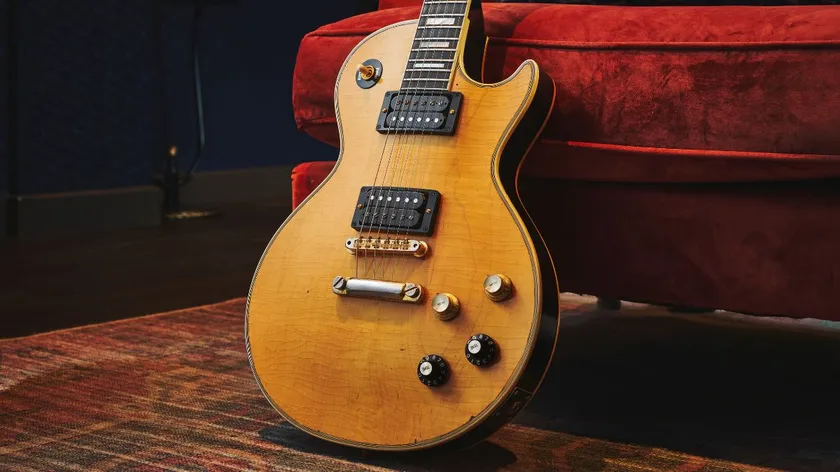
Rundle says the SG Special that defined that era’s tone was not an easy find. “The way you come to the guitar that ends up being your thing is always an interesting journey,” she reflects. “It’s partly to do with a ‘tone quest,’ financial means, and what access you have locally.”
Having worked in a guitar store, she cycled through the classics: she liked Teles but struggled with their twanginess and noise – “every time I take a Fender into the studio it’s picking up the radio!” Les Pauls sounded great but were too heavy.

She wanted a guitar that would handle the low end and dropped tunings, but still had grit and bite. After experimenting with Japanese knock-off SGs, she bought the SG Special from a teen who was happy to sell it for $350, to buy a phone.
As beloved as that Gibson was – it was “completely dented” from all her atmospheric slide work, she says – Rundle was pragmatic about selling it earlier this year.
“I see them as tools. Being nomadic and not having a lot of money means I’ve had to sell a lot of instruments, even my first guitar, a 1973 Fender Mustang. At a certain point, if it’s not serving you, you gotta make room for something else.”
That goes for her creative process too, which has spanned both carefully orchestrated compositions and minimalist, improvisational works. Her latest album, These Killing Times, features a full band after five years of solo guitar and piano. That’s led her to think about the considerations behind relinquishing control.
“When I was younger I had a really specific genre and aesthetic I was going for,” she says. “But as I’ve gotten older I’ve become more relaxed, inviting other musicians in and asking them to use their voice.”
Though the new album’s sound is full and rich, with huge fuzzed-up choruses and lead lines from the guests – among them guitarists Nick Reinhart of Tera Melos and Gina Gleason of Baroness – the squeaks and creaks of a mic’d up nylon-strung guitar retain the vulnerability and intimacy which Rundle’s music is known for.

She reports that she’s dedicated to classical guitar these days, and she’s surprised by how “under-appreciated it is in the heavy music scene. It has such a full spectrum of tone; so much bass and harp-like qualities.”
Indeed, I’ve seen Rundle take to a heavy rock festival stage and command a pin-drop silence in a full tent with only a nylon-string, a pedalboard and her voice.
A band working together to make a powerful sound is a great metaphor for what people need to do
Currently she plays two Cordoba GK Pros, with rosewood and maple necks for different tones, and uses the inbuilt piezo under the saddle to tame feedback live. “This guitar rules,” she says. “No-one would think a classical guitar could hold a drop A# tuning. It’s like a secret thing – I love it!”
The Cordoba is lifted into celestial ambient spaces with a “basic palette” of an EarthQuaker Palisades, a Boss RV-5, a DigiTech Hardwire RV-7 and a Line 6 multi-FX – split into a Roland Jazz Chorus and Verellen combo stereo rig that blends the best of their solid-state and tube tones.

With the SG gone, when she does plug in an electric these days, it’s her Fender Jaguar Special Baritone HH, which she says she’ll never sell. “They only made them for a short time and I have two. Baritones mostly suck, but the HH intonates so well.”
Rundle regards her music as “capsules of life experience of where I was at the time,” and she’s been candid about dark, difficult emotions and a two-decade struggle with addiction (she’s been sober for several years). Her unflinchingly honest and uncompromising approach has won devoted fans on both sides of the gothic folk and metal aisles.
Nonetheless, on These Killing Times, she wants to combat the “dour tone” of her 2021 album, Engine of Hell. “The world is such a heavy place right now. I wanted to address the issues that are dominating all of our lives but in a way that adds light and hope. We don’t need any more sadness – we need uplifting, empowering music.”
Her latest sound takes inspiration from the records of her formative years, especially Smashing Pumpkins’ Siamese Dream. “There’s a really uplifting quality to some of those songs that takes angst and transforms it into this powerful and energizing thing. I thought, ‘I want to do that.’”

Collaboration has always been key to Rundle’s sound and growth; and inviting friends like Reinhart and Gleason, and returning to a full-band dynamic, enabled her to put the album’s themes into practice. It also left her with a burgeoning sense of optimism.
Unsurprisingly, she found five years of stripped-back solo performances “isolating and very intense psychologically.” Now she’s excited to get on the road with her band full of friends this autumn.
She states: “Watching a band working together to make a powerful sound is a great metaphor for what we as people need to do.”
- These Killing Times is released on September 18. Rundle’s US tour commences on October 10.

