

Hello everybody, and welcome to my new column for Guitar World. In this series of lessons I will demonstrate the techniques and approaches that are essential to my playing style. I hope that the material we cover will be beneficial to you in your own musical endeavors.
I’d like to begin by talking about the importance of the blues and blues-influenced music, such as gospel, soul and R&B, in my approach to music and the guitar. I come from a family of musical brothers, and blues and gospel played a big part in our lives and provided a strong foundation for me as a musician.
Like all aspiring blues guitarists, my brothers and I listened to B.B. King, Albert King, Freddie King, T-Bone Walker, and all of the blues guitar greats. I learned as much as I could from all of them, as well as gospel music, in trying to develop a sound and approach of my own.
Figure 1 illustrates a solo played over medium-slow shuffle in the key of B. I begin in bars 1-5 with simple melodic phrases based on B major pentatonic (B, C#, D#, F#, G#) that are supported by chordal accents, such as B9 in bars 1 and 3, and E7 in bars 2 and 5.
To me, these single-note phrases are very vocal-like; maintaining a “vocal” mindset helps me to stay focused on speaking in a musical way in the lines that I play.
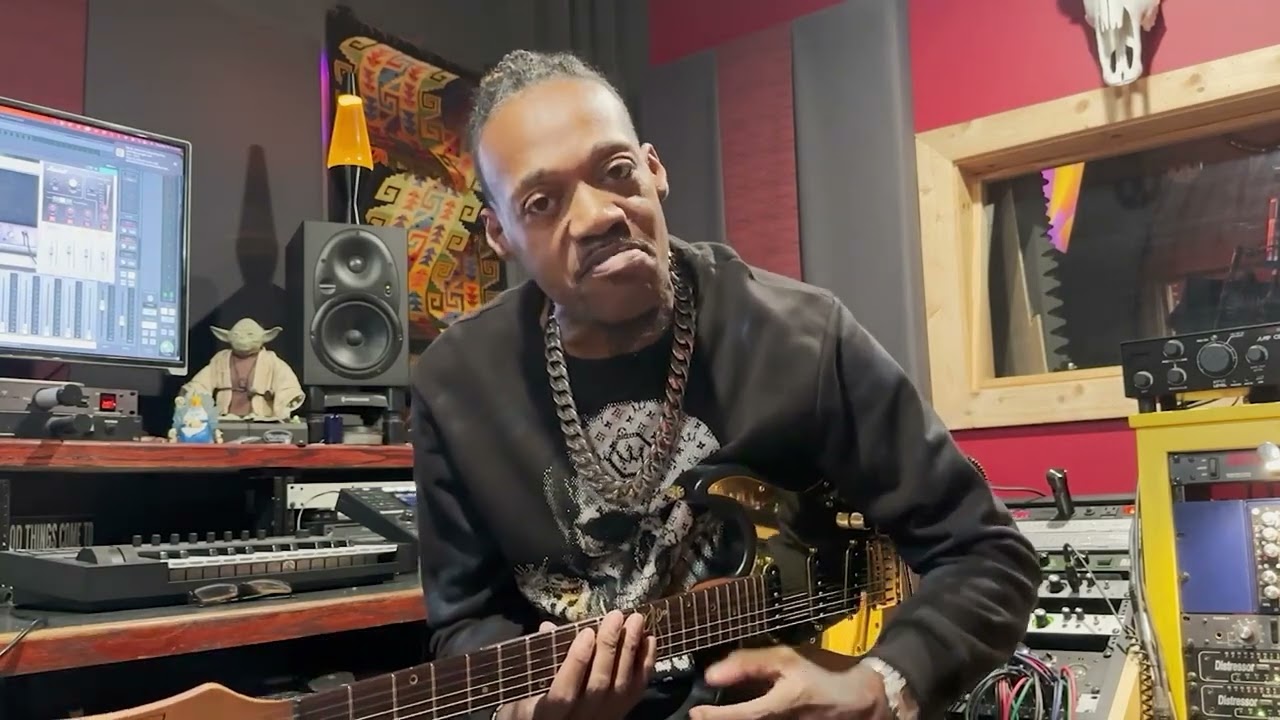
I must mention that I choose to play the guitar “upside down.” I take a guitar strung for a right-handed player and flip it over and play it left-handed, in the same manner as Albert King, Otis Rush and a variety of other players, including my late brother Emmanuel Gales, aka Little Jimmy King.

Playing this way completely changes the riffs, phrases and chords that are available to you. One of the big differences is that, to bend one of the treble strings, I need to pull it downward, as opposed to pushing it up as most players do.
Additionally, with the guitar strung and played this way, it’s easy for me to finger some unusual chord voicings that would be unnatural for “normal” players; a good example is the F7#11 chord in bar 4, wherein the high B note, the #11 (or b5), is fretted by wrapping my thumb around the top of the neck at the 7th fret.
Figure 2 illustrates a few more examples of my pull-down string bends, with many of the accented notes in the phrases treated with a wide, fast vibrato, a la Albert and B.B. King. If playing the guitar in the conventional way, you would, of course, need to push the strings upward to perform these bends and vibratos.

As I move through the I-IV-V (one-four-five) blues chord progression – B7-E7-F#7 in the key of B – I like to reference each chord with the chord tones. Over B7, I’ll accentuate B, D#, F# and A. Over E, I’ll touch upon E, G#, B and D. And over F#7, I’ll emphasize F#, A#, C# and E, resolving back to the I chord, B7 when necessary.
Having a firm grasp and understanding of the blues lays an essential groundwork for all guitar players, regardless of the specific style of music they choose to explore and perform.
Just about every style of music has had an influence on me as a player, but blues is definitely at the core of my playing style.
- This article first appeared in Guitar World. Subscribe and save.
