

In this column I’d like to talk about the oft-used drop-D tuning, wherein the guitar’s low E string is tuned down a whole step to D (low to high: D, A, D, G, B, E). Drop-D tuning creates the opportunity for all kinds of otherwise inaccessible riffs and chords, plus it’s a great and easy way to expand the instrument’s low range into new subsonic territory.
I play the song Trigger Finger, from 2025’s Breakthrough, in drop-D. What I find most useful about the tuning is that it simply presents more options to me as a guitarist. For example, as shown in Figure 1, I can play the song’s main riff in 8th-10th position in standard tuning, but as you’ll notice, I sneak in the open low D root note in bar 3 on the upbeat of beat 2.

Another option is to tune all six strings down a whole step, to D standard (low to high: D, G, C, F, A, D). But only dropping the 6th string down a whole step gives you the best of both worlds – you’ve got your low D note while the other five strings are tuned normally.
Figure 2 illustrates the main riff as I play it on the track. Performed mostly in 3rd position, it’s based on the D blues scale (D, F, G, Ab, A, C) with the inclusion of the major 3rd, F#. Notice how I utilize the open low D note, bouncing off it for rhythm and sonic emphasis in a few spots.

One of my favorite purveyors of drop-D riffing is the late, great Chris Whitley, whose playing I love, especially on his 1998 album Dirt Floor. My band and I opened up for Chris in 2000, at a place called the Patio in Indianapolis. I’d heard of him but didn’t know his music or his playing. In all honesty, his solo performance blew us off the stage! He was a brilliant player, and I recommend you check out Dirt Floor, as well as his many other albums.
Chris used drop-D to play some fantastic octave figures, fretted on the 6th and 4th strings. In drop-D tuning, each note of the octave is located at the same fret.

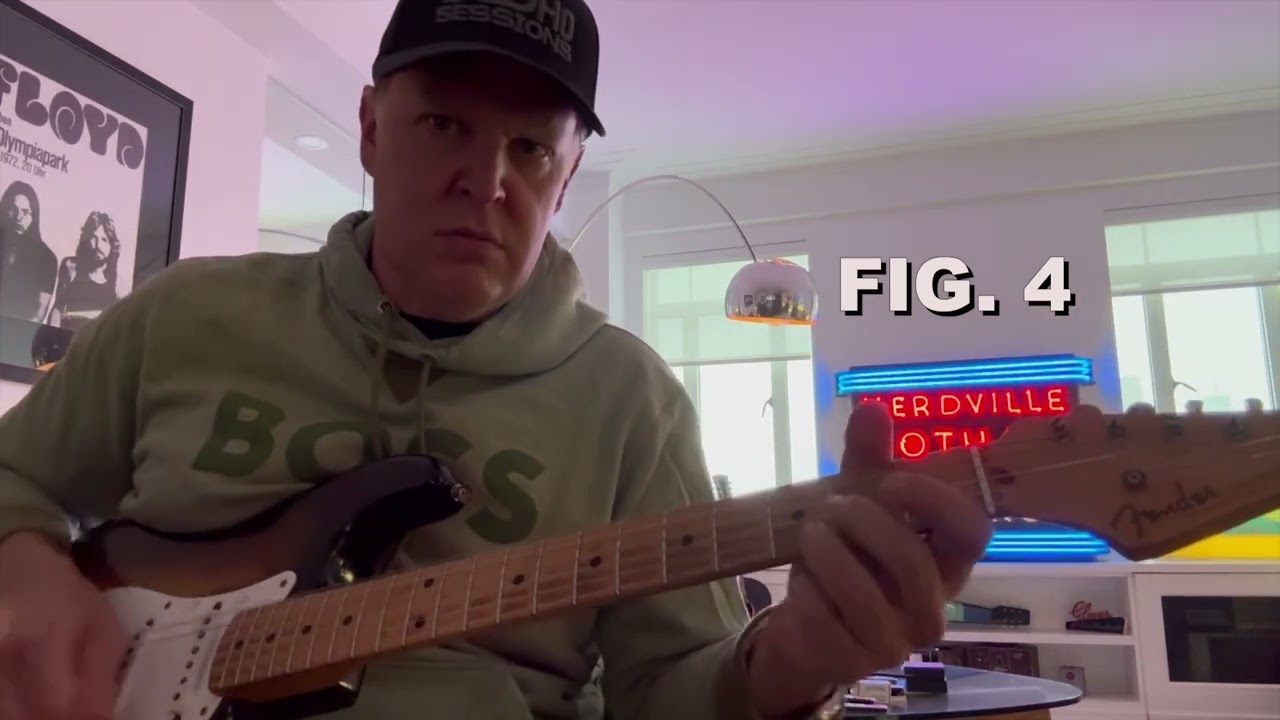
Figures 3 and 4 present Whitley-esque passages. In Figure 3, the phrase moves up and down the fretboard in the aforementioned octave shapes.
In Figure 4, I combine these octave-based phrases with shifting power chord licks in bars 4, 8 and 9. In bars 8 and 9, I barre my index finger across all of the strings at the 7th fret while playing a single-note melodic line on the 5th and 4th strings.

This is along the lines of Whitley’s approach to using drop-D tuning. As you play the figure, you’ll notice how unusual the rhythmic patterns are. Chris would play in this type of “choppy” style, and he blew me away when I saw him perform. His standard guitars of choice were both a National steel acoustic and an electric Les Paul Junior in “TV” yellow.
If you really want to get adventurous, try dropping both your low and high E strings down to D, what’s called double drop-D tuning (low to high: D, A, D, G, B, D). This will get you into some CSN&Y territory, as both Neil Young and Stephen Stills have explored this tuning to great effect, as has Jimmy Page on Led Zeppelin’s Going to California.
- This article first appeared in Guitar World. Subscribe and save.

