Many guitarists spend hours navigating different string gauges in the quest for the perfect tone. In John Mayer's eyes, however, there are only a few factors you should really pay attention to.
The 'thicker strings equals thicker tone' debate is a popular topic among players, with some believing that a heavier string gauge can give way to meatier, beefier tones. The trade off, of course, is that thicker strings are harder to play.
But, speaking to Guitar World in 2010, Mayer dismissed such talk, saying that “the argument about string gauges is about the silliest thing a guitarist can engage in.”
“Maybe you get a better tone from bigger strings,” he conceded, “but if you can’t bend up to the note, what’s tone anyway? Hendrix probably had .010s, so it’s whatever you can bend.”
In other words, what's the point of picking heavier strings if you can't cope with them? Prioritize playability and the tone will follow.
His observation came during a discussion of Stevie Ray Vaughan, who famously opted for heavier strings. SRV played with a custom 0.13–0.58 set, tuned to Eb, which led many players to think that alone was the secret sauce.
That’s one of the reasons why Mayer feels Stevie Ray Vaughan has “the most misunderstood tone around.”
“Everybody thinks you get a Tube Screamer, you turn the distortion all the way up, and you turn the level as loud as it goes before you get yelled at,” he said. “But his sound wasn’t about gain – the gain was in his hands. It was in the muscular, atom-bomb left hand, which made it sound loud.
“It was loud, but it wasn’t distorted. When people try to play Texas Flood through distortion, it sounds awful. Stevie primarily used the amp’s volume [he played through edge-of-breakup Dumbles] and a distortion pedal as a boost. Then he just whipped the hell out of the strings to get that sound.”

Mayer’s argument is that the relationship between the fatness of the strings and the tone is not necessarily symbiotic, especially if it comes at the expense of how much movement you can get out of your bends.
That’s why his signature Ernie Ball string set is considerably thinner than SRV’s go-to, albeit coming in a little fatter than standard gauge strings at 10.5-47. They are, he reckons, the perfect Strat strings.
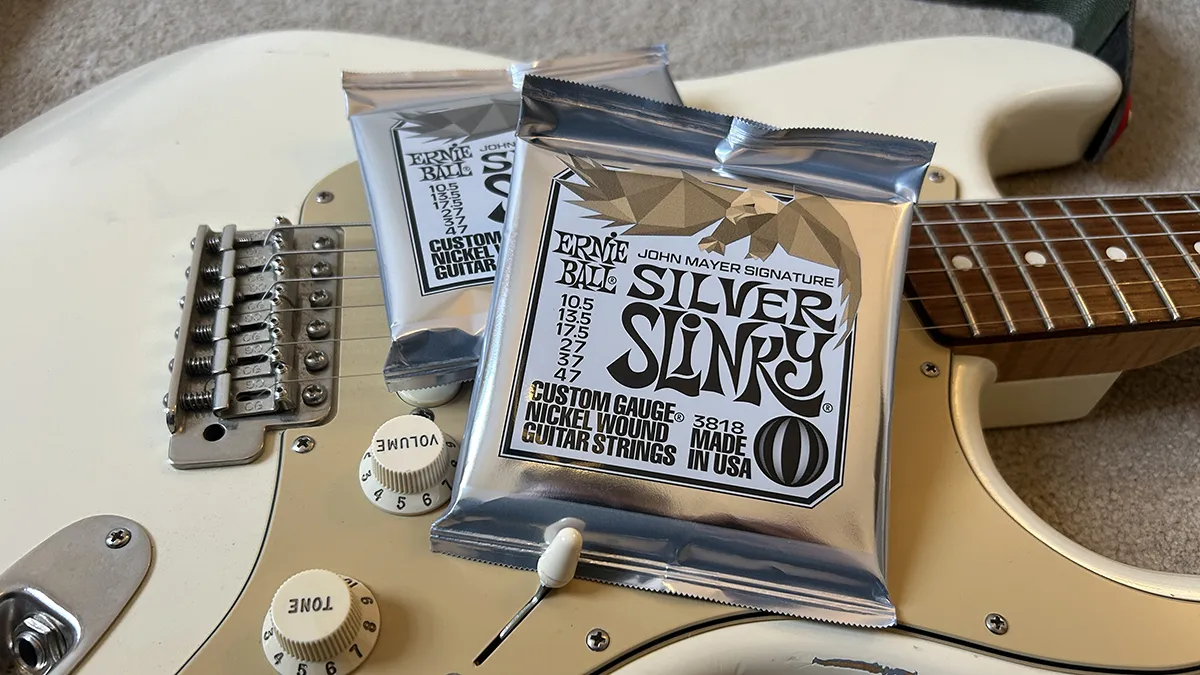
“The tension is exactly where I’ve always wanted it,” Mayer said of his signature Silver Slinky strings in 2024. “[They’re] big enough to get great tone, but nimble enough to finesse those vocal bends we as guitar players are always going for.”
So, yes, while he does seem to nod to the fact that thicker strings can contribute to a thicker tone, both his words and his gear reflect a belief that the quest for a beefy tone is far more multifaceted than most give credit for.
This is his sweet spot, but it must co-exist with everything else in his rig, and his personal playing style, too.
Other players prioritise playability alone. B.B. King famously used light string gauges to make bending easier, and Billy Gibbons ended up following suit after meeting the blues legend.