





Guitar World Verdict
Ignore the connotations of its green color and title. This is an impressive drive/boost pedal with the unique Body control being the crux of its versatility. It can provide a relatively full-range drive, or a mid-humped lead as a boost or a standalone pedal. Something that could find a home in many a setup.
Pros
- +
More versatile than its TS-associated name suggests.
- +
Unique Body control creates interesting tones.
- +
Great as a boost or a standalone overdrive.
Cons
- -
Some experimentation is needed to get the best from the Body control.
You can trust Guitar World Our expert reviewers spend hours testing and comparing guitar products so you can choose the best for you. Find out more about how we test.
What is it?
With so many options, it can be hard to choose an overdrive pedal. For the most part, it comes down to two things - the job you want the pedal to do, and personal preference. The original Little Green Wonder from Finnish brand Mad Professor is an example of a more interesting choice, with its different take on controlling tone courtesy of its unique ‘Body' control.
Since the initial release around 20 years ago, the original version has been discontinued, with that ‘Body' control being replaced by the more ubiquitous Treble and Bass controls on the second iteration, named The Green Wonder.
Now, Mad Professor is bringing the original layout back, including its bougie handwired nature. With it in front of me for review, I am looking forward to seeing what this different take on an EQ control can do.
Specs

- Launch price: $378 | £286 | €330
- Type: Overdrive pedal
- Made: Finland
- Controls: Volume, Gain, Body
- Features: Unique ‘Body’ control EQ, handwired
- Connectivity: ¼” in and out
- Bypass: True
- Power: 9V centre negative, 4mA
- Dimensions: 2.7”x5.3”x2.5”/70x135x65mm
- Weight: 0.9lbs/415g
- Contact: Mad Professor
Build quality

Build quality rating: ★★★★★
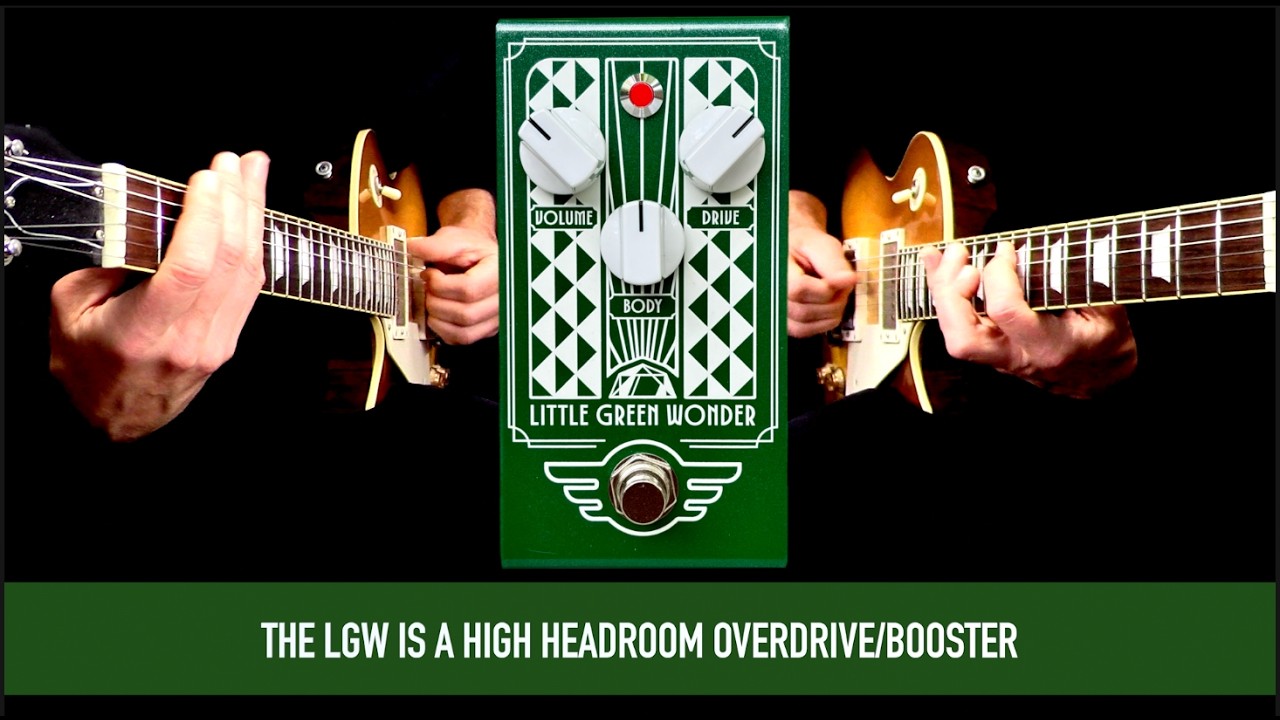
Being a hand-wired pedal, we are paying a hand-wired price, and the Little Green Wonder, with its metal chassis, boasts the near-indestructible feel we can expect when spending this sort of money.
It’s an impression that continues with the knobs and footswitch pushing back in a way that makes them feel premium and reassuring in use, and a bright power LED settled in a metal bevel completes the feeling of industrial strength.
The artwork here is more intricate than the less expensive factory version, and in my opinion, the art deco approach just looks better and, yes, more premium as a result.
Usability and features

Usability and features rating: ★★★★½
Whilst the Body control might take a beat or two to figure out, it is still a simple pedal that requires only minimal brain power to get the head around
With only three controls and without no screens or menus to worry about, there is no need for a manual here.
A ¼” in and out is as you would expect, and the standard 9V power input that will suit any pedalboard power supply. It can take up to 18V, but Mad Professor recommends we stick to the noted 9V for best results. Still, it’s handy to have this range to avoid any accidents with mixing up voltages.

To state the obvious, the Volume control makes things louder, and the Gain control adds more drive. Less obvious is the Body control. Fully left adds more bass and low mids with a slight treble boost, and fully right reduces bass with more mid focus.
We’ll get into the minutiae of the sounds later, but the result is a control that is, oddly, darkest in the middle and different types of bright at the extremes. In other words, not your usual tone control, or the low-end control that most people would associate with the term.
Whilst this might take a beat or two to figure out, it is still a simple pedal that requires only minimal brain power to get the head around and dial in on the fly.
Sounds

Sounds rating: ★★★★½
The increased headroom and Body Control are where things differ quite drastically from a classic TS-type pedal
Now, as a drive pedal with green in its name and finish, most are going to, fairly, assume that the Little Green Wonder is a take on a Tube Screamer.
The gain range is similar, as it goes from light breakup to a relatively driven overdrive. But the increased headroom and Body Control are where things differ quite drastically from a classic TS-type pedal.
With the Body control set straight up the middle, the tone has a TS-style mid hump, but without the smooth feel of a Screamer. This is my least favorite setting, as it sounds a little lacking in high-end life to me.

Turn left, and some high-end gets added back in while the bass response is retained, resulting in a pleasing, relatively full-range type of drive, quite far removed from the TS thing, and perfect for edge of breakup tones or classic rock rhythms when the Gain is pushed.
Turn right, and some more high mid is added (at a higher mid-frequency than a screamer), and the low end is slightly reduced, which means a cutting type of drive that will get you heard in the mix whilst still being pleasant to listen to on its own.

A unique-sounding drive pedal that can work well as a standalone crunchy rhythm or driven lead, or as a boost for a driven amp and other pedals
This setting is well-suited to pushing another drive pedal or driven amp into saturation, helped along by a huge amount of output available on the Volume control.
This all ends up in a unique-sounding drive pedal that can work well as a standalone crunchy rhythm or driven lead, or as a boost for a driven amp and other pedals. It is not transparent like a Bluesbreaker, for example, but has a mid hump that is not as forward as a TS-type pedal. A pretty great middle ground.
Verdict
The result of all this is versatility. It can do Tube Screamery things, but the highlights are within the Little Green Wonder’s ability to provide a range of boost and overdrive tones, creating a drive pedal that will fit most pedalboards or guitars. A handy little device.
Guitar World verdict: Ignore the connotations of its green color and title. This is an impressive drive/boost pedal with the unique Body control being the crux of its versatility. It can provide a relatively full-range drive, or a mid-humped lead as a boost or a standalone pedal. Something that could find a home in many a setup.
Test |
Results |
Score |
|---|---|---|
Build quality |
A robust metal chassis and sturdy feeling controls. Nothing to fault here – and it looks better than the Little Green Wonder. |
★★★★★ |
Usability and features |
Simplicity makes this easy to use, with just a little experimentation needed to figure out what the Body control does. |
★★★★½ |
Sounds |
It's a mid forward sound that offers more versatility than it's color and name might suggest |
★★★★½ |
Overall |
A pedal that covers a range of different drive tones sounds that allow it to funciton as both a standalone overdrive and a capable boost |
★★★★½ |
Also try

Hands-on videos
Mike Hermans
Mad Professor