




Guitar World Verdict
Who would have thought in 2016 that the best Fuzz Face-inspired pedal of 2026 so far would have come from Strymon? But the digital powerhouse has proved it has the appetite for adventures in analog, with the Canoga presenting as an old-school fuzz that can be equally effective as an all-purposes dirt pedal.
Pros
- +
Simple two-knob format.
- +
Brilliant, versatile sounds, and cleans up without losing any high-end information.
- +
Super-solid build and top-mounted jacks.
Cons
- -
Some players might want a tone dial on the pedal.
You can trust Guitar World Our expert reviewers spend hours testing and comparing guitar products so you can choose the best for you. Find out more about how we test.
What is it?
Strymon made its name on the back of its formidable skills in digital guitar effects design, reverb pedals the likes of which we had never seen nor heard before, great, multi-modal delay pedals like the TimeLine that come packed with all kinds of sounds.
Its DSP architecture puts studio-quality sounds on your pedalboard – sounds ranging from the quotidian essentials to the avant-garde. There is MIDI connectivity, presets, functions out of the wazoo.
The Canoga is not that. It’s something completely different; an analog fuzz pedal inspired by a vintage Fuzz Face. Just two knobs and the truth, ma’am. And it wasn’t even designed to be launched as an actual project.
That’s the thing about stompbox designers like Strymon CEO and analog engineer Gregg Stock; they just like making stuff. The Canoga was initially a fuzz box that was made to complement the UltraViolet Vintage Vibe, something suitably Jimi Hendrix to get the most out of this digital Uni-Vibe-inspired modulation for the demo videos. They even made a rudimentary, unbranded enclosure for it. And it sat around gathering dust.
In the interim, Strymon underwent a revolution of sorts. It went analog, unveiling the Series A in December 2025 with the launch of the Fairfax Class A Output Stage Drive. It was a taste of things to come. Strymon, as it turned out, had a heart that beats for all things old-school and analog, too, such as the Garnet Amplifiers Herzog device that inspired the Fairfax, and the Arbiter Fuzz Face that inspired the Canoga.
This two-knob silicon fuzz does not reinvent the wheel-shaped original. But, says Strymon, it might just prove to be more than the sum of its parts. The Canoga is a simple pedal but it is designed to perform both as a fuzz, and a drive-come-distortion when you roll the volume back on your electric guitar.
Specs

- Launch price: $199 | £199 | €263
- Type: Fuzz pedal
- Controls: Drive, Level
- Features: Silicon analogue fuzz circuit, internal jumpers for switchable power-up state (bypassed or engaged)
- Connectivity: 1/4" input/output, DC centre-negative power input
- Bypass: True
- Power: 9V DC (min. 50mA)
- Dimensions: 4.53” (D) x 2.83” (W) x 2.33” (H)
- Weight: 270gm
- Contact: Strymon
Build quality

Build quality rating: ★★★★★
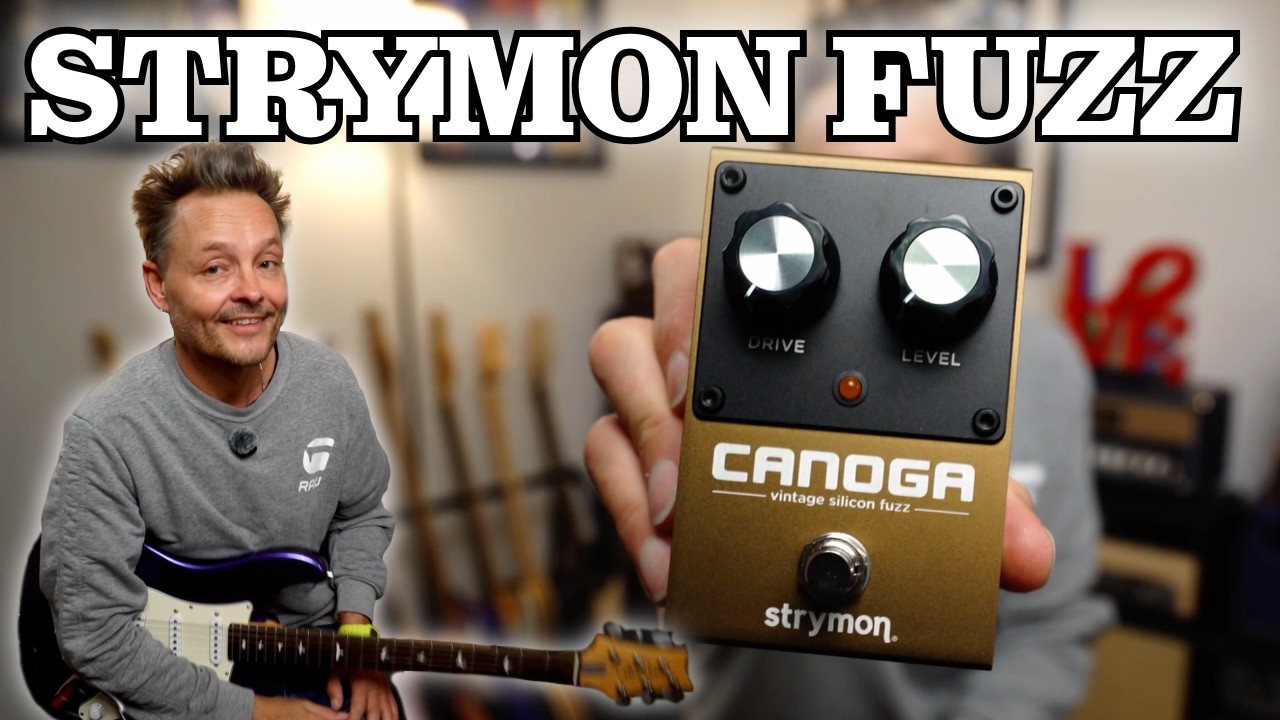
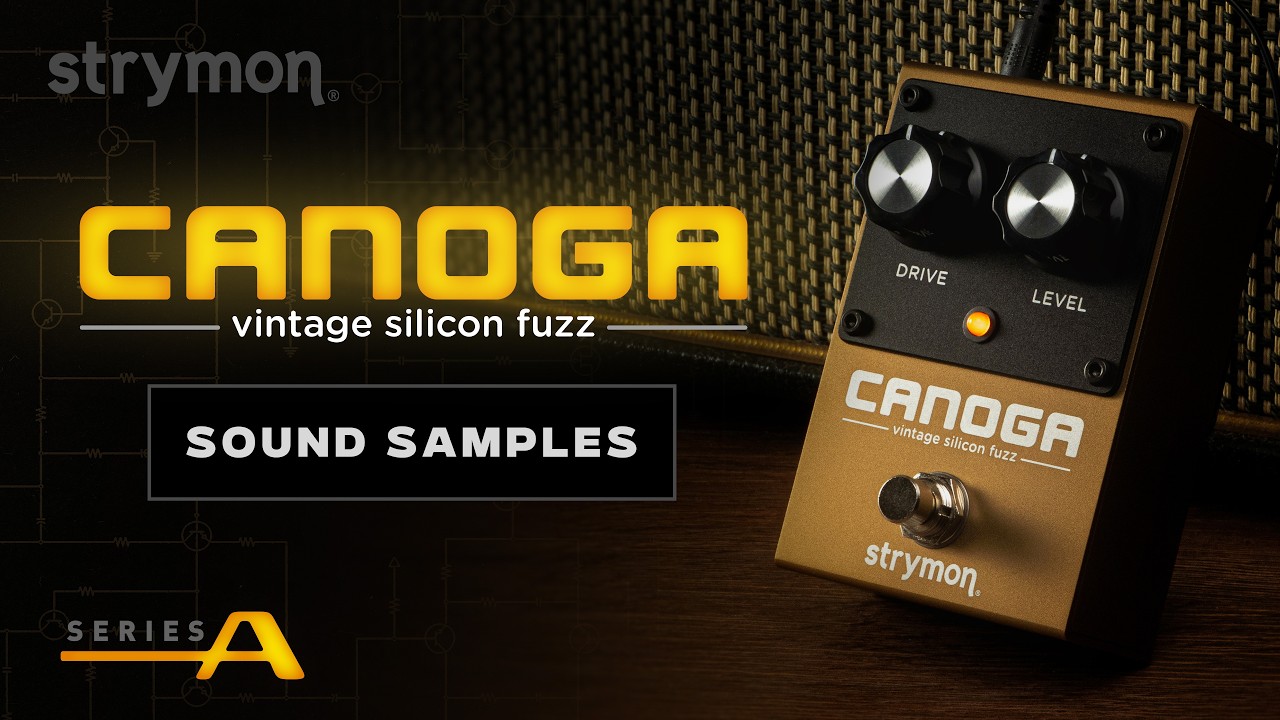
Like the Fairfax, the Canoga arrives in an unfussy boxy but compact enclosure that will appeal to players who baulk at any pedal that requires consultation with the manual. It has a silent soft-touch footswitch, a pair of amp-style knobs for Drive and Level that sit on a raised black plastic panel.
As with all the pedals that come out of Strymon’s US facility, the build is impeccable. There is no battery power here. Feed it 9V DC from your pedalboard power supply and it’s good to go. All of your connections on the top of the pedal. It’s a simple affair but you can unscrew the base plate to change how the pedal powers up.

By default, it will power up in bypass mode, but there are a pair of internal jumpers that allow you to set it to power up as engaged, which may be useful depending if you have this in a rack setup. The orange LED lets you know when it’s on.
The Canoga has the feel of one of those super-rugged pedals you throw on your 'board, tape it down, and never have to worry about it again. There's no buffer. Stick it on the front end of your signal chain and have at it.
Usability and features

Usability and features rating: ★★★★☆
It is Woodstock ’69, not Coachella 2026, and there is something to be said for that
Sure, the switchable power-up modes speaks to the stereotypical Strymon user – those of the multi-level pedalboards, loop switches, electric toothbrushes and Soundbrenner wearables... Y'know, the tech-literate and ready to mingle. But the Canoga is a time machine pedal. It is Woodstock ’69, not Coachella 2026, and there is something to be said for that.
It’s not about presenting players with all mod cons. We can have too many features. There is none of the post-modern fuzz accoutrements here, no selectable modes, no blend knob or bias control. There isn’t even a tone control. It is old school.
Adjust the Drive and Level, and use the volume control on your guitar to roll off the gain. The Canoga’s simplicity, its presentation of a vintage Fuzz Face in the hear and now, is what we’re here for.
Sounds

Sounds rating: ★★★★★
This is one of those occasions where the instinct to dime a fuzz pedal’s controls and work back makes sense. Strymon has designed this to be one of those fuzzboxes you set up on the floor but control with your guitar’s volume knob – or indeed with how hard you hit the strings.
Just like a shot of tequila as your first drink of the night can be a bit much, the Canoga is best introduced when you’ve already got a little bit of breakup on the amp – that’s where it sounds the sweetest
Unity gain was a little surprising. With my ‘50s Telecaster into a clean tube amp, it came around two o’clock on the Level control but there is a whopping amount of output gain beyond that. The Canoga can hit your amp hard.
But just like a shot of tequila as your first drink of the night can be a bit much, the Canoga is best introduced when you’ve already got a little bit of breakup on the amp – that’s where it sounds the sweetest. And it really does sound sweet, teasing out that harmonic content, adding a bit of sparkle and bloom to your chords, giving single notes the juice they need to hang in the air a bit more.
Strymon is as good as its word here; the Canoga cleans up beautifully. Starting from our all-guns-blazing position of both dials maxed out, there’s all the bestial woof you could want – especially when switching to a Jackson loaded with a Bare Knuckle Holy Diver humbucker, but notably also with both Tele pickups engaged in series, whereupon it came good for all those hairy Kyuss-style stoner tones.
Rolling back the volume brings us to almost clean but with the Canoga just heating everything up. This is where your Hendrix-style triads might take flight. Who needs a blend control when a pedal sounds this good?
Sadly, I didn’t have a Uni-Vibe to hand, but the disorientating throb from the CE-1 vibrato mode on my Boss Waza Craft CE-2 Chorus pedal was surely lysergic enough to give some acid casualties a mean flashback to Monterey; burning Stratocasters, all that mojo. Just add some tape echo and you might open up a new dimension (or set off the smoke alarm). Hmm, maybe it was just as well there was no Uni-Vibe.

Stick it on your ‘board and you’ll surely open up pathways to all kinds of sounds. There is the countrified scratch of its low-gain drive-stortion voicing. There is chewy Gary Moore blues-rock.
Just as the original fuzz pedals were deployed for quasi-horn tones, you can dime this, noodle on the upper registers on the neck pickup and the guitar transcends its anatomy as a stringed instrument.
Which is all to say that the Canoga is a great-sounding vintage-voiced fuzz, and that can be a much more versatile pedal than you might think, especially if you are comfortable working your volume pot during a show.
Verdict

Fuzz pedal design has moved on since Hendrix et al tread the boards, for good and for ill.
There will be some players who, quite reasonably, might baulk at paying 200 bucks for a Fuzz Face clone in 2026. Some of them might want a more modern voicing. Others might simple want more stuff going on. These days, we are used to options. There will be those who want more control over their tone on the pedal. Again, not unreasonably.
From the full-bore fuzz, to those in between tones that could pass for console grit or dirt from some unbranded vintage drive pedal you found at a pawnshop, the sounds are stellar
But the Canoga makes no promises on that score. It invites you to turn it up and search for the sweet spots via your instrument, or your amp, and how the Canoga interacts with that and other pedals further down the signal chain.
From the full-bore fuzz, to those in between tones that could pass for console grit or dirt from some unbranded vintage drive pedal you found at a pawnshop, the sounds are stellar.
And the simplicity lets you concentrate on doing the playing instead of worrying how the pedal is setup. Sometimes you realise that’s what you've been looking for – what you have needed – all along.
Guitar World verdict: Who would have thought in 2016 that the best Fuzz Face-inspired pedal of 2026 so far would have come from Strymon? But the digital powerhouse has proved it has the appetite for adventures in analog, with the Canoga presenting as an old-school fuzz that can be equally effective as an all-purposes dirt pedal.
Test |
Results |
Score |
|---|---|---|
Build quality |
Tip-top, made in the USA quality from Strymon. |
★★★★★ |
Usability and features |
It's a two-knob fuzz with a simple drive. |
★★★★☆ |
Sounds |
Exemplary vintage Fuzz Face sounds and cleans up exceptionally well. |
★★★★★ |
Overall |
It can be your Fuzz Face stand-in for Hendrix-style sounds – but it does a whole lot more. |
★★★★½ |
Also try
Hands-on videos
Strymon
Perry Frank
![Strymon | CANOGA Vintage Silicon Fuzz | VIDEO REVIEW [NO TALK / ONLY TONES] - YouTube](https://img.youtube.com/vi/0ZJvEl8rZ3k/maxresdefault.jpg)
Pete "Danish Pete" Honore