


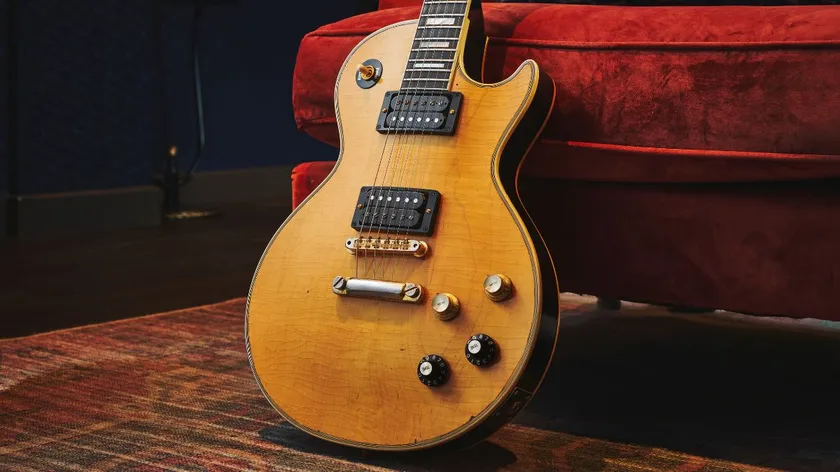


This three-pickup Les Paul Custom belonged to Neal Schon of Journey. Its distinguishing feature is the cherry finish, and Gibson only made six of them for the Swedish company Hagstrom in 1960.
Very few people know that these exist, and this one may be the only surviving version that is fully intact. The others I’m aware of have suffered broken headstocks and other repairs. We don’t know of Gibson making Les Paul Customs in any other color at that time.
Schon sold it in a Heritage Auction in the pandemic [to clear space in his home]. It turned out to be the worst time to do an auction because his guitars really undersold. I remember having a conversation with Joe Bonamassa afterwards, and he felt Schon should have waited.
I was amazed he didn’t just get a storage place and put it off for a year or two, but nobody knew where the market was going to go at the time. It was a brutal auction to watch because we were worrying that it would hurt the vintage guitar market, but it had no effect either way. Things just started popping like crazy a couple of months after the auction happened. Schon just missed the boat, which is a shame.
The special run of cherry Les Paul Customs all have late-1960 serial numbers and this one is ‘0 5700’. Despite that, it doesn’t have a blade-thin neck, but the neck has a little less depth than ’bursts from earlier in the year. It's never been touched or tampered with, and still has its original case and tiny little factory frets. It’s very much a ‘fretless wonder’, and with only minimal wear over the first three frets, it was probably used by a cowboy chord player.
The gold hardware, Grover tuners, and three Patent Applied For pickups are exactly as you would expect. The plating has worn and the pickup covers look more like nickel than gold, but it’s otherwise very clean. There’s the ebony fretboard, mother-of-pearl inlays, and split diamond headstock inlay. One point of interest is the ‘Made in USA’ stamp, which at the time was something Gibson only did to guitars specifically made for export. After 1970, all the guitars were stamped that way.

Gibson also started making necks with volutes around that time, but not all models had them. For instance, they wouldn’t put one on an L5, or any of the high-end jazz models. Maybe Gibson just figured that the owners were less likely to drop them or send them flying off guitar stands than Les Paul, SG, or ES-335 players.
I think Gibson preferred making necks without volutes but it was aware that the necks had gained a reputation for being weak, and rival companies like Fender were alluding to it in their advertising. I often wonder why the company didn’t try putting some kind of reinforcement in there. Maybe Gibson tried it and didn’t like the way the guitar sounded because it disturbed the way that energy traveled from the tip of the headstock to the body.
The switching options are neck pickup, then the neck pickup with the center pickup out of phase, and then the bridge pickup in the back position. A lot of people modify the circuit if they’re going to play the guitar out live, and some don’t like center pickups because they get in the way when they’re strumming.

People complain about scratching sounds, hitting the pickup cover, and making noises. Although, when I discussed this with Peter Frampton, he insisted it’s easy to play between the pickups. I just laughed and said, ‘Yeah, but not everybody’s you.’
The body is solid mahogany and there’s no maple cap. The translucent finish has a very pretty and rich color. Some call it ‘wine red’, but I think Gibson’s official ledger refers to it as ‘Cherry’. It’s completely unfaded, so Gibson had obviously transitioned to a light-fast red pigment by the time this guitar was made.
It doesn’t resemble ‘aniline red’ and it looks like a stain with clear gloss coats on top. You have to be right in front of the guitar to notice any lacquer-checking and besides a few nicks and things on the back of the neck, it’s in very fine condition.
- Vintage guitar veteran David Davidson owns Well Strung Guitars in Farmingdale, New York / 001 (516) 221-0563
- This article first appeared in Guitarist. Subscribe and save.
