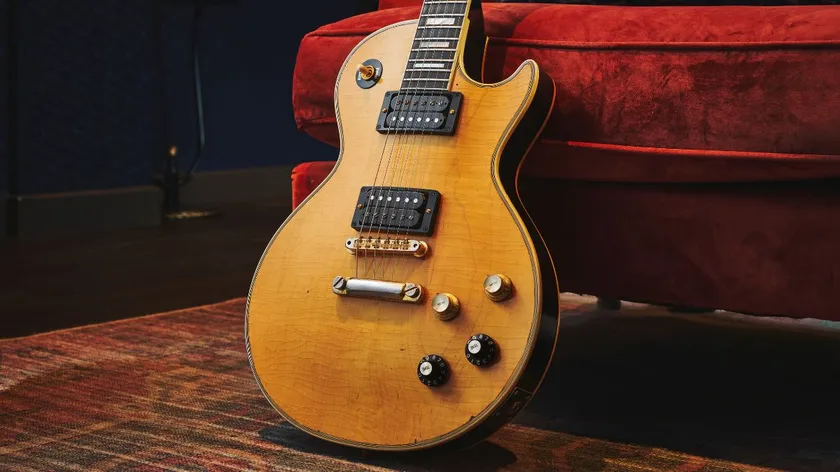


What happens to iconic guitars after a famous (or cult hero) guitarist dies? These days it’s common to see instruments sold at high-profile auctions and vanish into the clutches of anonymous collectors with deep pockets.
However, some guitars live on in museum collections, remain under close guard as family heirlooms, or get passed along to famous player friends, where they continue to make history.
We decided to take a closer look at five of the most celebrated Telecasters (actually, one is an Esquire) played by guitarists we’ve loved and lost, and figure out where those instruments are now. Today, we look at Muddy Waters’ circa-1957/58 Fender Tele, aka “The Hoss”.
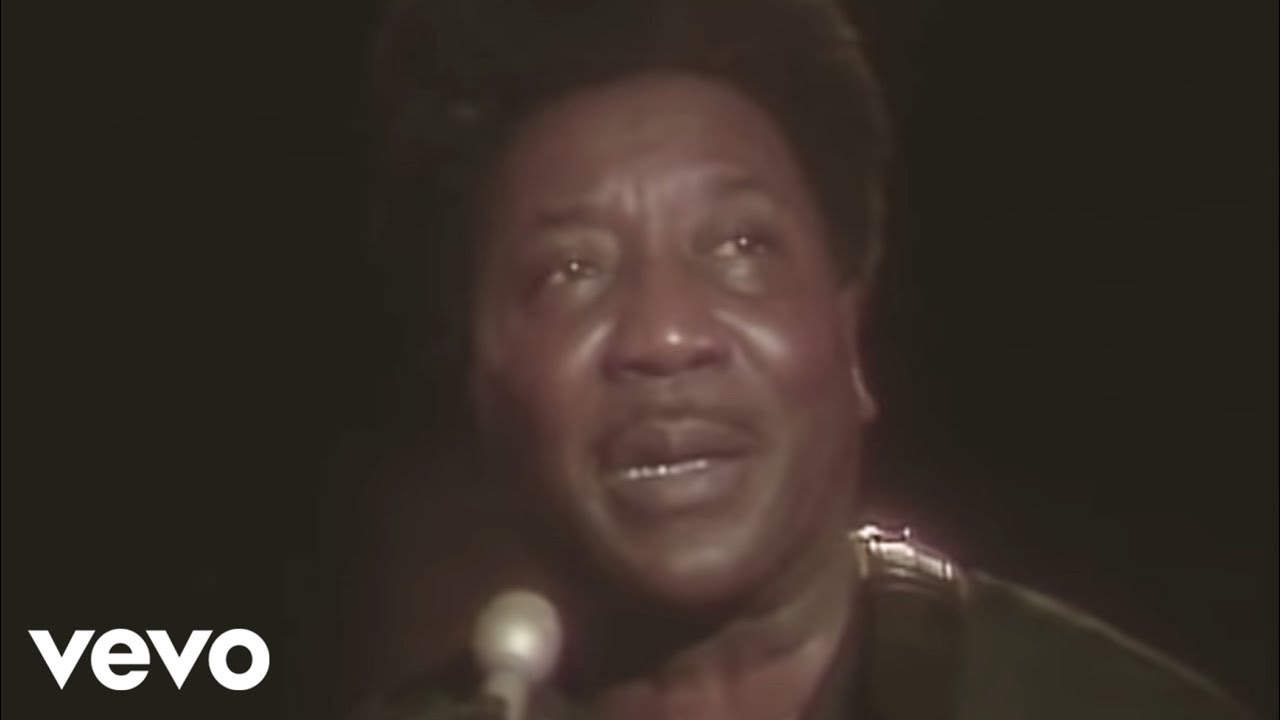
Rightfully revered as the “father of modern Chicago blues,” Muddy Waters greatly inspired blues guitarists as well as rock players in England and America during the ’60s and beyond.
From the mid-’60s, when he gained prominence and acclaim from white rock audiences, through his death on April 30, 1983, at the age of 70, Waters was regularly seen and photographed playing a bright red Telecaster on stage. This Tele, which Waters nicknamed “the Hoss,” became almost a holy relic among devotees of electric blues.
Waters acquired the Tele, probably as a brand-new purchase, sometime during the late ’50s. It was a standard 1957/58 model with a maple neck/fretboard and light blonde-finished ash body that looked almost white.
Despite numerous accounts claiming that Waters painted the guitar red and swapped the maple neck for a later version from a Telecaster Custom with a rosewood fretboard during the early ’60s, a photo shot on May 7, 1964 – while Waters was filmed in Manchester, England, for the Granada Television special Blues and Gospel Train – shows that the Tele was still in its original blonde/maple neck configuration.

By the summer of 1965 (as verified by credibly dated photos), Waters had performed several significant modifications to the guitar. The original 1957 body remained, but it was now painted in a vivid, metallic red hue, and the aforementioned circa-1959-61 Telecaster Custom neck with slab rosewood fretboard also made its debut.
Waters also replaced the chrome-plated metal flat-top control knobs with a set of skirted and numbered plastic knobs from a Fender amp, a mod that may have inspired Fender’s switch to these knobs on Telecaster Custom and Deluxe models starting in 1972.
At some unknown point during the ’60s, four extra screws were added to the original five-screw pickguard to keep the pickguard from warping. Finally, in 1980, Waters swapped the original ashtray bridge with three smooth steel saddles to a gold-plated flat-plate brass bridge with six adjustable saddles.

Although Waters played a variety of other electric guitars earlier in his career, including a goldtop Les Paul, his “Hoss” Telecaster with its red finish became an icon thanks to its appearances in numerous photos and television appearances from 1965 onwards. This was the guitar Muddy played at several Montreux Jazz festivals from 1972-77, on his 1977-81 “comeback” albums produced by Johnny Winter, and at high-profile concerts with Eric Clapton, Robert Cray, and the Rolling Stones.
After Waters died in 1983, his manager Scott Cameron took possession of the “Hoss” Telecaster. It appeared in public occasionally and was displayed at the Rock and Roll Hall of Fame museum in Cleveland starting in the ’90s. George Blanda of the Fender Custom Shop closely examined the guitar in 1999 when Fender developed the Muddy Waters Artist Signature Series Telecaster produced from 2001 to 2008.
In 2017 after Cameron’s death in 2015, Cameron’s widow gave the guitar back to Waters’ family, where it remains to this day. Most recently it was displayed in 2019 at the “Play It Loud” exhibit at New York City’s Metropolitan Museum of Art.
- This article first appeared in Guitar World. Subscribe and save.