

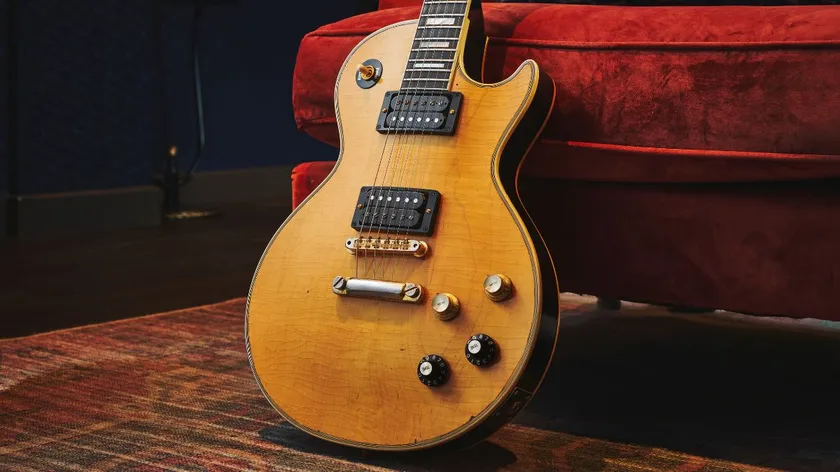


This is a custom-made Super 400 that Gibson built for Merle Travis. I bought it at Christie’s in New York when his stuff went up for sale, along with several other guitars that belonged to him. It intrigued me because it has some features that were rarely seen in 1968.
By the late 1960s humbuckers were standard pickups for the Super 400 and this body has humbucker cut-outs. But Merle must have specified P-90s, and Gibson placed a very thin plastic cheat ring under the neck P-90 cover to hide the humbucker rout. The bridge pickup has a standard spacer that also conceals the hole.
The really cool pickguard is obviously custom-made, and the Bigsby has the burnished brown colour that you sometimes see on archtops. It’s actually an enamel finish that has chipped off in certain places. It has a palm bar, which is more like a long wire with a hook on the end.
When he played, Merle would operate the Bigsby with his pinky finger as he picked with his thumb and index finger. The bar is fixed so it doesn’t swing out of the way; he had about a hundred guitars with this setup. That was Merle’s thing and I’ve bought several instruments that belonged to him, including a 1952 Fender Esquire. He mounted a big old Bigsby right on the end of that with the same long bar.
The pickup selector is a standard three-way switch, but it’s in a completely different position from a standard Super 400 switch. It’s maybe an inch lower and almost directly in line with the pickup. A second switch, next to the pickguard, was used to put the guitar in standby.
The witch-hat knobs are pretty standard for late-1960s Gibsons, and there’s a big plastic plate where the jack socket is mounted. I’m sure somebody broke the jack at one point and just stuck that sucker on to cover it.

There’s also a homemade wire hook for his strap that is screwed into the tail block. It’s not the first time I’ve seen one and it’s the kind of thing techs did back in those days. I don’t really care because, to me, this is an artist guitar.
The guitar has such a thin neck, I’m sure it was carved that way especially for Merle. It’s a very comfortable instrument to play and it’s made from three pieces of maple with a fair bit of flame.
In contrast, the back of the body, which appears to be carved from a single piece of maple, has no figuring at all. The sides are maple, too, but the really interesting thing about the body is that it has less depth than a regular Super 400.

The scary part is that this represented Gibson’s best in 1968 and, to be honest, the materials are just not that great.
I sometimes look at guitars from this era and wonder where they found such unremarkable wood. I can’t believe they used maple like this for their flagship model guitar, particularly one made for an artist like Merle. But I guess they didn’t really care that much.
The scary part is that this represented Gibson’s best in 1968 and, to be honest, the materials are just not that great.
The truss rod cover says ‘custom’ and the front of the headstock has a Les Paul Custom-style split diamond inlay that is echoed on the back of the headstock, in regular Super 400 style. The fingerboard is ebony, with typical Super 400 inlays, and it has been refretted with wire that’s a little flatter and wider. The Kluson Sealfast tuners are also original and have never been replaced.
The biggest differences between this custom-made guitar and a regular Super 400 that you could buy off the shelf are the thinner body, the pickups, the pickguard and the switching arrangement. It’s wonderful to be able to feature it here because most people don’t get to see guitars like these and it isn’t one that we have publicised.

There is a little wear and tear because this guitar has been played and loved on, and Merle did keep it to the end of his life. I have a cute little thank you note from Christie’s and the original poster board that they made to display the guitar.
There is also a CD that was in the case when I bought it with session outtakes and noodling on this actual instrument. On it, you can really hear how Merle used the vibrato and he was an absolute master of it.
I had a conversation about this with Brian Setzer a couple of weeks ago and he was commenting on Merle’s command over the instrument. He was such an exceptional guitarist.
- Vintage guitar veteran David Davidson owns Well Strung Guitars in Farmingdale, New York / 001 (516) 221-0563
- This article first appeared in Guitarist. Subscribe and save.
