


Innovation Week: For most of the electric guitar’s history, changing pickups has meant commitment. Strings come off, screws come out, the control cavity opens and somewhere along the way a soldering iron gets hot. That’s fine if you’re installing a favorite set for good. Not so appealing if you simply want to try a different pickup five minutes later.
The idea of quick change pickups is not new. Dan Armstrong’s clear Ampeg guitars, launched in 1969, used interchangeable pickups that could slide in and out without dismantling the instrument. What has changed is the number of modern builders revisiting that idea and the different ways they’re trying to make pickup swapping as routine as changing a pedal.
Gibson takes a more straightforward approach with its Quick Connect system. Used on select Gibson guitars since 2011, it replaces traditional solder joints with plug in connectors inside the control cavity. It may not be as quick and easy as some other systems but with a screwdriver and a compatible Gibson pickup, the job becomes considerably less intimidating.

Seymour Duncan’s Liberator, EMG’s solderless system, Kwikplug by Guitar Fetish and Obsidian Wire harnesses follow the same general philosophy. They leave the conventional pickup mounting arrangement intact but remove soldering from the equation. For home experimenters, repair shops and players wary worried about cooking a lead wire or soldering a bad joint, solderless pickup connectors may be appealing.
The most dramatic reinvention comes from Guitar X, whose Swiss developed magnetic, removable module mounting system allows pickups to be pulled through the rear of a compatible guitar and replaced in seconds. Guitar X offers mounted pickups from Cream T, Fralin, Seymour Duncan and others, while its technology has also found its way into guitars from additional builders.

Somnium takes a more engineered approach with their Tonestorm system. It uses machined aluminum cartridges that snap into the guitar body and make their electrical connection automatically. The cartridge can house standard pickups from different manufacturers, including active and passive designs, and a loaded module can be changed in seconds.
Aclam takes a similar route with its AECPUS Exchangeable Cartridge Pickup System offered on Canivell guitars. Pickups live in cartridges that lock into a rear frame using gold plated contacts, allowing players to move between single coils, humbuckers and P 90s without removing strings or reaching for a soldering iron.
Other builders expand the modular idea beyond one pickup at a time. Reddick’s Voyager guitar uses complete removable pickup layouts plus separate control modules, so a player can move from humbuckers to single coils, P 90s or Tele style combinations in seconds.

Fern’s Phoenix guitar goes further by putting pickups, controls, wiring and capacitors into completely interchangeable cherry wood modules that can be swapped out in seconds.
Then there are newcomers like The Boaz One which uses complete pickup cassettes, while Shark Guitars uses a one button release module that accepts standard single coils, humbuckers, P 90s and active pickups.
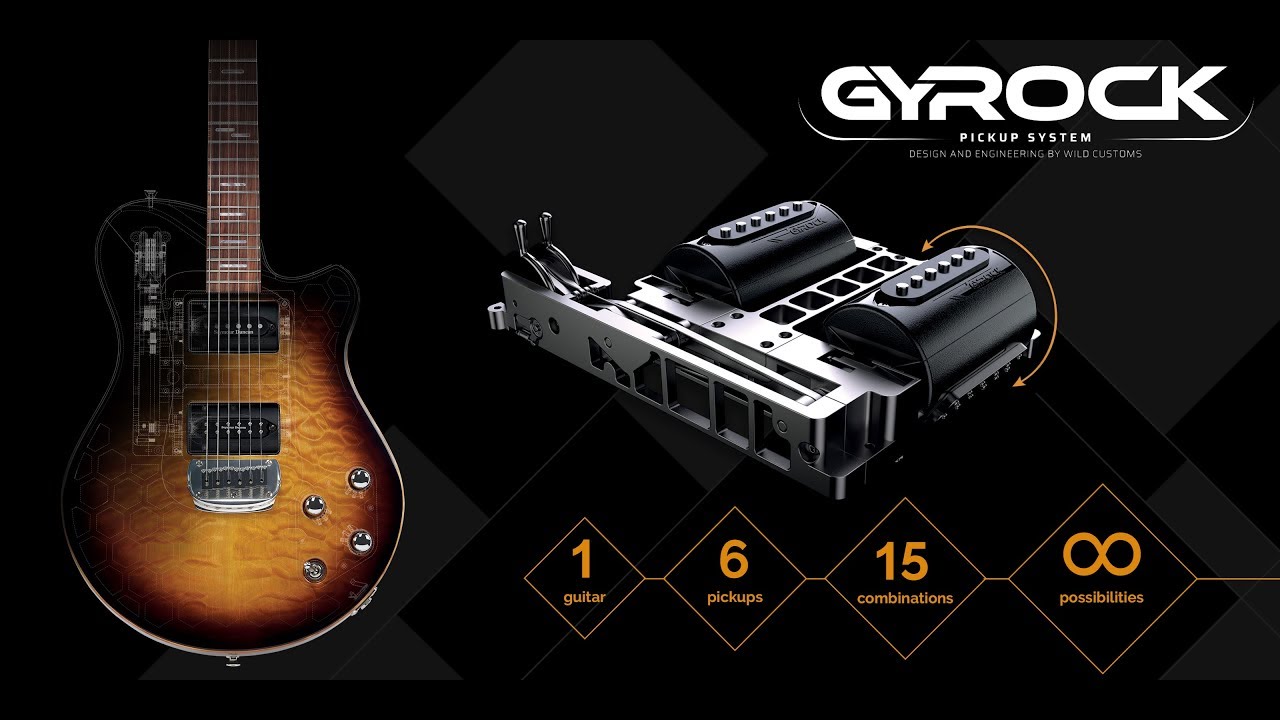
The Gyrock system from France’s Wild Customs is perhaps the most mechanically ambitious quick change design in the category.
Rather than removing one pickup and installing another, the guitar houses several pickups inside the body on rotating drums, mechanically shifting the desired pair beneath the strings and giving players access to as many as 15 real pickup combinations. The pickups are mounted in removable Gyrock modules accessed from the rear, so the cartridges themselves can also be replaced with different pickups.
The advantages of quick-change systems are pretty obvious but there are also some drawbacks. Most true cartridge systems require a guitar designed specifically around them, or some fairly serious modification to an existing instrument. And because many use their own proprietary format, they only really work if enough guitars, pickups and replacement modules are available to support the system.
The cost for some of these systems may be out of range for some players and many guitarists still like the idea of owning several guitars rather than asking one instrument to impersonate all of them.
So, has the soldering iron finally met its match? Not quite. Most of these systems still live in their own little worlds and they’re not compatible with each other. Once you commit to a particular system, you’re kind of stuck there.
Plenty of players will keep soldering the old fashioned way simply because that’s how they like to do things. But the idea that every pickup swap has to become a wiring project is starting to feel a little dated. The soldering iron isn’t going anywhere, but it may finally be getting some competition.

