


Brian Bell joined Weezer as a replacement for Jason Cropper after most of their 1994 self-titled record (aka The Blue Album) had already been tracked. But since 1996’s Pinkerton, Bell has fully shared six-string duties with Rivers Cuomo.
He prides himself on “knowing what makes Weezer Weezer.” That’s come in handy across 11 studio records over the last decade – the most recent being 2026’s Weezer (aka The Gold Album). Bell shrugs off the band’s breakneck pace. “Going back to the pandemic, I’m sure a lot of people learned to bake bread,” he says. “We made six albums!”
Those releases are all over the sonic map, even if some fans are forever clamoring for music akin to The Blue Album. “I used to be ashamed of our success,” Bell admits. “I played it down. There was a time when it wasn’t cool to be on a major label.”
He’s referring to Weezer’s chart-topping era in the ’90s and ’00s, when many alternative and indie bands were being dropped or ignored. “There’s a thing – especially with that type of music – where you’re not supposed to make it. But now I’m like, ‘Hell yes, I’m Brian Bell of Weezer! Shove it!’”
He points out: “We were always on a major label. We were never on an indie label. That’s off-putting to music fans immediately. Then the internet came along, and that was their chance to take shots at you. That’s really what it became.”
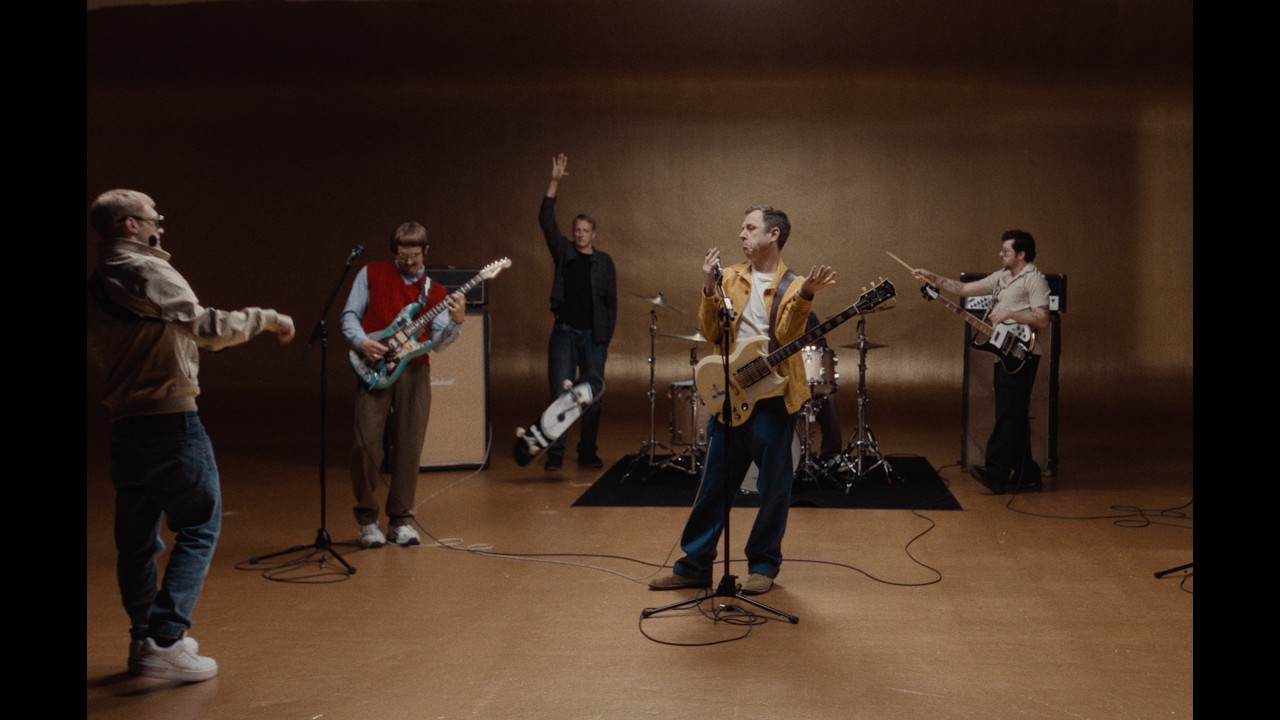
None of that has stopped Weezer from selling tons of records and packing stadiums worldwide. Odds are that The Gold Album, and its supporting tour, The Gathering, will be no different. Meanwhile, Bell says they’re returning to basics.
“You can have talented songwriters, but it’s not going to sound like a band playing organically if you come in with fixed ideas. It’s best not to adhere to those ideas so much; you can’t have blinders on. It’s best to just let songs become what they become.”
What was Weezer’s collective mindset going into the Gold Album?
We have a relationship with our fanbase where we listen to them, don’t listen to them, and keep them on their toes! The “seasons” records [their four SZNZ releases from 2022] were done on an assembly line; but with Gold we were like, “Let’s do something crazy… Let’s just jam these things like a band would!”
What informed the album’s overall guitar sound?

Rivers connected with a producer named Klaus Ahlund from Stockholm, Sweden. He’s produced Ghost, who Rivers is really into – he loves the way the guitars sound. So he started working with Klaus and a lot of great things happened.
But we were like, “This isn’t quite it; this isn’t the record we want to make yet. Let’s take some of these ideas into a rehearsal space.” That led to it being closer to what the record is now.
Once you got to that point, what gear did you turn to?
There are guitars I’ve had forever, and some new finds. I’m a collector – it’s my passion, or a disease! I seem to be the only one who cares. I don’t think Rivers cares as much. He has his custom-built Warmoth Strat, which I guess he can’t have built anymore!
But I had this beautiful ’67 Thinline Tele, even though they started in ’68. It’s one of the earlier serial numbers. I used that one for Pinkerton a lot. It’s one of my favorite guitars for when I want a cleaner sound. Then I have a late ’59 Fender Strat that I used for a lot of picking things. We spent a lot of time doing shootouts between amplifiers; it depended on what the part called for. With some of the songs I’m in bizarre tunings.
Weezer are known for their namesake tuning. Is that what you mean?
When we’re tuning to “standard” we call it “Weezer tuning.” It’s standard dropped down a half-step. We prefer E-flat as opposed to, say, D-sharp.
With the song The Show Must Go On, we started with Weezer tuning in drop D, which is then D-flat. The G string is actually tuned to F, the B string is tuned to A-flat, and the D string is tuned to D-flat. So, there’s three D-flats, two A-flats, and an F – the reason being the voicing of some of these chords.
What tends to inspire you when it comes to coming up with guitar parts?
I’m from Tennessee – not Nashville, but real Tennessee – so picking and bluegrass came naturally to me
I came up on piano, so sometimes I work conceptually. Like, “the show must go on,” to me, means the music must continue into the stratosphere; it’s never-ending. A lot of things I like to do hint at the upper structure of the chords by some picking patterns.
Starting on piano made me approach the guitar a little differently than other people. I’m from Tennessee – not Nashville, but real Tennessee – so the sound of picking and bluegrass came naturally to me. That found its way into our sound.
You mentioned you worked with some new gear finds.
There’s a 1957 Les Paul Junior on the last bit of the coda of The Show Must Go On. You can hear the depth of that thing, man; it sounds so good. I can’t wait to use it live. There’s nothing more beautiful-sounding than one pickup, you know? And if you want it to sound a little different, just roll off a little volume.

But I also used a ’58 Les Paul Custom with the three pickups – sometimes it’s referred to as a Black Beauty. I had this early 2000s Gibson Explorer, which is really flashy. I found that guitar in Rivers’ basement! He’d forgotten about it. It was in the corner and I was like, “What’s this? Can I use this?” I started playing it and he said, “Oh, yeah, you can just have that!” At one point he did want it back. I gave it back then he ended up not liking it again, and I took it back again!
A notable track from The Gold Album is C.E.O., which revisits Undone – The Sweater Song.
I heard that from the demos that Klaus and Rivers worked on, and I was like, “Dude, there’s something to this one.” If I give myself a pat on the back, it’s that I can hear what makes Weezer Weezer before Weezer knows it.
There was this D-Day where everybody got dropped – except for us and Beck. I felt the immediate hatred in town
I heard that, and I was like, “Fuck – this is like the answer to Undone.” But the song wasn’t fleshed out and kept getting pushed to the wayside. There was something off-putting about Rivers referring to himself as the CEO. So we worked very hard to come up with how it is now. I credit Rivers for hearing us out.
C.E.O. has certainly polarized the internet since its release – which Weezer are no stranger to doing. Why do you think you tend to have that effect on people?
It’s amazing! SNL did a skit about it where they say, “How can you be such fans of somebody and hate them so much?” But as far as that song goes, if we’d kept the lyrics as “I’m the CEO,” that was polarizing within the band.
![Weezer - We Might As Well Be Strangers (ft. Wednesday) [Official Music Video] - YouTube](https://img.youtube.com/vi/GyE8bkeSt8w/maxresdefault.jpg)
The way the public perceives Weezer seems to go back to the transition between The Blue Album and Pinkerton. People demand another Blue Album – and sometimes you give it to them – but most of the time it’s another Pinkerton, and they’re polarized by that, only to love it later.
I wish I knew why. With Pinkerton it was really the critics that hated it and slammed it. I don’t think fans hated it, but it was a complete departure from The Blue Album’s polish. There were key changes all over the place, and it was lyrically somehow related to Madame Butterfly. We were just a bunch of punky kids. I’d hate me too, probably!
That’s a good point – you were very young. What was the aftermath of Pinkerton like?
There was jealousy from other bands, who at that time were getting dropped. I remember a day in the music business when they signed practically everybody, and then there was this D-Day where everybody got dropped as far as rock music goes – except for us and Beck. I felt the immediate hatred in town.
How do you measure the legacy of Weezer as a guitar band?
Well, that’s exactly what we are. First of all, with the simplicity of some of these songs, a lot of people say, “Oh, wow, I can do that, too.” Like with The Sweater Song, that lick seems so simple, but it’s kind of more sophisticated than you think.
So the molding of simplicity with sophistication is one of the elements of our guitar approach. And also the use of inversions. But we also mask them a little as well. It’s definitely our own thing.
- The Gold Album is on sale now. Weezer’s next tour commences on September 8.

