


Johnny Marr woke up last night in a cold sweat. “I had a bit of a 3am attack of the ‘oh-my-Gods’,” he tells Guitarist. But there’s no need to ask the 62-year-old the cause of his palpitations.
On 17 September, the indie-rock legend will follow the biggest names in blue-chip rock ’n’ roll – David Gilmour, Mark Knopfler, Jeff Beck, Eric Clapton – and auction off his four-decade guitar collection at Christie’s of London.
For a player whose instruments have so often seemed like an extension of his arm, it’s practically an amputation. “This auction is a bit of a wrench,” admits Marr. “But for me it’s boom or bust. If I’m going to do this, I’m going to go for it. And once I made up my mind that I was going to go through the rest of my life without these guitars, I’ve tried to hold that position and not get too sentimental.”
That’s Johnny. As well as being a shining example of a human being (a proportion of auction proceeds will go to charity), the guitarist has never been one for nostalgia.
It’s the reason he quit the greatest indie-rock band of them all – The Smiths – at their ’87 peak for a kaleidoscopic solo career taking in everything from teaming up with Bert Jansch to the Inception soundtrack. Likewise, it’s why he chose to jettison these fabled guitars to record new solo album, The Age Of Everything, with a box-fresh signature Jaguar.
“With this guitar collection that I’ve had for 40-odd years being suddenly absent, it’s definitely going to feel like my life is different,” says Marr. “And I’m quite excited about that, y’know?”
What was the motivation behind your auction?
While I was documenting these instruments for the Marr’s Guitars book, there was a kind of catharsis. I’d go home from a day’s shoot and really be able to remember who I was and how I felt when I was using those guitars in the 80s, 90s and onwards.
Then we did the events in New York, Manchester, London and Dublin, and when they were being put back in cases, it felt like putting them in a cage at the zoo. It seemed really weird because they had become these living things to me again. So that was the overriding emotion – that they should be cherished on a daily basis by somebody.
How have you found working with Christie’s?
It’s been fascinating. From the transportation to the climate-controlled rooms to the forensic analysis. Y’know: “Why is this decal different? You must have changed it.” It’s mind-boggling, the expertise. I did enjoy nerding out with guitar nerds And with all due respect, everyone I’ve worked with at Christie’s are real guitar nerds!

Let’s start by talking about the ’82 Rickenbacker 330 Jetglo.
Anyone who’s been in a successful group will tell you the early days are unmatched. So all of that is synonymous with that Rickenbacker: the excitement of the early songs, but also The Smiths taking off at the age of 19, which is how old I was when I got that guitar.
I bought that with the first bit of money I made, and I immediately started writing things like Still Ill and Accept Yourself. And because that guitar had such a vibe, it stayed with me all the way through, even to the solo records.

You loaned it to Noel Gallagher. Weren’t you worried that he’d damage it?
It never occurred to me that my guitars would be damaged. I’ve always been very loose like that. I cherish them, but I also leave them leaning up against amps, lying on the floor. I’m a bit of a liability where guitar stands are concerned, so my guitars are actually safer leaning up against amps.
It’s an aesthete thing as well. I always thought guitar stands looked clumsy. Maybe it’s to do with being the oldest in an Irish family and being let loose to do whatever the hell I wanted when I was about 11. But I have the same attitude with my guitars. Like, “They’ll be all right.”

I suppose I’m a bit cavalier, but I’ve been pretty lucky. I’ve only had significant damage to two guitars, caused by myself. One was my ’73 Custom. My tech had come down with food poisoning so I had to use New Order’s tech, who had no idea about tunings, he only knew about synthesisers.
So the gig was a disaster and, in frustration, I threw the guitar up in the air. Miraculously, it only damaged one of the machineheads. Another time, it was a Flying V. But they’re notorious for breaking their headstocks.
Didn’t Noel once break a Les Paul of yours?
Yeah, in a fracas on stage in Newcastle. There’s probably some Geordie guy who’s still got the bruises to show for it.

We have to talk about the ’60 Cherry Red ES-355…
Seymour Stein of Sire Records came to wine and dine The Smiths one night in 1984. It was a done deal we were going to sign to Sire. We’d have happily paid him: it was our dream label. But I was asking about The Stones in the 60s, and he made the mistake of telling me he’d always take Brian Jones to get a guitar. So I saw my opportunity. I told him if he bought me a guitar, The Smiths would sign to Sire.
On a snowy day in New York, I hung around the Sire offices all day, so Seymour wasn’t going to escape. We walked to We Buy Guitars on 48th Street and, as is often the way – and it’s a bit like this with pets – it already felt like I owned it when I saw it.

There’s this romantic notion many musicians have – myself included – that instruments have music in them. As soon as I got that 355 back to the hotel, I wrote Heaven Knows I’m Miserable Now. Which took about 10 minutes.
Then I immediately wrote Girl Afraid. There’s a few guitars like that in the auction. If they end up in the hands of songwriters, they’ll definitely deliver songs.

Did your ’84 Roger Giffin ‘Telecaster’ have songs in it, too?
It did. Although it might be a trick of the mind because it was a very prolific time. That was a gift from my girlfriend [now Marr’s wife], Angie. It was probably the second time we felt like we were suddenly wealthy. It probably cost £400. It was just such a beautiful surprise, that my girlfriend put in the thought and research.
How she lugged it over from Tower Bridge to the West End, where we were recording that day, is beyond me. It’s the heaviest guitar you’ll ever come across because it’s got loads of brass. But that means it’s got an amazing sound.

It’s so loud. I was such a little guy back then, probably only seven-and-a-half stone. I’m not such a big guy now. But I would only be able to play three songs on it during a concert, and then I had to swap over to an acoustic to recover.
Because it’s such a stable machine, it held tunings really well. I wrote songs on it like Meat Is Murder, which is open G, and then The Headmaster Ritual, which was open D. I played overdubs, too, things like Nowhere Fast. It’s funny with guitars.
There’s this associative thing. For instance, in the 90s, if a guitar player came across his mate’s Epiphone, he’d probably start playing like Noel Gallagher. So because it was a Telecaster, Nowhere Fast was somewhat of a rockabilly song.
Did you hold any guitars back from the auction?
There’s a few. Bryan Ferry gave me a Hagstrom: it’s [in the gatefold] of the Roxy Music album For Your Pleasure. I have one of Nile Rodgers’ first signature Strats. There’s the Telecaster that Chrissie Hynde gave me.
It’s been a selection process. Like, there’s a signature Strat that Edge gave me that I did put in the auction because it’s for charity, and I think because it was previously owned by a name player, it’ll raise a bit of money.
I’ve kept a couple of ’73 Strats. My son owns a few of my Modest Mouse Jazzmasters, so I’ll be borrowing those off him. Another workhorse I’ve kept is a ’63 SG. In theory, I could get another, but I thought, ‘Well, this one’s perfect, so why bother?
How have you adapted your gear choices to record your latest studio material?
My workhorses have been easy to decide on. There’s a ’63 335, just an amazing instrument that delivers – I used that on my new album, The Age Of Everything.
This new album has so many different tones, from Spin’s edge-of-distortion chime to the glassy funk of Ophelia. How did you dig them all out?
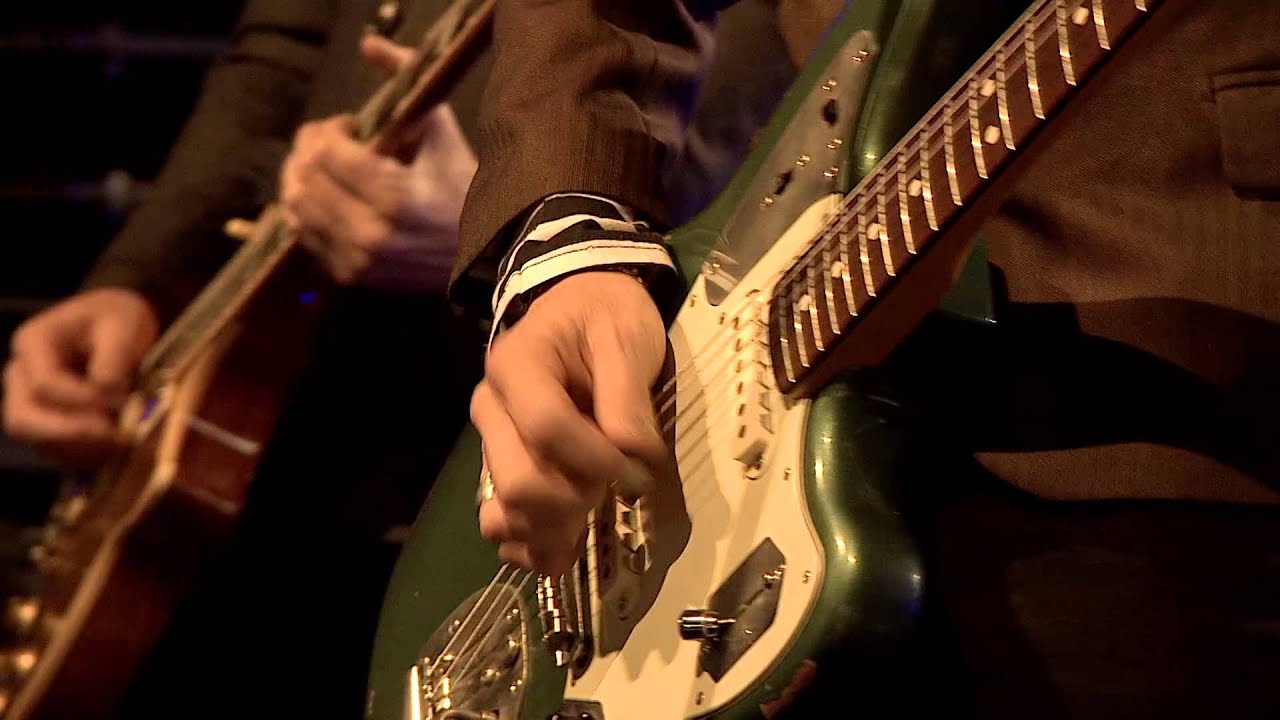
Rather fortuitously, the most recent version of my signature Jaguar has even more tone options. My Jags have 11 sounds, without any of them crossing over. But the Signature Special with lipstick pickups, it also has a position where it does all of that but with the added middle pickup.
There’s one other option, too, which is just the middle pickup but with high-pass filter. I’ve lost count of how many sounds I can do, but I used that guitar really extensively on the new album and it works a treat.
Isn’t there a danger of you inadvertently building up yet another collection?
Yes, there is. And who would blame me? That’s quite a nice prospect. But the remaining guitars that I have now – and there’s not loads of them – I really appreciate them.
The ’84 Standard is another icon.
I put the Bigsby on that in late ’85, I think. I always wanted a Bigsby, but I wanted a short one and back then they weren’t easy to find. Again, I’ve got Angie to thank. On tour, she went to some guitar store and came back to the soundcheck: ‘There you go, darling.’ She’s quite a woman. That’s why I’m still with her. It’s all because of the guitar gifts.

That Bigsby changed the way it felt significantly. Then I swapped the pickups to Seymour Duncans and put on partial-taps. I’m aware that, in theory, keeping a guitar stock, particularly where wiring’s concerned, usually means a better tone electronically. However, in the case of that Les Paul, everything came together brilliantly.
I investigated that guitar more fully – forensically, in fact – last year when Gibson made some copies for the Teenage Cancer Trust. We looked into the pitch angle, which is somewhat of an anomaly because it’s 14 degrees.
So the combination of the Bigsby, pitch angle, pickups and the partial-tap – which applies to the inside coil of the humbucker – makes it not behave like a regular Les Paul. Which I think is why I ended up playing it almost exclusively clean, like on the top line for The Headmaster Ritual. But you really hear it on Regret by New Order.

Smiths fans will definitely recognise the ’63 Casino.
Yeah, that’s the tremolo sound on How Soon Is Now. A lot of players of my generation in the 80s and 90s – I’m thinking of Noel, Paul Weller, Gem Archer – we liked the idea of those guitars. They were played by The Beatles, The Stones, The Kinks, and if it’s good enough for those guys, it’s good enough for me. But sound-wise, that Casino didn’t suit the existing Smiths material. It was too distinctive.
But that really paid off with How Soon Is Now. I hadn’t played that guitar for a long time, and when we came to photograph it for the book, I held it and it brought me back in the time machine. All you’ve got to do is stick it through a Twin, put the trem on and it sounds exactly like How Soon Is Now.
That nine-pickup Strat looks more like something Steve Vai would own.
The first night I got together with Isaac Brock from Modest Mouse, he had a Jag and my Telecaster just would not compete with his sound
I have no idea what happened there. I can’t imagine anyone [building that] other than if there was a guitar player who joined Kraftwerk in 1984. I bought that the first time Noel Gallagher and I went to a guitar shop together [in 1992].
I wasn’t actually drunk, but I’d definitely have been hungover. I was also very into Kraftwerk and just thought it looked amazing. It only came good in 2001, when I used it for Spirit Power And Soul. So it got there in the end.

There’s a Lake Placid Blue Jaguar in the auction. How did you fall for that model?
The first night I got together with Isaac Brock from Modest Mouse, he had a Jag and my Telecaster just would not compete with his sound.
That’s partly because he was playing through a Super Six. I had to abandon my Telecaster and Deluxe, and the only guitar at hand was a Jaguar. I thought I didn’t get on with them, but I played this black ’63 of Isaac’s and came up with the riff that became Dashboard.
After that, I went through a period where [people kept] offering me Jaguars. Angie told me, “You’re like one of those weird [people] who takes in every cat in the neighbourhood. Do you have to own every old Jag in the world?” And I said, “Yes, I do.” But to be fair, they were much cheaper than they are now.
Was that how your signature model came about?
Yeah. When I joined Modest Mouse, that was 2005, and in Portland, Oregon, at the time, everybody was making knock-ups, y’know, custom guitars. That led me to the idea of making my own Jag.
I was experimenting with necks and pickups, and doing it all in what I call ‘absolute conditions’. In other words, because we were playing arenas, the stages and the distance from your amps were the same every night. So if you change your guitar mid-set, you immediately hear it: “Oh, that pickup is brighter.’ We were playing so much that any change in my routine, I was able to evaluate straightaway.
I was absolutely obsessive for about two years. At that time, Fender contacted me and said, “Why don’t we do a signature?’ I said to them, “Look, leave me to it and I’ll make myself my perfect Jag – with Bill Puplett – then you can just copy it.”

How do you feel about the estimates at your auction?
My hope is that someone who’s got a regular job in Glasgow, who fancies a good guitar but wants one of mine, will be able to afford it
Well, compared with other auctions, the prices don’t look too horrible. The people who follow me might not necessarily be the same people who follow Mark Knopfler or David Gilmour. Two people I’ve got the utmost respect for. But my appeal as a guitar player is coming from a different place and a different time. That’s the main reason I put a lot of my Jags in there, precisely because they’re not heritage antiques.
My hope is that someone who’s got a regular job in Glasgow, who fancies a good guitar but wants one of mine, will be able to afford it. They’re not all tens of thousands. In the past, I’ve never regretted selling, like, one of the Playland guitars or something I used on The Messenger.
Because I know it’s someone who really cares about [what I’ve done in] my career overall. It’s not just someone who wants to buy the How Soon Is Now guitar and stick it in a glass case. I want a fan to buy these guitars.
How do you feel about the notion of a tech bro bidding on the Rickenbacker?
It’s not really for me to control if someone wants to hang it up in a collection, but something tells me that isn’t going to be the case. Precisely because I come from a different culture from Jeff Beck and David Gilmour. And not to say that their fans aren’t [guitar fanatics]. But y’know, I’m an indie-rock musician and I’ve got a feeling it’s going to be an indie-rock fan who buys my guitars.
When you take a bird’s eye view of your collection, are there any themes? You seem to prefer classic stuff.
Yeah, because when I first got known in The Smiths, playing what we know as ‘classic’ or ‘vintage’ guitars was quite unusual. There were other players doing it, like Edwyn Collins in Orange Juice, or Geordie [Walker] from Killing Joke played a 295, Will Sergeant played Jaguars. But there weren’t really many people playing semi-acoustics and certainly not Rickenbackers – although Paul Weller had done it before me.
Even for someone of my age to play a Tele in ’83 was unusual. But I was somewhat of a classicist, really. I remember, it being the 80s, Ovation gave me a loaner because I’d started using acoustics on songs like Please Please Please Let Me Get What I Want.
But whereas people in more mainstream bands would’ve just been happy to play the Ovation, it was important to me that as soon as I could afford it, I got a Martin D-28. I had enough about me to know about quality, from a recording point of view.
What was your first ‘proper’ guitar? Not a schoolboy knockabout, the real deal.
It was a black [Les Paul] Standard. I think it was a 1980. I had that in a couple of bands before The Smiths. I couldn’t afford a Gretsch Country Club, a 6120 or a Chet Atkins, but just before I formed The Smiths I felt I had to have the right guitar and that had to be a Gretsch. So I [traded the Les Paul and] got the Super Axe and that’s what I did Hand In Glove – and wrote all the first album – on.
Do you remember the first time you ever saw a guitar?
I was about five. At a party, my uncle put his Chelsea boot up on a chair and played a few chords. That blew my mind. But the most significant thing was at my cousin’s christening. I’m from an Irish family and at weddings and christenings there was always the same show band. Before they played, my dad approached the guitarist and said, ‘My boy’s guitar mad. Can he see your Strat?’
So this guy dutifully opened the case. I can still smell it. It was this otherworldly object, like something out of Raiders of the Lost Ark. It was all the things that people from the generations before me say about Strats, y’know, that the design was space age. And I was obsessed. I was really into football and my bike. But not like I was into guitar.
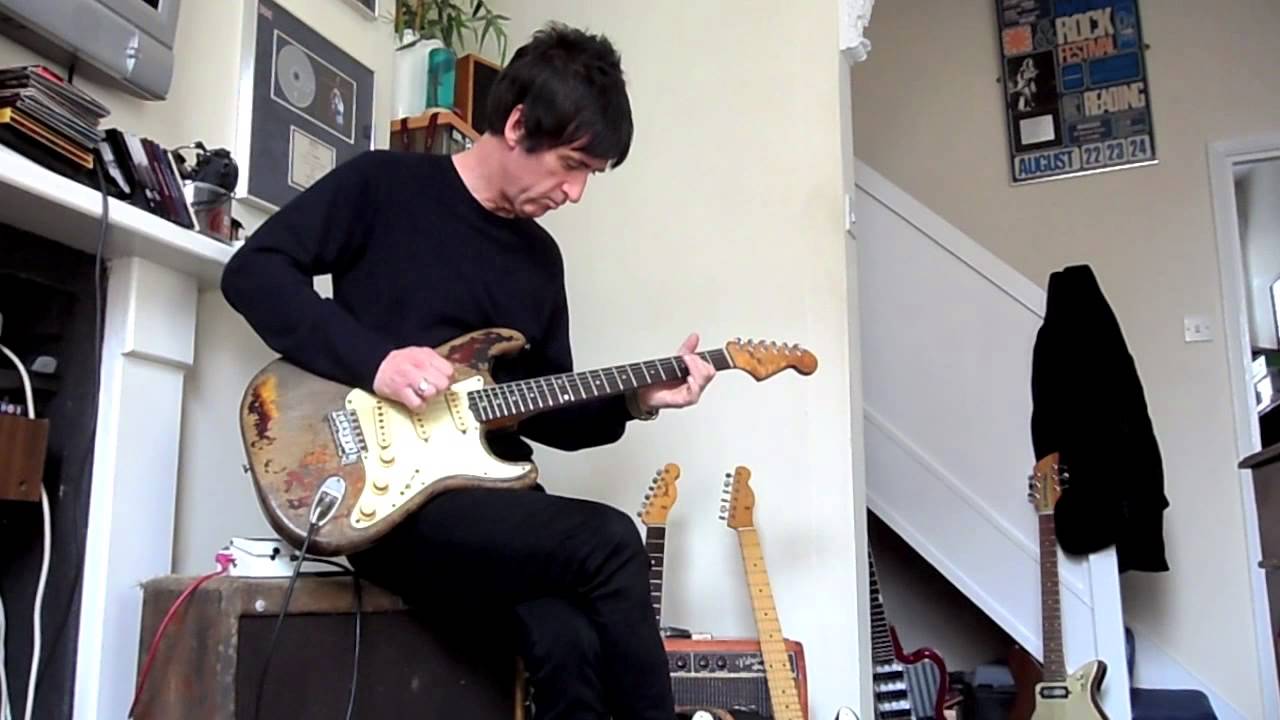
Would you ever consider bidding on a guitar yourself?
The one I really wanted was Jeff Beck’s Oxblood Les Paul. I think you have to be either a Jeff Beck freak or a guitar freak to understand the appeal. Because I’ve got a couple of mates who love rock music and it’s just a brown guitar to them. The other would be Rory Gallagher’s ’61 beat-up Strat, which I’ve had the good fortune to have played.
Do you remember how it felt to scrap for your next guitar? To sell one to afford another?
Oh, Jesus, yeah. Or swapping a guitar with somebody and hoping that it was better than yours, and that they didn’t realise that. It doesn’t seem that long ago when I was hustling – putting myself in some pretty precarious situations – to get my first proper Les Paul. So it’s not beyond me how amazing this whole thing is…
- Marr’s Guitars: The Johnny Marr Collection is held at Christie’s London on September 17.
- Johnny’s latest album The Age Of Everything is released 2 October on BMG.
- This article first appeared in Guitarist. Subscribe and save.

