

You suspect BB would smile to see it, maybe break out that warm butterscotch laugh – then give a disbelieving shake of the head at all the fuss. As Joe Bonamassa gathers the great man’s acolytes for the all-star BB King’s Blues Summit 100, it calls to mind the Charles Darwin quote that the company a man keeps is the best measure of his worth.
By that metric alone, King is a giant. And yet, to thumb through the guitarist’s back pages is to be reminded of a towering figure in his own right: not just a player who changed the possibilities of his instrument, but an instrument of social change himself.
Immortality wasn’t on the cards when Riley B King took his first breaths on 16 September 1925.
Born some 20 miles from Indianola, Mississippi, the boy’s lowly status was deepened by his parents’ separation, and when his mother sought work on a farm in the hills of Kilmichael, seven-year-old Riley grew up fast, working corn and cotton fields, snatching at strands of education and the transcendence of the Elkhorn Baptist Church.
Riley’s introduction to the guitar, too, had something of the spiritual about it. Some 80 years later, King could still picture the day a local reverend came calling and left his guitar unattended. Caught red-handed by the preacher man, King recalled his expectation of a scolding and his surprise at being encouraged to fret his first notes instead.
The field hollers were a starting point, as were the sounds of Blind Lemon Jefferson and Lonnie Johnson crackling from Riley’s Aunt Mima’s wind-up gramophone
As for repertoire, the field hollers were a starting point, as were the sounds of Blind Lemon Jefferson and Lonnie Johnson crackling from Riley’s Aunt Mima’s wind-up gramophone. No coincidence that his later style would sit squarely between them, with a third flavour from Bukka White – a cousin of his mother and a future star – who impressed the boy with his mesmerising slide touch.
Riley soon found himself seeking solace in music for intensely personal reasons, having lost his mother and grandmother in quick succession (while still scarred from the death of his two-year-old brother, reportedly from eating glass).
It fell to the orphaned 12 year old to survive alone in a cabin in the woods: a period when he withdrew from the world to silently process his grief. Mercifully, the farm owner had advanced the boy his wages, enabling Riley to buy his first guitar, a red Stella acoustic.

That instrument would be cruelly stolen, but when King joined another aunt and uncle in the Mississippi Delta, he saved for another six-string, put to good use upon joining The Famous St John’s Gospel Singers.
Soon, having secured a better-paid job as a tractor driver, Riley had the means to travel to Indianola on the weekends, soaking in the music that coursed through the city, while adding his own thumbprint as a busker.
From Farm To Stage
As an agricultural worker, Riley was ruled out of military service and by 1945 had become jaded by his life as a sharecropper. Yet it took a happy accident to get him moving. Returning from the field one day, he watched in horror as his tractor surged forward and snapped its exhaust against the barn’s doorframe. Panicking, Riley split for Memphis, the city whose fabled music boulevard, Beale Street, had appeared to him in dreams.
Already mesmerised by the electric sounds of Charlie Christian, now he picked up on Django Reinhardt and T-Bone Walker, while seeking an audience with the great harp-blower Sonny Boy Williamson II
Hooking up with his cousin, Bukka White, 23-year-old Riley found work by day and filled his evenings with music. Already mesmerised by the electric sounds of Charlie Christian, now he picked up on Django Reinhardt and T-Bone Walker, while seeking an audience with the great harp-blower Sonny Boy Williamson II, whose radio spot made him a local kingmaker.
Riley got in front of Williamson, who recommended him for a regular gig at the 16th Street Grill in West Memphis. The weekly pay was $72 (which was a leap from the $22 he’d made on the tractor), but it came with a condition – Riley had to gain radio exposure and plug the eatery on air. The logical first stop was WDIA – programmed for African-Americans – and King couldn’t believe his luck to be offered a daily 15-minute spot.
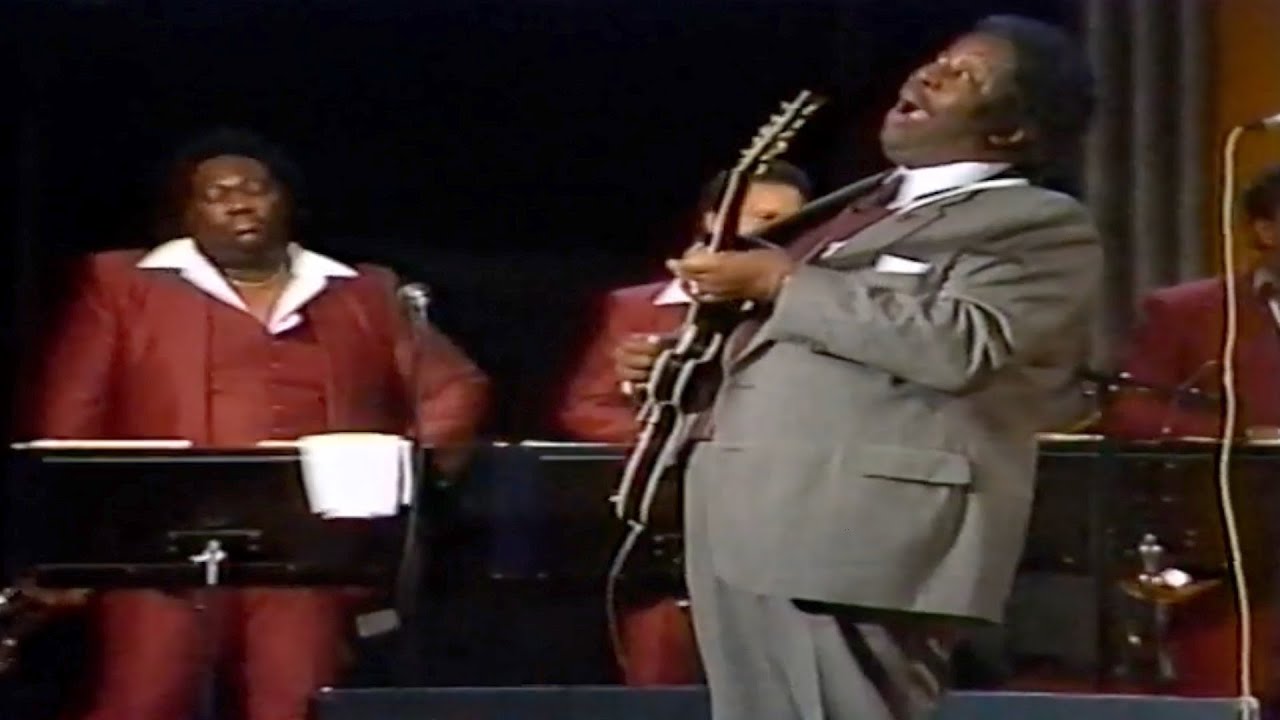
It was around this time that Riley became BB, albeit by degrees. Each of the DJs had nicknames, and the new kid evolved from ‘Beale St Blues Boy’ to ‘Blues Boy’, then ‘Bee Bee’, and finally ‘BB’.
Just as vital to his identity, meanwhile, was the first guitar billed as ‘Lucille’ (a Gibson L-30 archtop, by all accounts) after a fracas at an Arkansas nightclub.
“Two guys started to fight and one knocked the other onto this big garbage can full of kerosene,” King once told Guitarist. “When I got outside, I found out these two guys was fighting about a lady in the nightclub. [Her] name was Lucille. But then I realised I’d left my guitar inside. So I went back in for it – and I named it ‘Lucille’ to remind me not to do a thing like that again. And I haven’t!”
About Time
Through his WDIA connections, King began his recording career in 1950, cutting a few sides with little success. The breakthrough came with 1951’s 3 O’Clock Blues, supposedly tracked at Memphis’s Black YMCA using portable recording equipment and blankets on the windows to deaden traffic noise.
It gave the 26 year old his first No 1 on the Billboard R&B chart in February 1952 – 10 further singles would hit the Top 20 by 1955 – and unlocked a higher orbit of venues that King travelled between in a tourbus he proudly nicknamed ‘Big Red’.
But as the decade unfolded, rock ’n’ roll began stealing his audience, and a disaster in 1958 almost put him back to square one, as Big Red was involved in a serious collision with a butane truck near Dallas. While the musicians survived, two truckers died in the fireball, and it transpired that King’s insurance was invalid, leaving the bandleader personally liable.
IRS agents began showing up at gigs to demand money – BB claimed he was then paying himself just $75 a week
Deep in debt and robbed of the funds he’d earmarked for taxes, IRS agents began showing up at gigs to demand money – BB claimed he was then paying himself just $75 a week.
Nothing to do but work his way out of the hole. As the 60s got underway, King was relentless as a road warrior and businessman, switching to ABC Records in 1962 in the hope this bigger label could take him to the next level.
From King’s standpoint, there was nothing particularly special about the show of 21 November ’64 at the Regal Theatre in Chicago.
Uniquely, however, that concert was recorded and his 1965 release, Live At The Regal, would go on to rank among the best live albums of all time – a masterclass in one-note shiver and showmanship.
More significant for BB personally, however, was the February 1967 show at San Francisco’s Fillmore Auditorium, promoted by Bill Graham. The suburban audience gave the guitarist a standing ovation before he’d played a note, reducing King to tears; white hippy kids appreciating the rhythm and blues of a black man was entirely new territory.
King’s exposure to this new demographic came courtesy of a fresh generation of electric blues stylists. Eric Clapton had re-energised the genre in John Mayall’s Bluesbreakers; likewise Michael Bloomfield with the Paul Butterfield Blues Band.
That both of these hip young players, among others, tipped their hats did no harm for BB’s profile. Coupled with a new manager in Sidney Seidenberg – “the smartest career move I ever made” – the fruitless work and financial hardship of the late 50s and 60s were finally receding.

What A Thrill
The big pay-off came in 1970. A year earlier, King had hit the studio with producer Bill Szymczyk to record Completely Well. One track – The Thrill Is Gone, written in 1951 by Rick Darnell and Roy Hawkins – was a curveball, far from the standard I-IV-V structure. Szymczyk even added strings, marking a sonic departure for BB and giving the song true mainstream appeal.
The Thrill Is Gone duly achieved King’s highest-ever chart placing and won that year’s Grammy for Best Male R&B Vocal Performance, with the bluesman’s crossover confirmed by his appearance on The Ed Sullivan Show, reaching an estimated audience of 20 million.
With so many seminal bluesmen dying unknown in penury, it’s heartening that the second half of King’s life – from his mid-40s to his death at 89 – was an extended lap of honour. In 1971, for the first time, he toured overseas and was amazed to find pockets of fandom as far-flung as London, Japan, Australia and Africa.
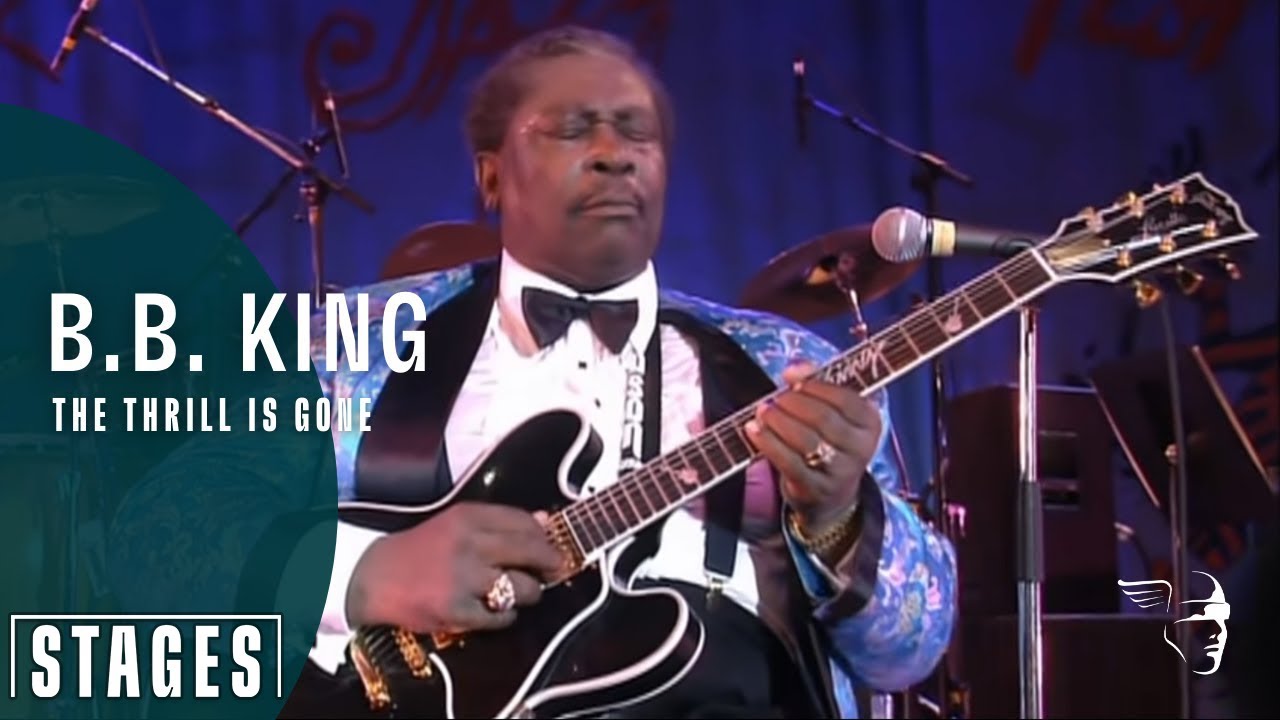
The 80s were heralded by King’s induction into the nascent Blues Foundation Blues Hall Of Fame, while Gibson honoured him with his own Lucille signature model (an ornate ES-355 without f-holes and the addition of a fine-tuning bridge).
In 1987, King accepted a Grammy Lifetime Achievement Award and was inducted into the Rock And Roll Hall Of Fame, while a year later he met a new generation thanks to When Love Comes To Town – the duet sung with Bono on U2’s Rattle And Hum. When the Irishman suggested they might bash through the song on acoustic guitars before recording, King politely demurred: “Gentlemen, I don’t do chords…”
The 90s, too, began in auspicious fashion, with the guitarist awarded a National Medal Of The Arts by President George HW Bush, before opening the first BB King Blues Club on his beloved Beale Street.
Having visited the White House a second time in 1995 to be honoured by President Bill Clinton as a Kennedy Center Honoree, two years later BB would even meet Pope John Paul II at the Vatican – and gift him a Lucille.

In truth, King’s late career was more about his shows and ceremonial role than breaking ground in the studio. Yet there were bright spots: 2000’s double-header with Eric Clapton, Riding With The King, earned double-platinum sales and a Grammy for Best Traditional Blues album (King’s second win in the category, following 1998’s Blues On The Bayou, among a lifetime haul of 15).
The sun will rise and fall and B.B. King will play the blues
Joe Bonamassa
Few of the founding post-war bluesmen crossed over into the new millennium, but for a time, BB defied his advancing years. In 2004, he was presented with the prestigious Polar Music Prize – not to mention a cool one million crowns – by the King of Sweden.
Closer to home, the following year saw officials break ground in Indianola for the BB King Museum and Delta Interpretive Center. Even 2006’s purported UK ‘farewell’ tour – with support from Gary Moore – proved nothing of the sort, with 2011’s Glastonbury Festival transported by his Pyramid Stage set.
“At times, his playing is staccato and stripped-back, punctuating songs with curlicues of melody,” wrote The Guardian. “At others it’s mellifluous and masterful, showcasing shimmering vibrato.”
But King was by then deep into his 80s, and so came a succession of ‘last times’. Four days after Glastonbury, King would play the Albert Hall and meet Guitarist for our final interview.
In 2012, he paid a last visit to the White House, performing Sweet Home Chicago with President Barack Obama on guest vocals. On 3 October 2014, he stepped offstage at Chicago’s House Of Blues to be diagnosed with dehydration and exhaustion, the eight remaining shows struck off.
King would never perform again, and died at the age of 89 in Las Vegas on 14 May 2015. The news was inevitable yet unthinkable, the sudden shattering of a tenet in all our lives as music lovers.
Writing in The Guardian, perhaps Bonamassa put it best: “The sun will rise and fall and BB King will play the blues. To say his loss is devastating to the blues community is an understatement. He defined the blues. He was the blues…”
- Joe Bonamassa on his friendship with the ultimate bluesman, B.B. King – and paying the ultimate tribute
- This article first appeared in Guitarist. Subscribe and save.

