


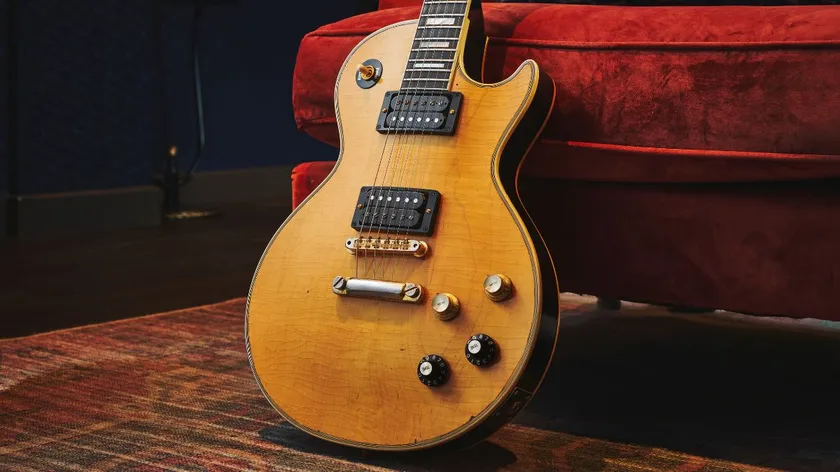


When Ginger Baker, Jack Bruce and Eric Clapton were putting together Cream in summer 1966, Eric had with him his Les Paul. This was the guitar that we now know as the ‘Beano’ ’Burst.
He’d bought it the previous year when he was a member of John Mayall’s Bluesbreakers, but now he plugged it in for Cream’s early rehearsals at a church hall in north-west London.
However, before he’d had a chance to play it in public or in the studio with his new band, it was stolen from the hall. Infamously, the ‘Beano’ ’Burst’s whereabouts remain a mystery to this day.
Eric began to seek a replacement, at first borrowing a few guitars. He used Keith Richards’ Bigsby-loaded ’Burst in July for Cream’s debut at a festival in Windsor (and a try-out in Manchester the night before). In a London club in August he played a cherry double‑cut Les Paul Special borrowed from support group The Clayton Squares.
Eventually, probably in August ’66, he bought a ’Burst from Andy Summers, the Summersburst that recently emerged thanks to Matt’s Guitar Shop in Paris. In the early months of the following year, Eric dismissed that guitar when it was the victim of an unsympathetic repair.

A New Psychedelic Fool
Perhaps he started to wonder if Les Pauls were jinxed for him, and he settled on a circa-1964 cherry-finish SG Standard – a different style, for sure, but with familiar humbuckers and control layout. Within a short time he took it to a pair of Dutch pop artists newly arrived in London, Marijke Koger and Simon Posthuma, who later started an art collective – and, briefly, a band – that they named The Fool.
Marijke and Simon painted colourful scenes and swirls all over the guitar, which Cream fans know as ‘The Fool’ guitar. Eric later called it a “psychedelic fantasy” and he played it as his main stage guitar throughout 1967 and into the summer of ’68, recording with it extensively, too, notably on much of Disraeli Gears.

On tour in America in spring ’67, Eric scooped up a few more guitars: a three-pickup 1958 Les Paul Custom, a Fender XII and a Danelectro Standard 3021. Again, he’d record some of Disraeli Gears with the Custom, and played the XII on Dance The Night Away. On a few occasions he played the Custom and the Dano on stage, but none of the three would count among his most favoured instruments.
A significant purchase came along in May ’67 when he went to Sound City in London and bought a secondhand 1956 Stratocaster, the one that later became known as ‘Brownie’. He got it just days before Cream travelled to New York City to record Disraeli Gears, heard at least on Tales Of Brave Ulysses, with its Strat-like tones and aggressive wah-wah sounding like an homage to the current king of the Strat, one James Marshall Hendrix.

Aside from sporadic uses in Cream, this Fender would later feature on stage regularly with Eric when he began touring with Delaney & Bonnie toward the end of 1969, and it was also prevalent in the studio during 1970 for his first solo album and the Layla sessions.
In his autobiography, he recalled how at age 12 he’d first seen a Strat, in the hands of Buddy Holly on a TV show.
“I thought I’d died and gone to heaven,” he wrote. “It was like seeing an instrument from outer space, and I said to myself: ‘That’s the future – that’s what I want.’ Suddenly, I realised I was in a village that was never going to change, yet there on TV was something out of the future. And I wanted to go there.”
Meanwhile, Eric hadn’t given up entirely on Telecasters: in 1968 he botched together a bound Custom Tele body and a contemporary rosewood-’board Strat neck.
During a brief visit to Denmark in February, Cream were filmed for an of-its-time movie, Det Var En Lørdag Aften (It Was A Saturday Night). In one of two scenes in which they appeared, performing We’re Going Wrong, Eric is seen with the unusual Tele/Strat hybrid.
This oddity’s most visible appearance would come in June ’69 when, now with a maple neck, it was his main guitar throughout Blind Faith’s debut concert in London’s Hyde Park.
A further acquisition on a US Cream tour arrived in April ’68 in the reverse-body shape of a 1964 Gibson Firebird I. At the time, Firebirds were not considered to rank among the front-running Strats and Lesters and Teles that many prominent guitarists of the day treasured. But the Firebird was nonetheless a useful instrument, and his single-pickup model turned up on stage during the band’s farewell dates later in the year.

More Les Pauls and a 335
Eric could be generous with guitars to his friends, and the most famous example concerns a Les Paul he gave to George Harrison. It was a ’57 Goldtop refinished in cherry that George would name ‘Lucy’ and use on several ‘White Album’ and Abbey Road cuts.
In September ’68, he asked Eric to play the recent gift once more, on While My Guitar Gently Weeps, an event that saw Eric become the only non-Beatle to play a guitar solo on a Beatles record.
The cherry-refin Goldtop had been owned by Rick Derringer, guitarist in The McCoys, and before that by John Sebastian of The Lovin’ Spoonful. Derringer decided the guitar was so beat up it could do with a fresh new finish and, living not far from the Gibson factory, he delivered it there in the mid-’60s with instructions to paint it with an SG-like cherry finish.
When he got it back he felt its quality had suffered in the process, so he traded it for another guitar at a New York City store – which is where Clapton acquired it, and Clapton in turn gave it to his Beatle chum.

Toward the end of ’68, Eric acquired his third Les Paul ’Burst, which he used occasionally on stage during Cream’s farewell tour. This one, too, did not last long, going to Paul Kossoff in a trade when Free supported Eric’s new band, Blind Faith, the following summer.
Another key purchase that most likely took place in late ’68 concerned Eric and his 1964 ES-335. Why “most likely”? There’s been speculation about when he got the 335 thanks to conflicting claims and a tangled history.
Eric was seen with this guitar on Cream’s final farewell dates at the Albert Hall in London, and he kept it until selling it in 2004 at one of his Crossroads-benefitting auctions. Eric recalled then that he’d bought it when he was still with The Yardbirds.
While there were certainly a couple of 335s around in that band – mostly played by Chris Dreja – specs and serial numbers and shipping dates prove that neither was the one Eric played in ’68.
Photographer John Peden snapped Eric at a San Francisco Fillmore gig in summer ’67 where, as one might expect, he played the psychedelic SG… but also apparently a red ES model, possibly a 335.
More recently, Jerry Donahue has said he sold the Albert Hall 335 to Eric a few weeks before the London shows of the farewell tour. At the time, Jerry was still an up-and-coming guitarist – this was before he’d played with Fairport Convention, Joan Armatrading, The Hellecasters and others – and he had a day job working at the Selmer music shop in London.
That leaves three possible scenarios. The first is that Eric bought the Albert Hall 335 in 1964 while in The Yardbirds, never played it at the time but instead kept it hidden away for years, only pulling it out for a gig at the Fillmore in ’67. Then he put it away again until the London gigs. But why would he go so long without using what is clearly a great guitar?
The second is that he bought the Albert Hall 335 in San Francisco in 1967, played it on one gig, and then squirrelled it away until the London shows. Same question: why would he ignore such a great guitar for so long?

The third scenario seems most likely, that Eric bought the ’64 Albert Hall 335 from Jerry at Selmer in 1968, a few weeks before the London shows. But a four-year-old guitar? Well, we know that Eric had a taste for used guitars.
He really liked it, the feel, the sound – it was perfect. Certainly, it took no time at all for him to get his wallet out
Of the dozen Cream-era electrics itemised in this feature only one, the Electric XII, might have been new – but even that could well have been secondhand. He was so taken with the benefits of budget-friendly used guitars that when he sat down with a ’60s interviewer who wanted to hear some tips for guitar buyers, Eric said that he’d recommend seeking secondhand instruments.
He gave his reasons: such instruments are “broken in and easier to play”, he insisted, and “the older the guitar the better it seems to have been made”.
Jerry Donahue recalled a happy Eric as the deal was sealed at the Selmer shop for that lovely ES-335.
“He really liked it,” Jerry said, “the feel, the sound – it was perfect. Certainly, it took no time at all for him to get his wallet out.” Even when you’re God, sometimes it’s impossible to resist the lure of a potentially great guitar.
- This article first appeared in Guitarist. Subscribe and save.
