

Guitar World Verdict
This is a great place to go for an authentically full-fat Mustang experience – and the new Mid '60s pickups are a big part of the appeal here, alongside the evocative looks and feel of Fender's golden era.
Reasons to buy
- +
One of the most inspiring and addictive middle positions around from well voiced pickups.
- +
The dark rosewood neck with clay dots look great.
- +
The most affordable and authentic '60s Mustang take with Fender on the headstock.
Reasons to avoid
- -
Spring adjustment required on our test model – keep in mind this can be part of the Mustang experience.
- -
Frets could have done with more of a polish.
- -
The authenticity of the headstock decals over the finish won't be to everyone's liking.
You can trust Guitar World Our expert reviewers spend hours testing and comparing guitar products so you can choose the best for you. Find out more about how we test.
What is it?
Is it a hot take to suggest the Mustang is Fender’s most underrated guitar? Often overlooked in the release schedule over its larger-bodied offset siblings, the Jazzmaster and Jaguar, the Mustang is nevetheless a crucial design for Fender. Like the Jaguar, it’s a short scale, but a smaller-bodied single-cut.
Designed as a student guitar by Leo Fender and introduced in 1964, its potential for younger beginner players is still significant as a result of the compact dimensions and easier bends from the shorter 24" scale compared to the Strat, Tele and Jazzmaster's 25.5". The Squier Bullet and now Sonic series Mustang models have been a testament to that continuing appeal, but for me, the Mustang isn’t just an excellent 'beginner guitar' option; it’s my favourite Fender.
Both my main guitars are hardtail Fender Player Mustang models, and the dimensions of Leo's design just feel right for me. To be honest, I wish I'd come around to it sooner.


I’ve modded my own guitars’ specs to my own taste around that core appeal – the modular nature of Fenders is always good for that. But when I saw the Vintera III Mustang update on the review slate it was a great chance to get back to a real Mustang that echoes a golden era ‘60s spec. A time long before Kurt Cobain's patronage gave the Mustang a much-deserved reappraisal.
Still, the model remains strangely under the radar even within Fender's own walls – I'm somewhat surprised to report at the time of writing this review that with Performer models phased out, the company doesn't currently have a US-made Mustang in its production model catalogue. Isn't that odd?
So the pressure is on for the Vintera III to deliver, but what’s notable about this iteration that the previous iterations didn’t quite grasp?
We’re at the very genesis of the model that was launched in August 1964… mostly
In short, it’s truer to the inspiration. Vintera III models are now honing in on specific eras within the decade they take inspiration from – and that means specs reflective of that. And for a mid-‘60s slant on the Mustang, we’re at the very genesis of the model that was launched in August 1964… mostly.
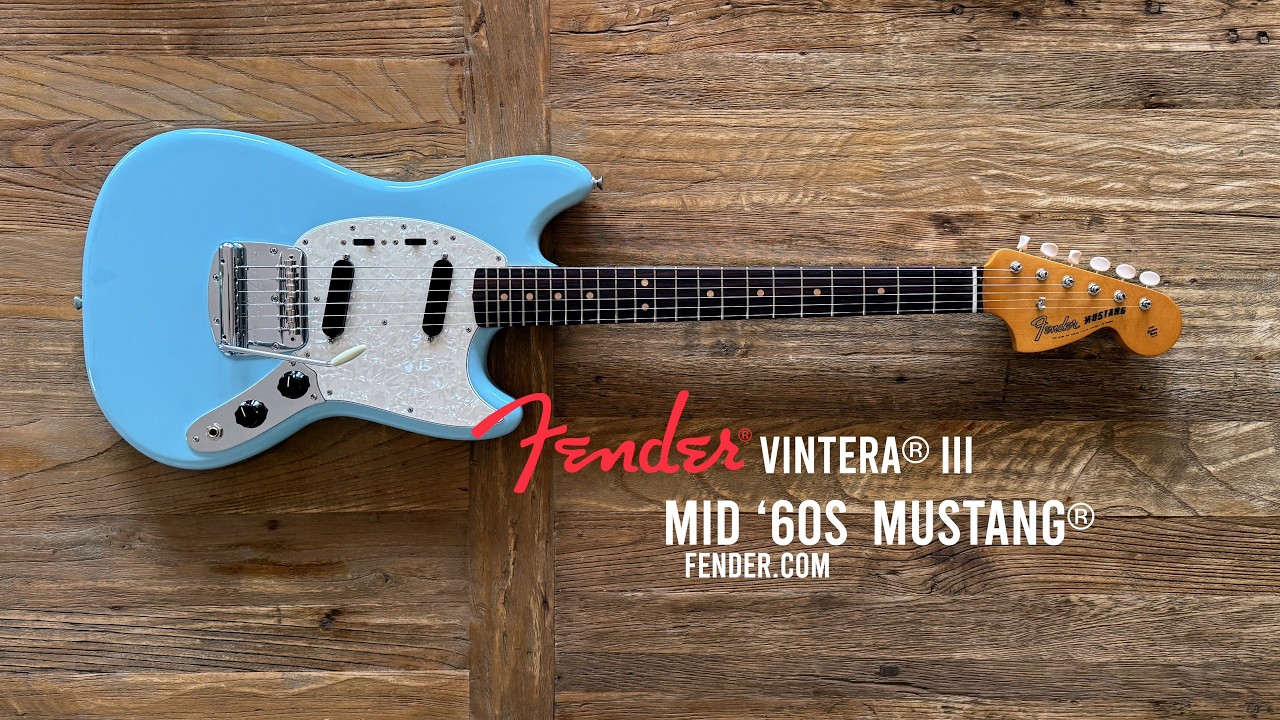
We’re moving beyond just the standard Mustang 24-inch scale and vintage 7.25” radius and vintage-tall frets here with ‘mid-’60s’ pickups and neck profile, and even true-to-era Fender decals added on top of the headstock lacquer. The rosewood fingerboard gains the unmistakable vintage vibe of clay fret dots too. This being a Mustang, there’s much more going on elsewhere too.
Specs

- Launch price: $1,249.99 | £1,029 | €1,199
- Made: Ensenada, Mexico
- Type: Six-string solid-body single-cut electric guitar
- Body: Alder
- Neck: Maple, Mid '60s C-shape, gloss urethane
- Fingerboard: Laminated rosewood
- Scale length: 24" / 610mm
- Nut/width: 42mm / bone
- Frets: 22, Vintage Tall
- Hardware: Vintage-style tuners with vintage white buttons, six-saddle vintage-style Mustang tremolo, four-ply tortoisehell pickguard
- Electrics: Vintage-Style Mid '60s Single-Coil Mustang bridge and neck single-coil pickups, master tone and volume controls, two on/off slide switches (one for each pickup)
- Weight of test model: 7lb/3.17kg
- Left-handed options: N/A
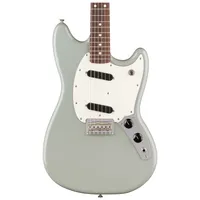
- Finishes: Dakota Red, Sonic Blue, Olympic White (as reviewed)
- Cases: Padded gig bag
- Contact: Fender
Build quality

Build quality rating: ★★★★☆
I personally think we have the choice finish of the three here. The options reflect the initial trio available at the Mustang's original launch with Sonic Blue now replacing the 1964 Daphne Blue, alongside Dakota Red and Olympic White. While purists may argue the pickguard should be a lighter, brighter red for vintage authenticity, I really like the darker burgundy tortoiseshell shades here. If anything, it looks a little more lived-in and well… vintage.
While the originals were first offered by Fender in two scale length options with 22.5" (like the existing Duo Sonic and Musicmaster student models) and the Jaguar's 24" – with the latter soon winning out as the popular choice. The Fender logo here is the transitional type from that time, in the gold with black outline style. And while the decal being stuck over the finish may look jarring to some, it is vintage correct. As are the off-white plastic tuner buttons.

The bridge cover from 1964 is absent here, a '60s idiosyncracy with Fender models there's little demand for now, but aftermarket spares can cater for. The nut is bone – a step up from the Vintera II's synthetic example. Again, true to the vintage era.
The fingerboard is round-laminated rosewood rather than slab here. This allows for the radius to be followed at the top and bottom, rather than just the slab's top. There's less mass of rosewood with laminate, which means – in theory – that this Mustang might sound brighter than a Vintera II equivalent. But you know the score with electric guitars – there are so many variables at play elsewhere, it's difficult to prove in this kind of testing situation.
I am immediately drawn to the dark rosewood and clay dots – it has all the vintage vibe I'd hope for, but it really needs a feed of lemon oil. While this isn't uncommon for guitars coming out of storage and varying conditions of humidity before they reach us for testing, the frets looking like they need a polish is less forgivable. It's taking the closet classic fantasy a bit far.
Still, that coffee dark fretboard really does make my Player II Mustang's rosewood look disappointingly caramel by comparison. Lovely stuff.
The dot placement draws from the '64 pre-CBS era but, more noticeably, the headstock does not – it's the larger late '65 shape . So the 'mid '60s' period is very much reflected here, rather than a specific year. This may not to everyone's taste, but Fender certainly isn't misleading anyone with the name.
At 7lbs, this test model is definitely bang on an ideal alder Mustang weight for me – my own Player II is half a pound lighter but that's without a floating tremolo system. However, looking at the stock Sweetwater has at the time of writing, this example is one of the lightest, though there's not much in it.
Apart from the frets and a tremolo issue I'll talk about next, fit and finish are sound. Would I have liked to see a nitro finish for a truer vintage reflection and much more desirable aging over time? Absolutely, and it would have bumped the price up a bit for sure, but I'm a little frustrated that nitrocellulose is only being rolled out on relic'd Road Worn Mexican-made models right now. However, this is Olympic White is very well delivered and is in the right territory of some vintage examples I've spotted.
Playability

Playability rating: ★★★★☆
I personally don't go in for sweeping statements when it comes to radius and suitability for certain styles of playing
There are a lot of opinions about what a 7.25" radius neck is good, and not good for when it comes to guitar playing. John Mayer entered the chat recently to stir the pot with some sound reasoning, but the fact is, our tastes, styles and hand sizes are all so different. So, I personally don't go in for sweeping statements when it comes to radius and suitability for certain styles of playing.
I do, however, have a period of adjustment whenever I go from my usual 9.5" Mustang modern C necks to this kind of vintage spec. The last time was for the Mike McCready Strat review for our sister site MusicRadar, and I really came around to the charms of a rounder radius. I certainly didn't find bending an issue with it.
The action is higher than I'd like on this test guitar at 1.8mm clearance from the low E and, more surprisingly, 1.85mm from the high E. After checking the truss rod relief and finding all is well (thankfully too, as this is vintage spec with the truss nut at the bass of the neck requiring neck removal), I decide to tweak the string action more to my liking.
Unlike my own Player Mustangs with block steel saddles, the six-barrel examples here aren't individually adjustable in height. It's a case of bass and treble bridge height adjustment with one of the three included allen/hex keys and a quick process even with a cautious approach of small changes. Because of the rounder 7.25" radius I'm careful not to go as low as I would with my 9.5" Fender necks and soon find a pleasing compromise.

Unsurprisingly, those frets feel a little scratchy at first but soon play in, and there's no getting around the fact that a short scale and this radius will be too cramped for some players. But equally, it will be a great fit for many, and a Goldilocks scenario for some smaller-statured players with smaller hands. At the end of the day, this is a vintage spec and of course, other options are available.
I prefer bending on a 9.5" radius, but I found myself coming up with more arpeggiated parts with this Mustang because of the ease of more complicated shapes. It feels like a deeper, more rounded C than modern Mustang necks I've played (at the first and 12th fret I measure the depth at 21.3mm and 23.4mm on the Vinter III vs 20.8 and 22.4mm with my calipers on my Player II's Modern C carve), but the lighter 9-gauge strings it ships with definitely help it feel friendly. Most experienced players will want to move to 10s on a short scale like this, or even 11s.
My testing with Vintera III Mustang covered a really strange period of weather in the United Kingdom – from 15 degrees up to the hottest June day on record here at 36 degrees. While my Player Mustangs with their hardtail bridges and fairly springy tensions with 10-gauge strings were surprisingly solid through it all, this Vintera was a challenge. And that's with light tremolo use - though that kind of more subtle wobble is what this type of tremolo is really meant for unless you want to be tuning every between every song, or even solo .

A safe bet would be that the floating tremolo needs calibrating. Not uncommon and often part of the deal with this design – and the 'cigar bar' for the tremolo leaning back, as you can see in the pic above, suggests that is the case. The strings tremolo plate needs to be removed for access to do this. But it has to be done to fully enjoy the sensitivity and thrills of the tremolo here without gritting your teeth in tuning anxiety every time.
It's worth mentioning that the floating design here requires a hex key to fit, adjust and remove the tremolo arm from the cigar bar every time – so keep a spare handy!
Sounds

Sounds rating: ★★★★★
The obligatory Mustang controls recap is needed here – the pickups are selected and turned off with a pair of three-way switches above them. In the middle the pickups are turned off (no sound), when either is switched left or right they are activated. Switch them both to the left or right together and they're in phase, switch one to the left and one to the right (it doesn't matter which as long as they're both opposites) and they're out of phase.
This out-of-phase position is the least desirable of the options for me. But it's not undesirable either. The low-end drop and reduced output does have some lo-fi charm and useful application for strumming. Especially when contrasted with the other positions.

The Mustang is not a short-scale Strat in tone, it's distinct – in a good way too. And it's just as much an iconic Fender sound for me as its more popular siblings. I'm going to go all-out and say the in-phase position is my favourite 'middle' position on any Fender, and my experience here only highlights that further.
Mustang single-coil pickup polepieces are usually flat, not the staggered heights of a Strats and the Tele's bridge. The result is a finer balance between the strings, certainly to my ears, and it brings detail to chords I find immensely satisfying. I've also found it makes for a great pairing with the addition of a P-90-sized Firebird bridge pickup in one of my Mexican Player models. However, I should note for all you potential modders out there that unlike the Player models, this Vintera III is only routed for single-coil-sized pickups.
Throwing a touch of plate reverb and some light harmonic tremolo is such an inspiring sound, I think it could convert Mustang newcomers
For a change, I start on the neck pickup and soon start sighing - there's an added dimension here that my own Player II's neck pickup doesn't have. And I really like that pickup. The round, focused response I love is there, but it's sharper and livelier. I'm an instant fan, the strings ring out for chords so fully, and throwing a touch of plate reverb and some light harmonic tremolo is such an inspiring sound, I think it could convert Mustang newcomers.
It's not the instantly identifiable strat spank, but a very interesting alternative that's more adaptable to my ears. It bodes well for further investigation.

I've found bridge pickups on some Mustangs to be quite gnarly affairs, requiring bespoke dialling on the tone control, and sometimes the amp, to get the best out of them. While I chose to swap out the bridge pickups on both by own Player Mustangs for Sunbear Soapbird P-90-size Firebird humbuckers, what I find with the Vintera III gives me some pause.
A guitar that would be a vibrant tool in a power trio, or a dynamic foil alongside a second, humbucker guitar player
The twang and snap I expect has that fullness again and yes, I do reach for the tone control to dial the top off things a little, but I find a voice that's meatier under overdrive than I expected through a clean Princeton and then a Neural Plexi model with my trusty little Wampler Tumnus. The volume control proves super responsive with these setups, revealing a guitar that would be a vibrant tool in a power trio, or a dynamic foil alongside a second, humbucker guitar player.
It's not really a surprise to find the highlight is the 'middle' in-phase position here. A shimmering sound for strumming chords that really laps up light modulation – a Boss CE-2 and Crowded House's Don't Dream It's Over intro and Johnny Marr's Smith arpeggios are addictive stuff here! It's a sublime and expressive experience for Knopfler-esque fingerstyle too, responding sensitively.
As I mentioned earlier, the out-of-phase option is a wiry, lo-fi and lower-output voice in comparison. Though hanging back in a mix or as a contrast in an intro or passages before kicking back into one of the other three voices, it could find useful favor.
Verdict

The third-generation additions make it distinct and perhaps the most focused Vintera Mustang we'll see
There's a lot to like about the latest addition to Fender's more affordable vintage-spec'd range, a reminder of why it remains my favourite Fender model. The third-generation additions make it distinct and perhaps the most focused Vintera Mustang we'll see unless the company decides to hone in on specific years for the next iteration.
A couple of setup issues with this test model notwithstanding, this is a persuasive showcase of Fender's dark horse model if you want vintage spec without the eyewatering price tag.
GuitarWorld verdict: This is a great place to go for an authentically full-fat Mustang experience – and the new Mid '60s pickups are a big part of the appeal here, alongside the evocative looks and feel of Fender's golden era.
Test |
Results |
Score |
|---|---|---|
Build quality |
Lovely looking dark rosewood neck and off-white finish, only let down by frets that just need an extra polish. |
★★★★☆ |
Playability |
The short scale / 7.25" radius is definitely not universal appeal but it's true to era, and the slightly deeper C helps the transition. Tremolo springs needed adjustemt though. |
★★★★☆ |
Sounds |
Superb - I think the pickups could win more players round to the Mustang cause, with a wonderfully expressive middle position |
★★★★★ |
Overall |
One of Fender's strongest Vintera offerings to date and the obvious step up from Squier's Classic Vibe. Long live the Mustang! |
★★★★½ |
Also try
Hands-on videos
Crutchfield

Audiomo Music

Brent Kingman