Guitar World Verdict
This punchy little amp is a more serious tool than it might seem at first glance – just make sure you are happy to embrace its high core-quality and simple but purposeful, performance-focused feature set.
Reasons to buy
- +
Warm, woody acoustic tone.
- +
Integral, rechargeable battery for busking.
- +
Compact, portable size and weight.
- +
Ideal for self-accompanists.
- +
Bluetooth music player.
Reasons to avoid
- -
A little light on features.
- -
More treble on tap would be nice.
- -
Touch pricey given the above.
You can trust Guitar World Our expert reviewers spend hours testing and comparing guitar products so you can choose the best for you. Find out more about how we test.
What is it?
Smaller amps seem to rule the roost these days – definitely in the electric guitar world but also when it comes to acoustic guitar amps too. With acoustic guitars, however, if you’re using an amp it probably means you’re actually going to perform for some kind of audience beyond your bedroom.
Busking is still the most common way people get into performing live with an acoustic, but busking’s close cousins (as activities) are performing in small bars and coffee shops or quick rehearsals in your kitchen or lounge.
Those kinds of scenarios seem to be the target of the latest amp from Orange – better known for its rip-snorting tube amps – though the announcement that it is a collab project with Ed Sheeran was certainly a bit of a surprise. So what do we get?
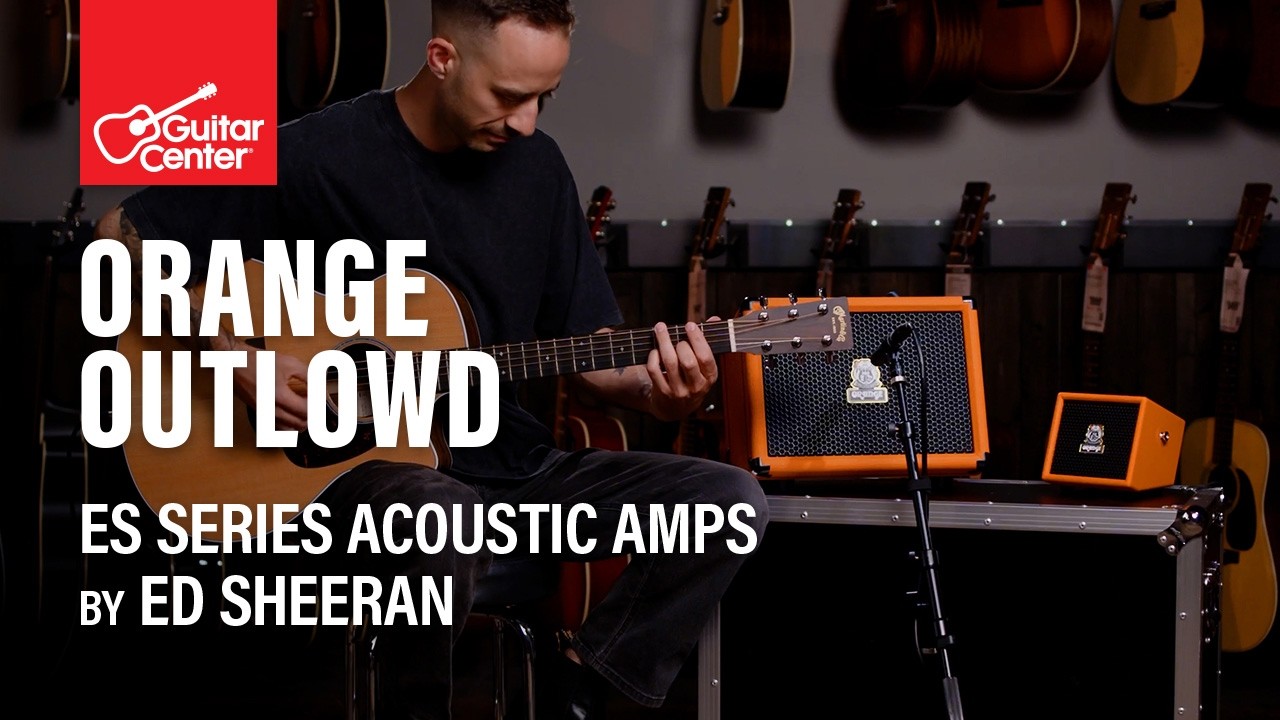
The Outlowd ES60, whose portmanteau name hints at Sheeran’s other big partnership with Lowden guitars, is a 60-watt combo that can be powered by mains supply or the internal Li-ion rechargeable battery.
This is an upgrade over the numerous AA-size batteries required by busking-ready rivals such as the Boss Street Cube II – though let it be said, the Boss puts out only 10 watts and is considerably cheaper than the ES60, so you’d rightfully expect the Orange to have a beefier solution to al fresco power built in.
A compact, lightweight combo at just over 7kg and only around 28cm high and 30cm deep, it meets its first brief of being the kind of thing you could carry on a bus or on the subway – and it’s padded, quality gigbag with shoulder strap hints at serious have-guitar-will-travel ambitions.
In the US, this model is available exclusively through Guitar Center and Musician's Friend.

The ES60 is a dual-channel design, with one channel clearly intended to plug your guitar into and featuring a high headroom preamp based on that of the Orange Acoustic Pedal. This guitar channel features volume, Treble control, a flexible Mids EQ section with dedicated controls for adjusting ‘Q’ and the centre frequency of the mids, plus Bass and a hall-type Reverb.
Over on the second channel there’s a combination jack/XLR input for a vocal mic or alternate sound source, 48v phantom power switch for use with mics that need it, a high-pass filter switch to take the woof out of vocals, plus an EQ, Volume and, here, a plate-style reverb that’s meant to be optimized for vocals, a Mids EQ section similar to that of Channel One – though minus the ‘Q’ control – and a channel level control labelled Gain rather than Volume.

Round the back we’ve got an XLR line out, so the amp can run straight into a powerful PA rig while giving you local control over EQ and so on, a Ground Lift button, plus an FX loop if you want to expand the tonal palette and sonic capabilities of the combo.
In short, the ES60 sets its sights on enabling serious performance rather than casual, hobbyist play – which may justify, to some degree, its slightly austere lack of extra onboard effects that rivals often offer.
Moving back up to the top panel there’s a button for pairing the combo with Bluetooth devices for music playback – useful when rehearsing songs and, of course, if your performance makes use of backing tracks – plus 1/8-inch headphone and line-in sockets if you need them.
Specs

- Launch price: $699 (exclusively via Guitar Center and Musician's Friend) | £499 | €599
- Type: 60-watt RMS solid state acoustic combo
- Origin: China
- Output: 60 Watts RMS
- Speaker: 8-inch Voice Of The World ‘Whizzer’ speaker
- Channels: TwoControls: Ch 1: Volume, Treble, Middle, Q, Mid-Freq, Bass, Reverb; Ch 2: +48v Phantom Power Switch, HPF Switch, Gain, Treble, Middle, Mid-Freq, Bass, Reverb; Master: Volume
- Connectivity: 1/4" jack Input, Combi XLR /1/4"Jack Input, Balanced Line Out (XLR). Effects Loop 1/4" Send & Return, Aux Input 3.5mm Jack, 3.5mm Headphone Output
- Footswitch: NoWeight: 16.18 lb / 7.34 kgDimensions: 355 x 280 x 295mm / 14 x 11 x 11.6”
- Contact: Orange Amplification
Build quality

Build quality rating: ★★★★½
The ES60’s angled cab feels chunky and robust. Impressively, it’s made from 15mm birch plywood rather than MDF or similar, underscoring the combo’s roadworthy credentials. The control knobs and switching feel positive and avoid flimsiness.
The fact the Bluetooth pairing button is metal not plastic is a nice touch, too. The chunky top-mounted handle is more than tough enough to lug the amp about on, given its light weight.
Usability and features

Usability and features rating: ★★★½
In terms of usability, the feature set on both channels is relatively straightforward though there are some quirks.
The Mid-freq and Q controls work as a double act in terms of tailoring the amplified voice of the guitar but do feel very slightly vague in operation – the Q effect certainly isn’t dramatic, though you could argue that allowing the player to apply gentle tweaking to the mids to match personal taste is completely valid and maybe more practical in the real world than making those controls overpowered.
If they’d called the two controls ‘sweetness’ and ‘focus’ it might make more intuitive sense as a subtle but audible rounding, opening or tightening of the mids is really what’s going on here. It grew on me the more I used it.

The Treble control really could have more authority, though - while I like the woody, warm voice of the amp, it would be nice to have just a little more crystalline edge on tap here to provide clarity and snap.
Bluetooth pairing is easy and intuitive and the Reverb couldn’t be simpler with just one Hall-type reverb on offer on the guitar channel, though the upper limit of the ‘verb is tastefully atmospheric rather than cavernous.
With rivals such as the aforementioned Boss Street Cube II or the Laney A-Fresco 2 offering additional effects such as chorus and more, you will either view the ES60s feature set as admirably straightforward with little to confuse you during performance – or a bit sparsely equipped.
Sounds

Sounds rating: ★★★★½
Plugging in my Beard Decophonic Southside with magnetic LR Baggs M1 soundhole pickup and my Martin Custom 000-14 (with an unknown but good-sounding under-saddle piezo system fitted by a previous owner), the roundness and warmth of the ES60’s sound is genuinely flattering and easy on the ear.
I may instinctively want a little more treble to be available but there are no unpleasant or unsatisfying sounds here, especially with the wiggle room for fine adjustment offered by the Mids controls – if Sheeran’s part in the project was to help dial in a very pleasant, usable overall sound, I’d say he did a great job.
The mic channel was similarly warm, supple of tone and usable with my test Shure SM57 and the few frills on offer didn’t hinder me from thinking the combo is a very capable tool for street performance and playing small venues.
Verdict

The ES60 is a purposeful and roadworthy acoustic / street performance tool that has a really attractive sound. It feels curiously over-specced in some areas and under-specced in others.
It does face some keen competition at this price and below and you can’t help but wonder how much that famous moniker alone is adding to the hangtag price.
And, let it be said, it does face some keen competition at this price and below and you can’t help but wonder how much that famous moniker alone is adding to the hangtag price.
But if you view it as a piece of no-nonsense, capable kit with an emphasis on core quality rather than a showy spec sheet bursting with gimmicks it makes solid sense.
Guitar World verdict: This punchy little amp is a more serious tool than it might seem at first glance – just make sure you are happy to embrace its high core quality and simple but purposeful, performance-focused feature set.
Test |
Results |
Score |
|---|---|---|
Build quality |
Solid, purposeful build with real plywood cabinet gives a pro feel. |
★★★★½ |
Usability and features |
The features are simple to access and use but some controls lack authority. |
★★★½ |
Sounds |
Warm, punchy and admirably easy on the ear, it’s a sweet-sounding amp – especially for a battery powered unit. |
★★★★½ |
Overall |
There is a lot of competition for the title of "ultimate busking amp" but the tones are compelling. |
★★★★☆ |
Also try
Hands-on videos
Orange and Ed Sheeran

Thomann

Guitar Center