Guitar World Verdict
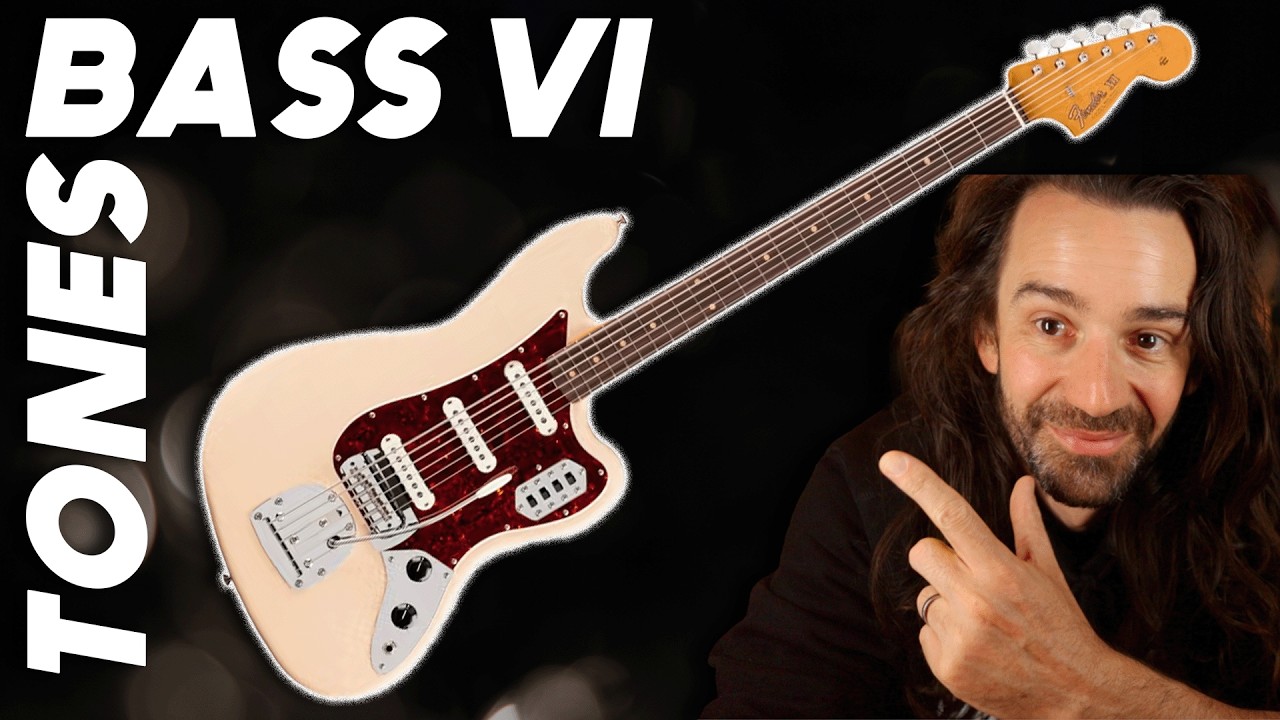
Ambitious in its vision, flawed in its execution, the Vintera III Early '60s Bass VI is an ode to the oddball offset that has become one of Fender's most enduring cult classics. There are some nice tones on tap, and the difficult marriage between guitar and bass is largely successful, but there are some glaring issues that seriously hamper the overall experience.
Pros
- +
Unique design that offers something different and inspiring
- +
Good playability for a guitar/bass hybrid
- +
Nice tones when dialed in in the right setting
Cons
- -
Those bridge saddles are really bad
- -
Can be tricky to wrap your hands around
- -
Not that practical, won’t be for everyone
You can trust Guitar World Our expert reviewers spend hours testing and comparing guitar products so you can choose the best for you. Find out more about how we test.
What is it?
In the annals of cult classic Fender offsets, the Bass VI – an oddball, six-string guitar/bass hybrid – is probably up there as one of the most recognizable and widely beloved. This is, after all, the instrument that was championed by John Lennon and George Harrison. Robert Smith used it with The Cure. Joe Perry, Jack Bruce, Jet Harris… the list of notable Bass VI fans goes on.
What makes the Bass VI so intriguing is its mashed-up design brief. Look at it from a distance, and it resembles a Fender Jaguar with a third pickup. Get up close with one, though, and you’ll realize it’s anything but. Instead, it’s a de facto six-string bass guitar, but proportioned accordingly to resemble the feel, style and playability of a conventional electric guitar, tuned to standard a whole octave down.
The result? A truly unique build that feels both familiar and alien at the same time – something that isn’t quite a bass guitar, nor is it anything like your standard electric guitar. It all makes for interesting reading on paper – and an interesting playing experience when you have one in your hands.

But for all its big-name players, the Bass VI has remained something of an enigma in Fender’s inventory. It’s seemingly both the guitar that every curious string-plucker wants to try, yet at the same time one that is lesser-spotted due to its on-off inclusion in Fender's catalog.
Thankfully, as part of the bumper Vintera III launch earlier this, Fender rolled out what we have here: the Vintera III Early ‘60s Bass VI.
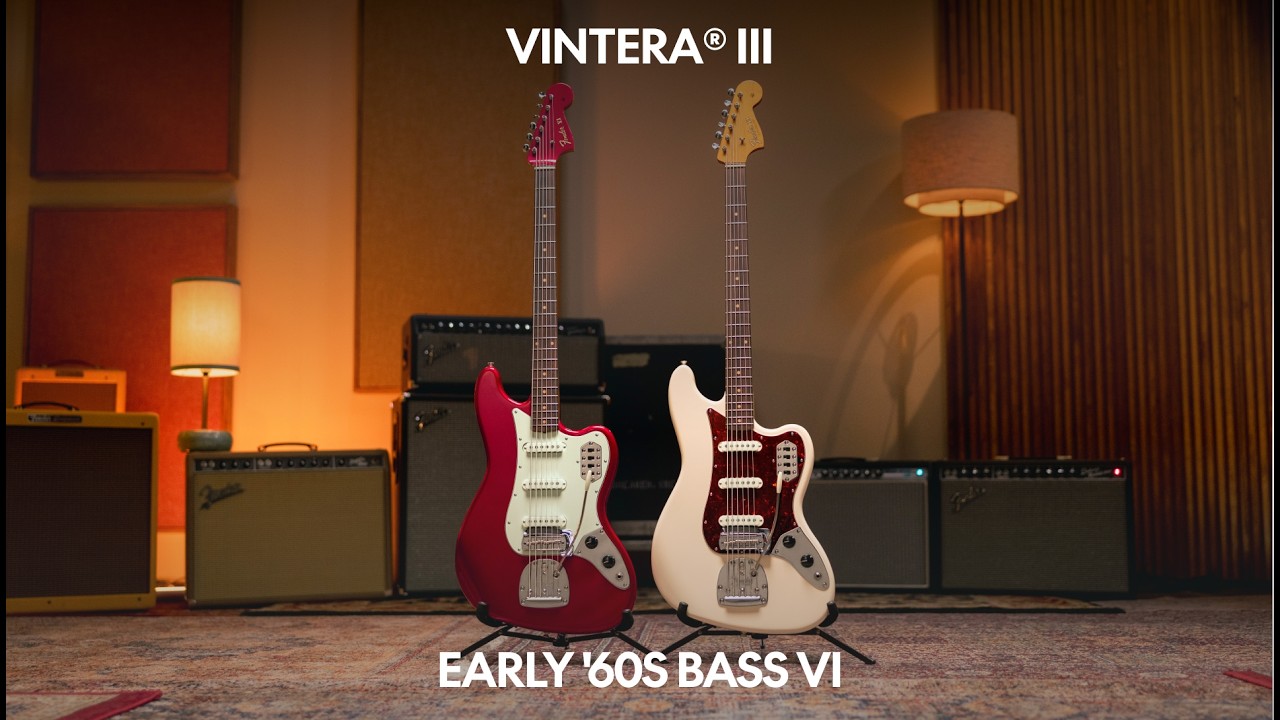
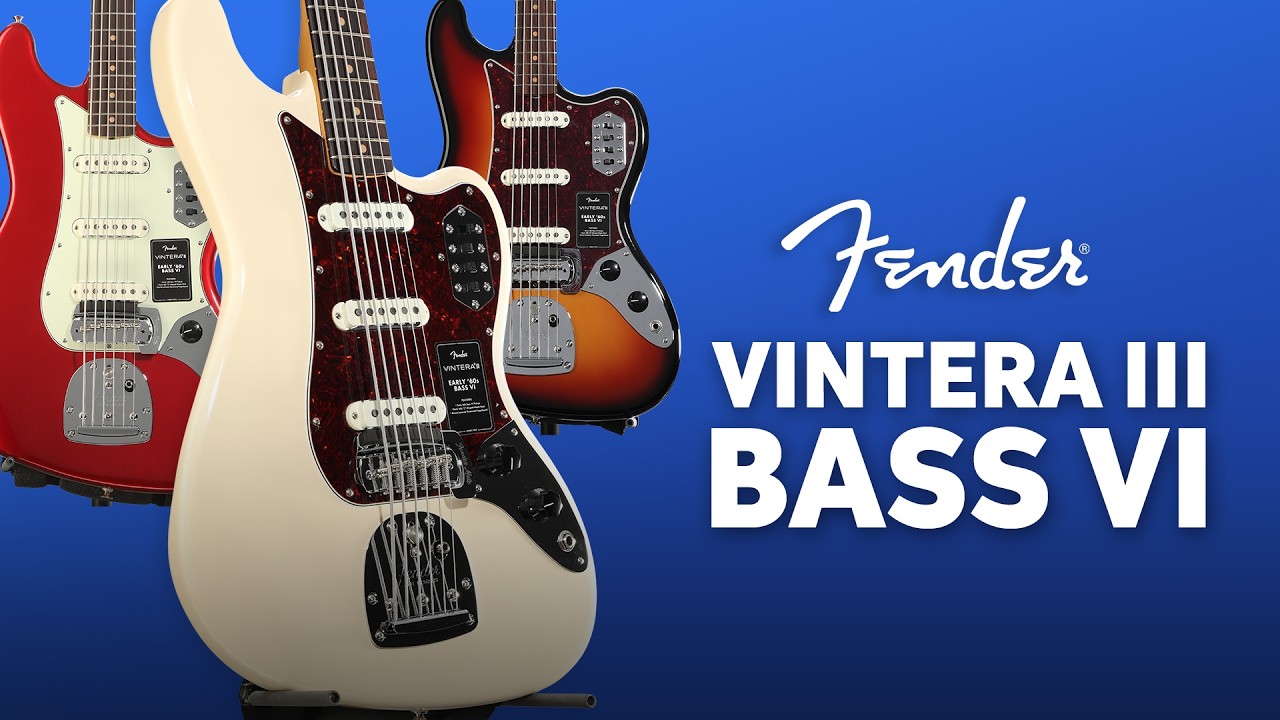
Available in 3-Color Sunburst, Olympic White and Candy Apple Red, this Bass VI is said to be a faithful reissue of the original, with specific ‘60s Bass VI pickups, a floating tremolo, and other “era-correct details”.
We’ve seen a few reissued Bass VIs in the past – Fender Japan relaunched a version in the '90s, Fender's Custom Shop honored it in the '00s before production models in the Pawn Shop (2013) and Vintera II (2024) saw it join the line-up once again.
Along the way, Fender has offered a more affordable version - in the Squier Classic Vibe Bass VI, indeed, it eclipsed the Precision Bass as Fender's best-selling low-ender of 2022. Currently, though, (at least on paper) the Vintera III version is the best new Bass VIs money can buy. But just how good is the ‘best’?
Specs

- Launch price: $1,499 | £1,249 | €1,449
- Made: Mexico
- Type: Six-string electric guitar / bass guitar hybrid
- Body: Alder
- Neck: Maple / Early '60s "C"-Shaped Neck
- Fingerboard: Rosewood, round-laminated / 7.25" radius
- Scale length: 30" / 762mm
- Nut/width: Bone / 42 mm
- Frets: 21
- Hardware: Vintage-style tuners / 6-saddle vintage-style adjustable bridge / “Floating” tremolo w/ pop-in tremolo arm / Fender rubber mute system
- String spacing at bridge: 54mm
- Electrics: Vintage-style Early '60s Bass VI Pickups / master volume & tone / x3 on/off pickup switches / x1 low cut switch
- Weight: 9.7lb/4.4kg
- Left-handed options: N/A
- Finishes: 3-Color Sunburst, Olympic White, Candy Apple Red
- Cases: Yes, Fender gig bag
- Contact: Fender
Build quality

Build quality rating: ★★★☆☆
Building something like the Bass VI must be a tricky feat to pull off. How could you possibly marry the longer-scale, low-tuned vibe of a bass guitar, with the feel and general playability of an electric guitar? How do you then give it six-strings, style it like a Jaguar, and package it all in an instrument that actually performs how it’s supposed to?
Well, in the case of the Vintera III Bass VI, you do it with great difficulty – and there are some glaring issues that stem from this mammoth task that threaten to derail the whole experience. But first, the good: this Bass VI example is, at least visually, impeccably styled. My review guitar has and postcard-perfect Olympic White finish that looks killer, and to its credit everything is in fine working order.
The switching system is good, the volume and tone controls have a nice responsive sweep, and the gloss neck feels premium but not sticky. The fret ends are smooth and nicely treated, the rosewood fingerboard here looks dark and lush, and the rubber mute system – which sits just under the bridge – is a nice addition that works as it should.

But such positives are joined by some negatives when you start to play. For one thing, those vintage-style tuners struggle under the sheer weight and tension of those bass strings. The higher strings cope better, but that low E string really needs some elbow grease to get moving.
And perhaps most damning of all, the bridge saddles Fender has used here really let the whole thing down. As opposed to having single slots a la regular bass guitar saddles, these opt for a period-correct threaded design. Fine, but the threads are simply not wide or thick enough to accommodate such thick strings. That means the strings, especially the thickest three, are prone to move about the place.
If you pick or strum too hard, the E and A strings could end up anywhere along the bridge, affecting string spacing and pulling it out of tune. This then makes it harder to navigate what is already a pretty tricky fretboard to get around (more on that later), reducing the already-small gap between rather thick strings and causing all sorts of problems.

And there’s another knock-on effect. The saddle is so unstable, and the break angle over the bridge for the E string is so desperately shallow, that the lowest string is practically unusable straight out the box. Playing it open, there’s a hideous buzz from the bridge. Worse still, I fret every note on that bottom string, and not a single one sounded correctly – everything choked out and buzzed.
Engaging the mute can help soften the blow, but the mute is so effective in dampening the sound that it almost cuts all the life out of the instrument.
Now, this can be adjusted with a raise of the bridge saddle – or, even better, a completely new bridge. But it’s such a disappointing and frustrating fix to make for a guitar that costs $1.5k.
Because of the sheer weight, tension and proportion of this thing, you’re then probably looking at neck shims to compensate for the higher action… and that’s a can of worms I’d like to keep closed with this Bass VI.
Playability

Playability rating: ★★★½
This does a fine job of channeling the feel of a regular guitar
This is an absolute beast to get around, and the biggest compliment I can give it is, it does a fine job of channeling the feel of a regular guitar. The 30” scale length doesn’t feel too cumbersome, adopting a short-scale bass length, four inches shorter than full-scale, and the era-correct Early ‘60s C-shaped neck doesn’t feel too far removed from the profile of my 1961-inspired Strat.
As mentioned, the gloss finish of the neck isn’t too sticky or tacky to the touch, meaning you can make your way up and down the sizable neck with relative ease, and the enlarged offset body distributes the weight effectively when standing and sitting with it.
What doesn’t come as easy, though, is navigating the fingerboard, which can feel quite cramped given strange bass/guitar hybrid layout. The strings here are really thick, and given the nut width (42mm) and radius (7.25") is the exact same as a traditional Fender Jaguar, that means there’s the same amount of real estate for the thicker strings to compete for.

As such, it all feels weirdly bunched up to play like a regular guitar, and far too close to behave like a standard six-string bass. It’s not really great at strumming usual chords, or ripping through solos, nor is it as effective as a regular bass at churning out classic basslines. I found the register far too frumpy for the former, and rather flimsy for the latter.
That’s not to say you can’t do any of that – the Beatles used it for progressions, famously, and utilized it for many basslines – but it won’t really excel at either of those things.
But on the flip-side, that all just means you have to get creative with how you approach this. After giving up on trying to use it to pad out some demo recordings with regular chord shapes and lead melodies, I began using it as a tool to explore more textural sounds – double-stops, arpeggios… that sort of thing.

Furthermore, it’s an excellent utility tool to have around. I've used it for double-tracking basslines, and it's also a great tool for progressive riff writing. Misha Mansoor’s insanely expensive Surfcaster reissue was inspired by his love for the Bass VI, and you can see why.
Thumpy single-note riffs hit really nicely, and when supplied with some experimental and textural effects, you can get really creative.
Elsewhere, from a practical standpoint, the ergonomics are excellent and the control layout is intuitive. It’s easy to operate the pickup switches – of which there are four – and the master volume and tone knobs are within easy reach for tweaking.
It all comes down to expectation. I wasn’t expecting this to exactly do the bass/guitar thing, but even I was surprised with what the final version feels like. But if I were to give this a bridge swap, and use it for a specific purpose, I could see its merits.
Sounds

Sounds rating: ★★★★☆
The pickups used here are “Vintage-Style Early '60s Bass VI Pickups”, designed to deliver the “deep and growling, rich and articulate tones” you’d expect from a Bass VI. The thing is, such is the novelty of this instrument, I’m not sure many players out there will even know what to expect from a Bass VI. I certainly wasn’t too prepared.
That said, I was quite surprised. These definitely aren’t regular Jaguar single-coils shoved into a bass guitar. There’s a bit more oomph, unsurprisingly leaning into the lower register, that is present across all three positions.
In practice, there’s an on/off switch per pickup, as well as a Low Cut switch that channels a more focussed, mix-cutting tone. That latter function is the MVP of the Bass VI, and can help turn some pretty run-of-the-mill low-end sounds into genuinely useful and inspiring tones.

When a bit of fuzz or distortion is introduced into the mix the articulation and character of each pickup is easier to discern.
When played clean, there’s a passable amount of nuance between the positions to offer a decent spread of thumpy low-end and brighter jangles, and I had some success when combining the various single-coils – even if some, such as the neck and middle together, were a tad washed-out and muddy, especially when gunning for a usable rhythm tone.
That said, when a bit of fuzz or distortion is introduced into the mix the articulation and character of each pickup is easier to discern. As such, I found myself having a bright, always-on transparent overdrive – my JHS Pedals Morning Glory with the Tone at full whack – to help eke out some extra brightness and definition that the pickups needed.

Verdict

The Fender Vintera III Early ‘60s Bass VI is an interesting concept that, despite offering an incredibly inspiring and unique playing experience, is slightly flawed in its execution.
For the price of $1.5k, you’d expect an instrument to be dialed-in and ready to go – regardless of all the moving pieces and challenging design hurdles that comes with something like this.
Instead, I was disappointed with aspects of the Bass VI’s reality. That much fretboard and bridge buzz from the $1.5k guitar is unforgivable, even with the unique setup. The playability shortcomings are an occupational hazard, but they’re still worth considering. Don’t expect to take to this as easily as an electric guitar.
I could see this is a valuable – but certainly not indispensable – tool to add to your arsenal
Despite this, the hurdles highlighted here won’t by any means be a complete deal breaker for some, and those who are willing to part with that much cash for such a niche instrument will most likely be attuned to its shortcomings.
It does a very particular sound rather well and, if given the proper remedial measures to sort out the buzzing and playability problems, I could see this is a valuable – but certainly not indispensable – tool to add to your arsenal. The Vintera III Early ‘60s Bass VI was made for Bass VI fans. It might be wise for the rest of us in search of additional color with a lower risk to look towards the more affordable Squier Classic Vibe Bass VI.
Guitar World verdict: Ambitious in its vision, flawed in its execution, the Vintera III Early '60s Bass VI has some good qualities, but overall there are some glaring issues that seriously hamper the overall experience.
Test |
Results |
Score |
|---|---|---|
Build quality |
Nicely put together and looks killer but the bridge will cause you problems. |
★★★☆☆ |
Playability |
Unforgivable buzz for a $1.5k guitar but a good hybrid between guitar/bass designs nonetheless |
★★★½ |
Sounds |
Decent assortment of tones on tap, but need help to make them excel. |
★★★★☆ |
Overall |
It's not for everyone but the Bass VI brings something unique to the table. |
★★★½ |
Also try
Hands-on videos
Fender
Sweetwater
Leon Todd