
 Access Backstage Pass




by Jeff Kitts
To celebrate the upcoming release of Guitar Hero Encore: Rocks the ’80s for the PlayStation 2, Guitar World had the pleasure of interviewing Marcus Henderson, the California-based metalhead who records the majority of the rip-roarin’ guitar parts for the highly successful video game franchise. Watch the video and read the full interview, and be sure to check out his monstrous gear list at the end of the text interview.
For more information about Marcus, check out myspace.com/binarysuicide

GUITAR WORLD Where did you grow up?
MARCUS HENDERSON I grew up in the East Bay of the San Francisco Bay Area in the late Seventies, and we always had these weird babysitters around—you know, the guys with the mustaches and the funny little cigarettes—and we’d get real excited about the rock they’d bring into the house. Before long my brother and I both had pretty killer record collections and I just got really into the guitar through bands like AC/DC and Boston and Led Zeppelin.
GW When did you start playing guitar?
HENDERSON When I was 14. I had been skateboarding for years, and when I started playing guitar I would catch shit from friends of mine who felt I needed to pick one or the other. They’d be like, ‘C’mon, let’s go,’ and I’d be like, ‘Nah, you guys go ahead—I’m gonna rock out here for a while.”

GW What were you playing in your formative years?
HENDERSON I was out of tune for a good year and a half and had no real idea what the hell I was doing. [laughs] It wasn’t like I had some mystical guitar guardian angle come down and give me all the information I needed—I pretty much had to figure it out myself, and that just comes with being an inquisitive guy. I’m super analytical about everything and really curious about the guitar, so I figured I would just answer the questions myself if nobody was gonna be there to direct me. So I didn’t have guitar lessons early on—I pretty much just fumbled around playing power chords. There were two kinds of music that I liked back then, punk rock and heavy metal. Punk rock was more my skill level as a guitarist, and heavy metal was a little beyond my abilities. I used to be real into Racer X—I loved listening to Bruce Bouillet and Paul Gilbert just go crazy. I used to fantasize about being able to play that fast, but then I’d put on a Circle Jerks album and just rip it. So at some point my ambition and my skill level started to meet, and I just kept trying to improve.
GW Did you ever get into the theoretical aspects of guitar playing?
HENDERSON I’m really weird with the way I approach and analyze things, and for some reason I don’t like taking the magic out of things. I don’t like delineating things that grab you emotionally. To me, music is one of those things that is actually
magic. As corny as it sounds, your guitar is like a sword, and you’re using your sword to cast spells on people—it’s one of the last ways of invoking any real emotion out of people anymore. In that regard I never wanted to sit there and devalue the emotions I was feeling by putting a number to it.
GW What led you to working with the Guitar Hero game series?
HENDERSON I knew this guy, a buddy of mine who’s a drummer and was working at Sun Microsystems in the Bay Area, and a buddy of his was an engineer for WaveGroup Sound—the best studio in the world, in my opinion—and he introduced me to the incredible Bill Frank, this engineer who was working on the first Guitar Hero game. Next thing I know, they’re asking me if I want to record a song for this video game, even though they couldn’t tell me what the game was. The told me what the song was: “Symphony of Destruction” by Megadeth, and asked how long I needed to learn it. I said, “Give me two or three days, no problem”—and then I went in and knocked out the song, and that was it.
GW Were you surprised by how successful the game became?
HENDERSON Definitely. It’s not the kind of thing you see in a store and go, “Wow, this is gonna be rad”—when you look at the box, you think, Are they making fun of us guitar players? But the game is straight-up, balls-out, in-your-face rock and roll, and it really speaks the culture of what we do and who we are more so than anything else that’s been out there. But it does blow me away that it would be as huge as it is.
GW Does it ever concern you that you’re not being recognized for your own music; that you’re essentially a highly successful cover guitarist?
HENDERSON In some regards, yeah—I don’t want to be typecast forever as that one guy who did that one thing and then disappeared. I’ve been playing guitar for 20 years, and ever since I first started my only goal was to be a famous rock guitarist. But the fact that there are millions and millions of people playing my work every single day across the globe is just mind-blowing to me. I could set down my guitar tomorrow and say, “I’ve made more of an impact with my instrument than I ever could have imagined.” But I’m not just here to hit a grand slam and say, “Goodnight everybody!” It’s not a sprint, it’s a marathon—and the truth is that I’ll never be satisfied musically. I’ll always be looking for a situation that will enhance my playing or make me feel like I’m actually growing as a musician.
The great thing about Guitar Hero is that, not only is it an awesome outlet for my work to be heard, but it’s also really challenging for me. Each song is on a completely different level and it takes a completely different approach, and everything I do has to be done systematically. It’s requires a deep analysis of these songs, and I think that falls in line with exactly who I am. So it’s a really good thing that I have this gig, mainly because I care so much about the tone, I care so much about the game, I love all the people that play it—and I get to play guitar for a living.
GW Tell us about the process of recording these world famous rock songs for a video game.
HENDERSON A lot of the artists don’t want to be covered exactly, because it could make the final product watered down. Sometimes people bitch about the songs in the
game not being note-perfect, and what they forget is that you are in a cover band in this game—it’s okay if you’re not identical to the original recording. The only part of the game that we are sticklers about is the guitar—the guitar has to be absolutely dead-on.
As far as the recording process goes, once the tracks for the game are selected—some of the tracks for Guitar Hero II that I picked were “YYZ” by Rush and “Miserlou” by Dick Dale—it goes over to WaveGroup Sound, where our composers, Scott Dugdale and Will Littlejohn, sit around and analyze the music. For my part they create a mix-minus for me—just MIDI drums and MIDI bass for me to track over. Sometimes there is no mix-minus for me, so I’ll have to go in and record directly over the master—with the master tracks coming out of the left side and my tracks coming out of the right side. But aside from all the intangibles, like figuring out the tuning on the song, we get straight into it—I select the right tube grid for the amp, grab the equipment, then go to work figuring out how to respectfully cover the song while still retaining all the little idiosyncrasies of the original players. Any given song can take two to four hours for us to record, but some can take up to two days. A song like Megadeth’s “Hangar 18” can take up to three days because of all the little variables and the tempo pushes and everything else going on. That’s something a lot of people don’t realize about this game—we don’t quantize anything. We recreate everything about each song—if there’s a huge, dramatic tempo push, we have to recreate that. If we didn’t, the songs we record would sound like crap—but they don’t. They breathe—they literally come to life, and that’s because we spend so much time working on them.
GW How do you go about mimicking tones?
HENDERSON Depends on the song and the band. There’s no one specific formula for anything I do. I have such a good ear that I can hear the original song and pick out production techniques and even the original gear used in the studio. One of the songs I worked on was “Laid to Rest” by Lamb of God, and what I did was freeze-frame their Killadelphia DVD right at the part that Willie Adler was talking about his rig, and I could see all of his settings written above his dials. So I zoomed in and wrote everything down, and called Mesa and asked them to send me a Mark IV, and I used that to record the song for the game. When I did Nirvana’s “Heart-Shaped Box,” I needed to get that fuzz in the chorus, so I ended up using a ToadWorks John Bull British Overdrive pedal and a Boss DS-1 distortion, because Kurt Cobain used a DS-1. So sometimes I have to research what was in a guitarist’s pedalboard when he did the original song and then use that when I record it.
GW Which would you say were the most challenging songs to learn for the game?
HENDERSON Some of the ones that are more challenging are the ones you wouldn’t think would be challenging—like “Heart-Shaped Box” by Nirvana. I mean, it’s got three chords, why is it gonna be hard? But I’m so used to playing music by guys like Marty Friedman, music that requires this deep technique and this incredible concentration, that playing something like “Heart-Shaped Box” forces you to go into a different mode and play more by method—you have to think “grungy.” Sometimes I would have to do a deliberately missed note, which comes back to not over perfecting the music and keeping the vibe in tact. But every song is different—something like Audioslave can take 20 minutes, but other songs can take forever. And all these artists put so much into writing and recording these songs, and I have to redo it in like a day—so it all comes down to how much I prepare.
GW Do you transcribe the music yourself before going in to record it?
HENDERSON Yes, and no charts are ever given to me. One of the things I have to do is figure out the fingering and positions of the original players; every song is a roadmap, and I need to figure out where the player is going next and where he’s going to end up. There are so many different places to play things on the fretboard, and you have to figure out where things are being played so that you stay within the right positions on the neck. So I do it all by my own ear—except in the case of Pantera’s “Revolution Is My Name.” I knew I had to record the track, and I was in a music store in the Bay Area and I saw this Dimebag Darrell signature Washburn on the wall, and I decided to buy it. And as I’m paying for it, I see a copy of Guitar World with a transcription of ‘Revolution Is My Name’ [issue 2007] so I bought that too. We sat in the studio with the copy of the magazine and the Guitar World CD-ROM that had the video of lost Dimebag lesson, and we watched it for any reference to the song—any hints or tips we could use. And that’s what we used to guide us through our recording of that song.
GW While you and the other Guitar Hero musicians perform all the music in the game, Buckethead submitted his own song, “Jordan,” for Guitar Hero II. How did that come about?
HENDERSON Buckethead’s a friend of mine, so I just called him up. I knew he’d be perfect for the game—I mean, he’s a video game character in his own right. He’s not
the most accessible person in the world and he doesn’t do interviews or talk in public, so I had to jump through a few hoops to get him to call me back. So he called me back and thanked me for giving him the opportunity to be part of the game, and we worked on “Jordan” together over the phone. I told him what we wanted: something between three and four minutes, nothing over 64th notes because the game can’t figure out the difference, and start off with a great intro and then go into “Buckhethead land” for two or three minutes and come back around—and whatever you send us will be perfect. And when he was done he left me a voicemail that said, “I think this is one of the best things I’ve ever recorded in my entire life.” And when I heard it I got chills up my spine—it was just incredible. He called it “Jordan” as an homage to Michael Jordan—he’s a huge basketball fan, which makes sense since he’s like 6’7.”
GW What was it like recording the Black Sabbath songs “Iron Man” and “War Pigs”?
HENDERSON It was awesome—Tony Iommi is the high priest of all metal and my absolute favorite guitar player of all time. Playing like him is unlike anything out there because there’s a certain feel to his playing that you just can’t recreate. He is a master at doing the twin-lead dogfighting thing where you don’t know which one is in control or which one is in tune but they’re both fighting for position. And when you look at the lineage of guitar players who doubled and tripled their solos, it pretty much starts with Tony.
MARCUS' GEAR LIST!
GUITARS
FENDER AMERICAN STANDARD STRAT W/ SEYMOUR DUNCAN JB HUMBUCKER, GRAPH-TECH HARDWARE
TOM ANDERSON DROP-TOP CLASSIC - STOCK
FENDER BIG APPLE STRAT HEAVILY MODIFIED W/ CUSTOM EMG 85/85 PICKGUARD ASSEMBLY, GRAPH-TECH HW, SPERZEL'S
YAMAHA TY TABOR SIGNATURE MODEL STOCK WITH SEYMOUR DUNCAN JB HUMBUCKER; HOT RAILS SINGLE COILS, SPERZEL'S
WASHBURN DIMEBAG DARRELL SIGNATURE MODEL STOCK W/DIMEBUCKER
GIBSON FLYING V - STOCK
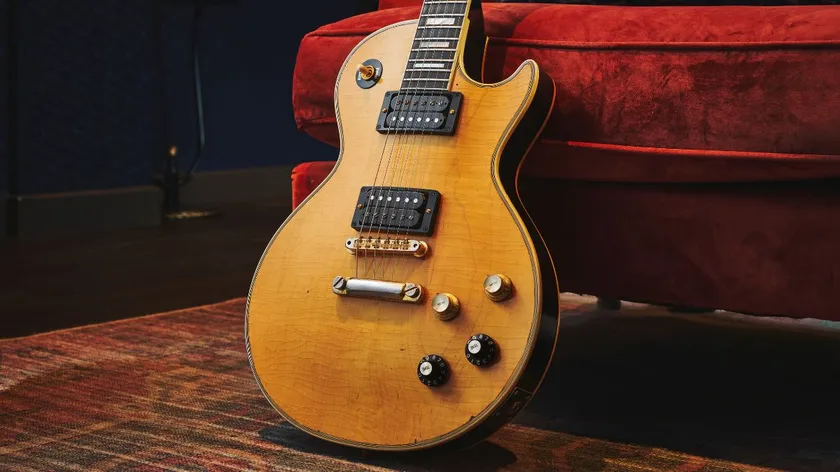
GIBSON LES PAUL CLASSIC WITH BILL LAWRENCE L-500XL HUMBUCKERS, SPERZEL'S
DEAN DIMEBAG DARREL SIGNATURE MODEL - STOCK
GIBSON EXPLORER - STOCK
ESP PARAMOUNT HOLLOWBODY - STOCK
IBANEZ RG440 WITH DIMARZIO EVOLUTION PICKUPS, FLOYD
ERNIE BALL MUSIC MAN LUKE - STOCK
AMPS
1994 VHT PITBULL CLASSIC HEAD
VHT DELIVERANCE 120 HEAD
MESA/BOOGIE MARK IV LONG HEAD
RIVERA KNUCKLE HEAD TRE' HEAD
KRANK REV. ONE HEAD
CARVIN LEGACY HEAD
MESA STILETTO 2X12 COMBO
FRAMUS COBRA HEAD
RANDALL V2 HEAD
MARSHALL JCM 900 HEAD
CABINETS
MARSHALL 1960A 4X12 CABINETS W/ G12T-75 CELESTIONS (2)
VHT DELIVERANCE 4X12 CABINET W/CUSTOM EMINENCE SPEAKERS
PEDALS
VHT VALVULATOR POWER SUPPLY * POWERS EVERYTHING; ALWAYS ON
BOSS HEAVY METAL PEDAL WITH KEELEY MOD
BOSS DS-1 DISTORTION
BOSS FZ-2 HYPER FUZZ
KRANK DISTORTUS MAXIMUS
TOADWORKS JOHN BULL BRITISH OVERDRIVE
MXR WYLDE OVERDRIVE
BOSS RV-5 DIGITAL REVERB
DIGITECH WHAMMY III RE-ISSUE
MORLEY PRO SERIES VOLUME
MORLEY BAD HORSIE 2 WAH
MORLEY TREMONTI WAH
CRYBABY WAH WITH FASEL INDUCTOR
BOSS DD-20 GIGA-DELAY
MAXON OD808 OVERDRIVE
ISP DECIMATOR NOISE REDUCTION
DIGITECH BLACK 13
BOSS TUNERS
MISC
MORLEY A/B
MORLEY TRIPLER
THD HOT PLATE (8 OHM)
EBOW PLUS
BBE 482I SONIC MAXIMIZER
STRINGS
DEAN MARKLEY BLUE STEEL VARIOUS GAUGES
ERNIE BALL SLINKY VARIOUS
PICKS AND TRICKS
DUNLOP JAZZ III BLACK
ERNIE BALL MEDIUM
FENDER MEDIUM
DUNLOP NYLON .73
DUNLOP NYLON .88
TORTEX .88 SHARP
TORTEX 1.14 SHARP
STONE PICK * USED ON THE SOLO FOR BUTTHOLE SURFERS TUNE FOR MAX ATTACK
1971 AND BICENTENNIAL QUARTERS
DUNLOP SLIDES
BLACK BANDANNA * USED TO OCCASIONALLY MUTE STRINGS FOR TAPPED PASSAGES
EDITING TAPE TO SLOT NUT OR TAPE STRINGS
BLACK WOOL BLANKET * USED AS BAFFLE OVER CAB
THIRD HAND FROM ENGINEER ON NECK * ???
USELESS INFORMATION
FAVORITE PLAYERS ARE: PIGGY, RANDY RHOADS, DR. KNOW, TY TABOR, STEPHEN EGERTON, PAUL GILBERT
COUSIN OF STEVE VON TILL OF NEUROSIS
PREVIOUS JOB(S) INCLUDED PRINTING MEGADETH CYBER-ARMY FAN CLUB CARDS
CURRENTLY WORKING ON PROJECT WITH STEVE SMYTH OF TESTAMENT; NEVERMORE AND BUCKETHEAD/BOOTSY COLLABORATION THIS YEAR

