


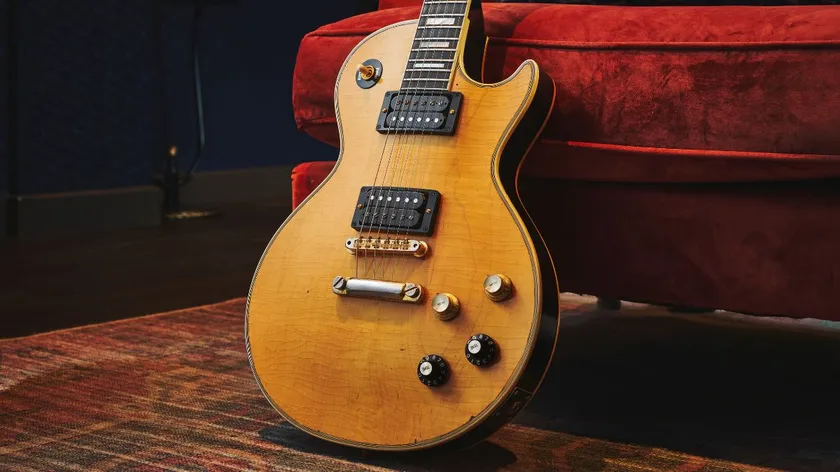


In the late ’70s, B.C. Rich, with all its pointy and wacky-shaped guitars, was giving out guitars like weary-eyed parents to children on Halloween. Aerosmith’s Joe Perry was given one such guitar, a bright red B.C. Rich 10 Supreme.
The guitar has become wholly associated with Perry, though by his own admission, he hardly played it with Aerosmith. Yet he was shown with the guitar slung over his shoulder on the cover of Aerosmith’s Live Bootleg record.
These days, Perry always takes it on the road with him, as he too understands the guitar’s connection to his persona. It’s with that in mind that Perry dialed in with Guitar World to look back on his relationship with his Rich Bich.
What’s the story behind your 10-string B.C. Rich?
When I started my relationship with B.C. Rich, they were different-looking guitars, but you could tell they were built really well. The neck went all the way through the body, and they had all these touches, and it sounded incredible.
I thought B.C. Rich was definitely top-notch as far as workmanship. The only thing that bothered me about them was that they had all these switches and, like, three boosts, which was kind of overkill because they had some pretty good PAF reproductions in there.
You didn’t need three boosts, so there was a lot going on. After one of mine was stolen, I didn’t have time to go to the factory and talk to them, so they just kind of handed me the next guitar, which was this 10-string.
What did you think of it?
I guessed the theory was that if you set it up with the right strings, you could play it with more attitude than a regular guitar. You could get vibrato off the strings and do things you normally wouldn’t do – and experiment.
It really worked for some things because as soon as you bend the strings, they don’t bend in tune, so there are certain places where it works and others where it doesn’t.

Did you eventually get comfortable with the onboard electronics?
There was a period where I unhooked all the electronics except for the volume and one tone knob. I kept hitting all the other switches and knocking the boost on when I already had a fuzz pedal on, so I thought, “Maybe I’ll cut that stuff out and the guitar will breathe a little more.”
But I eventually put it back to the original specs. Also, for a short period of time, I took off the extra four strings and played it like a normal six-string, but that kinda defeated the purpose.
You used it with Aerosmith, but it was one of your main guitars after you launched the Joe Perry Project in the ’80s.
I played it on a few Aerosmith songs in the studio when I first got it, and I played it live a bit. But it was kind of near the end before I left, so it was funny that it ended up in the photo on the Live! Bootleg album.
I was surprised, considering how [infrequently] I played that guitar, but it became one of the top three guitars associated with me. [Laughs] I still work it into a couple of songs in the set because nothing else sounds like it.
- This article first appeared in Guitar World. Subscribe and save.

