

Tucked away in a parish in the coastal city of Nafplio, Greece, is the unassuming figure of Father Dionysios Tabakis: an Orthodox priest who, after performing his church and community duties, moonlights as a guitarist and viral musical sensation.
Described by Pitchfork as pinballing “between drone metal and techno Christmas carols, field recordings and hymns,” his debut album wasn’t meant to lead to any sort of virality or fervor among the left-field crate diggers inhabiting Reddit.
It was initially released as a limited 150-cassette run through the Greek labels Heat Crimes and Elhellel. But by luck or divine intervention, it captured the imagination of journalists and music aficionados worldwide.
Demand is now so high that the labels are re-releasing it on vinyl later this summer, and Father Tabakis is packing up his budget Harley Benton and Persian ney, ready to make his first Stateside appearance at Philadelphia’s Making Time fest, as well as a headline show in London.
“I never had such ambitions,” Father Tabakis tells Guitar World. “The bad and the good in our lives always come uninvited and without warning. That is the unexpected beauty of life.
“It works without frets and without fixed patterns. When I was recording the songs at home, I never imagined they would end up on an album that would travel around the world.”
It all started with his YouTube channel, which was discovered by a “young man from Thessaloniki.” Enamored with Father Tabakis and the genre-blending, Byzantine-inspired music he was crafting, Elhellell label founder Nikolas Rafael suggested it be released as a bona fide album.
“‘Not even one will sell,’ I thought. ‘The boy will waste his money!’ I told him, ‘I did not have the money for such ventures. If you have it, then with my permission and my blessing, go ahead.’”
Under the attention-grabbing moniker Paradise Metal, the cassettes sold out in a few hours, and international reviews quickly followed. Perhaps the most admirable part of the story, however, is Father Tabakis’ steadfast and genuine connection to his heritage as it manifests itself in his music; it’s not merely a connection adopted to pander to a trend.
Born in a poor household in the port city of Piraeus during the ’70s – a period of great upheaval for Greece – Tabakis’ first guitar was a “plastic one from a village festival,” followed by a DIY effort: he took a plank, drove a few nails in and strung some wires to it.

In his teenage years, Tabakis and his brother managed to buy a cheap travel guitar, which he taught himself to play. “In a poor family, there was no spare money for music conservatories,” he says. “My father would not even discuss it.
“But the priests taught us Byzantine music for free then, and from that time on I tried to apply it, as much as possible, to the cheap classical guitar, playing it more like a bouzouki (a long-necked plucked lute popular in Greek folk music).”
His fascination with instruments continued to flourish. He built a whole arsenal, including a qanun (a traditional stringed instrument popular across the Middle East, North Africa, and Central Asia), a Greek baglamas, Middle Eastern oud, Turkish cümbüş and a Chinese bowed erhu.
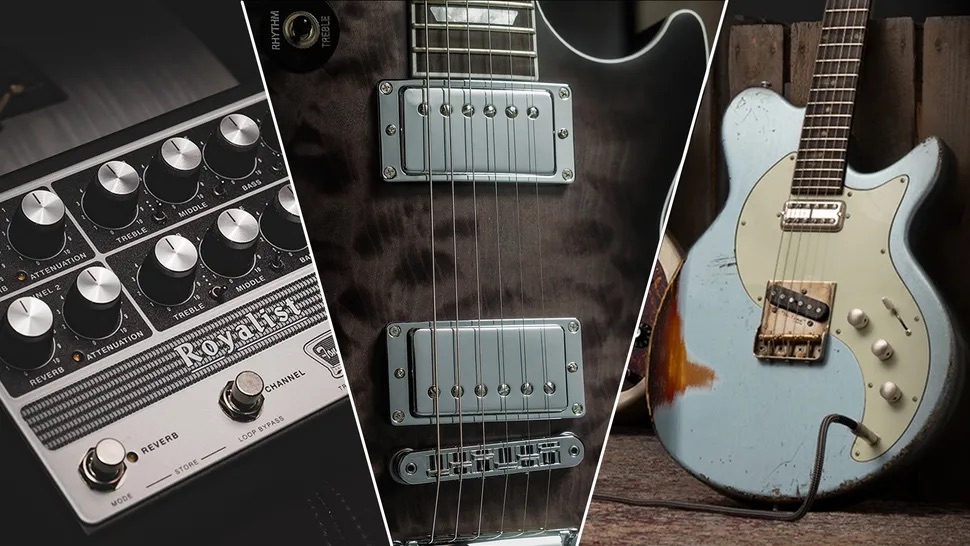
But it wasn’t until his grandchild gave him a nudge that he plucked up the courage to buy his first electric guitar. “It was an unspoken desire of mine,” he admits. “I made my revolution and bought a cheap but sturdy Harley Benton [TE-20HH Standard] for €130 euros (about $148).
“I had always been curious: how would the hymns and the music of the Church sound if performed on an electric guitar? So I began to experiment.”
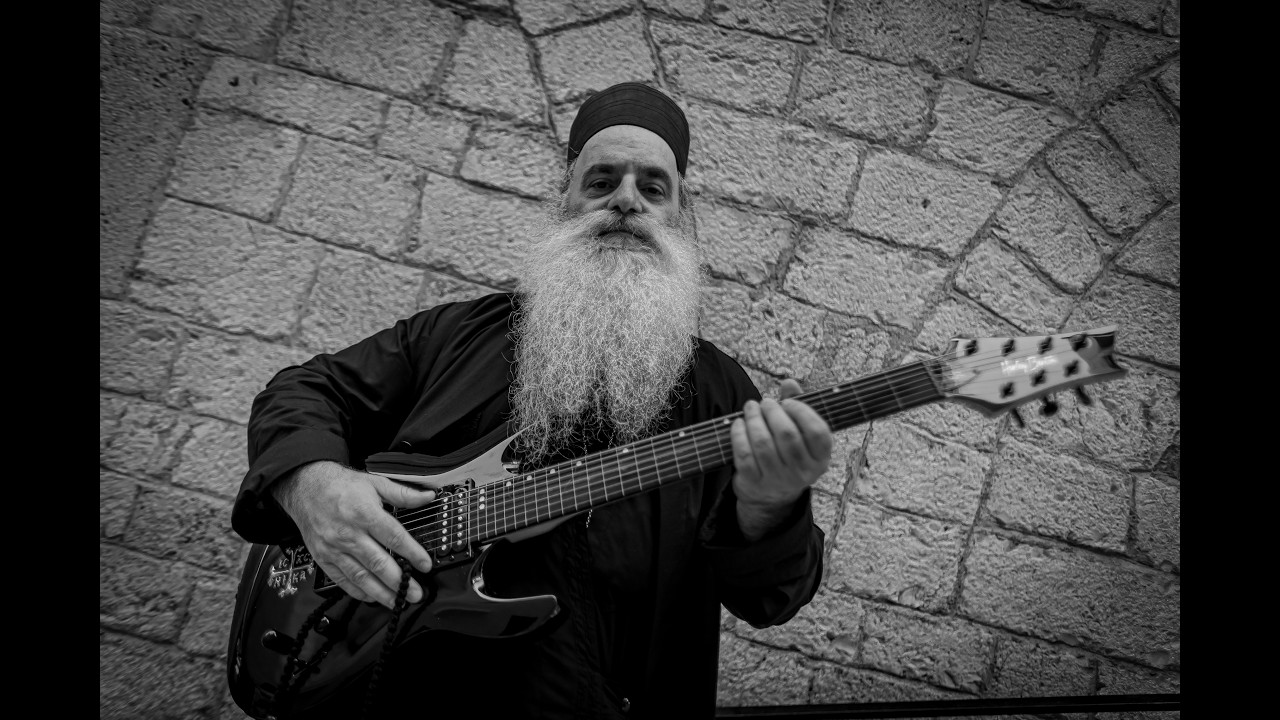
From there he graduated to a full-blown metal guitar – an eight-string Harley Benton R-458. “The name reminds me of Harley-Davidson road bikes, which gives off a sense of freedom and travel.” He went a step further by freeing himself from the shackles of frets – he removed them to convey the microtones present in Byzantine scales.
“Frets are necessary, like a baby walker that a small child uses to learn to walk,” he says. “They are an important stage in music class, but after a certain point, they can become restrictive for some musicians.”
Paradise Metal is characterized by an interplay of centuries-old traditions and secular music. It seamlessly shifts between Christmas carols and techno, hymns and heavy metal, religious chants and rap. That might seem like an unusual combination to most players, but they’re natural partners for Tabakis.
“They simply complement each other and coexist. After all, what does rap mean?” he says. “It comes from the ancient word ‘rhapsody,’ meaning ‘I sew odes.’ I am convinced that the ancient peoples, and especially the Greeks, would have sung their poems in rap and techno rhythms in contests and in preparations for war.”

Despite his growing international profile, Father Tabakis’ life is still rooted in his community, family and home in Nafplio, where he’s surrounded by religious icons and a barrage of musical instruments. He’s still trying to come to terms with the idea that, off the back of Paradise Metal, he’s being booked to play abroad.
“I rehearse constantly at home, driving my wife crazy, but my little granddaughter makes me happy when she hears me play and is impressed. I need a lot of practice, but I believe I can manage it in order to give a beautiful sound and a taste of the East to the people who come to listen to us.”
Tabakis sees his newfound success as a “responsibility and a weight” on his shoulders. However, the mission, as he calls it, is also infused with a dash of wanderlust and an unadulterated joy for evangelizing the universal language of music.
“We in rebellious and free Greece, who are often free even to be foolish, in the vast blue of the Aegean Sea and the sky, have learned to fly when we play music.”
With thanks to Della Savvidou for translating from Greek.
- Paradise Metal is out now via Heat Crimes/Elhellel.

