


Finding the first one of anything can be a tricky business. It can make your head hurt. Try this, for example: Who made the first guitar? Impossible to know, especially as you can tie yourself in knots defining ‘guitar’ before you even get to brands and time periods and… well, you get the picture.
But let’s try something that ought to be simpler. What was the first signature guitar?
You know what a signature guitar is, of course. One that bears the name of a well-known musician, usually alongside a popular brand name, offering some kind of connection to a guitar that this particular guitarist is or was known to play, and is manufactured as a production item and offered for sale to us mere mortals.
Replace that phrase “well-known musician” with “your guitar teacher”, however, and some early examples come into view. The Bambina, which dated from about 1870, was a tiny classical-like instrument with a 13-inch scale, designed by Catharina Josepha Pratten.
She was a well-known guitar teacher in London at the time and had a brilliant scheme: she signed labels and sent them to her French guitar maker, who stuck them inside the guitars that she would then sell on to pupils eager to have an affordable instrument with a hint of teacher’s magic. Maybe the Bambinas qualify as the first signature guitars?
This kind of idea continued, for example with Martin’s special Style 44 for Vahdah Olcott-Bickford, a Hollywood-based teacher – only a touch over 30 were made, starting in 1913, the majority in Martin’s size 0. Other signatures in this category followed, always with the aim of the teacher having an answer ready for when the student asks the inevitable question: “What guitar should I buy?” Ah! Here’s one specially for you!
There were more early acoustic instruments that qualify as signature trailblazers, and the first Gibson signature guitar, if a vanishingly rare one, was probably the Walter Boehm harp guitar of 1923.
Walter, a successful musician and businessman based in Buffalo, New York, was an early adopter of Gibson’s mighty harp guitars and helped the company’s development of the instrument, popularising its role in mandolin orchestras and standardising tuning.

The idea was to play the instrument’s regular six strings as normal, while the extensive set of sub-bass strings – in Gibson’s design supported by an extension connected to the body and the headstock – added sustained bass accompaniment and drones.
A few years later, and still at Gibson in Kalamazoo, we’re greeted by the man who seems the most likely contender for the title of First Famous Guitarist To Get His Own Signature Model.
Nick Lucas was known as America’s Singing Troubadour, and he became a big star with catchy hits, including his 1929 smash Tip-Toe Thru The Tulips With Me – almost as off-the-rails as the much later cover version by Tiny Tim. Some of Nick’s more sensible cuts, such as Teasing The Frets, show off his assured guitar playing, too.
Gibson’s extravagant ’29 catalogue blurb for its Nick Lucas guitar looks very much like the model for every piece of signature-guitar hype that followed.

“The wizardry of Nick Lucas and his guitar is known to all music lovers,” it says. “Combining his ideas and knowledge with the skill of Gibson Artist-Craftsmen has given birth to a truly magnificent guitar. To play it is to know a measure of the same inspiration that has carried Nick Lucas to great heights.
“You love the feel as it comes to life with the touch of your fingers. Your regard grows like a rare flower watered by the crystal drops of purest melody. It is indeed an instrument by an artist, for the artist.”
Your regard grows like a rare flower watered by the crystal drops of purest melody. It is indeed an instrument by an artist, for the artist
Blurb from a Gibson ad for Nick Lucas's signature g
There were other signature acoustics from this era, including a Harmony guitar named for Roy ‘Wizard Of The Strings’ Smeck, the lute-shape Vita-Guitar launched in 1928. Roy was a widely popular star from the vaudeville days who played ukulele and banjo as well as steel and Spanish guitar.
Gibson, too, made a deal with Smeck a few years later for the Roy Smeck Radio Grande and Stage Deluxe Hawaiian flat-tops, first seen in 1934.
A few signature models turned up in Gibson’s contract brands around this time. The company repurposed a flat-top from its budget Kalamazoo line for a Recording King model, the Carson J Robison, introduced in 1933 for the New York-based country singer-songwriter. Recording King was a house brand of the hugely successful Montgomery Ward mail-order operation.

At the end of the ’30s, Gibson produced a pair of short-lived Recording King signature models for the singing cowboy Ray Whitley, who helped Gibson with the introduction of its SJ/J‑200 jumbo flat-top.
During the early years of electric development, there was an obscure Harmony-made Rickenbacker electric flat-top, the Ken Roberts of 1935. More or less all we know about Mr Roberts is that his first name was Ken and that he wasn’t Alvino Rey.
A year later, Epiphone launched the fabulous if hefty Electar Rocco double-neck electric lap-steel, although history insists we remember Anthony Rocco as an effects pioneer thanks to his Tonexpressor volume/tone pedal.
Toward the end of the ’30s, the tireless Roy Smeck signed off on a couple more Recording King guitars, his Professional and A104 electric steels.
Big In America
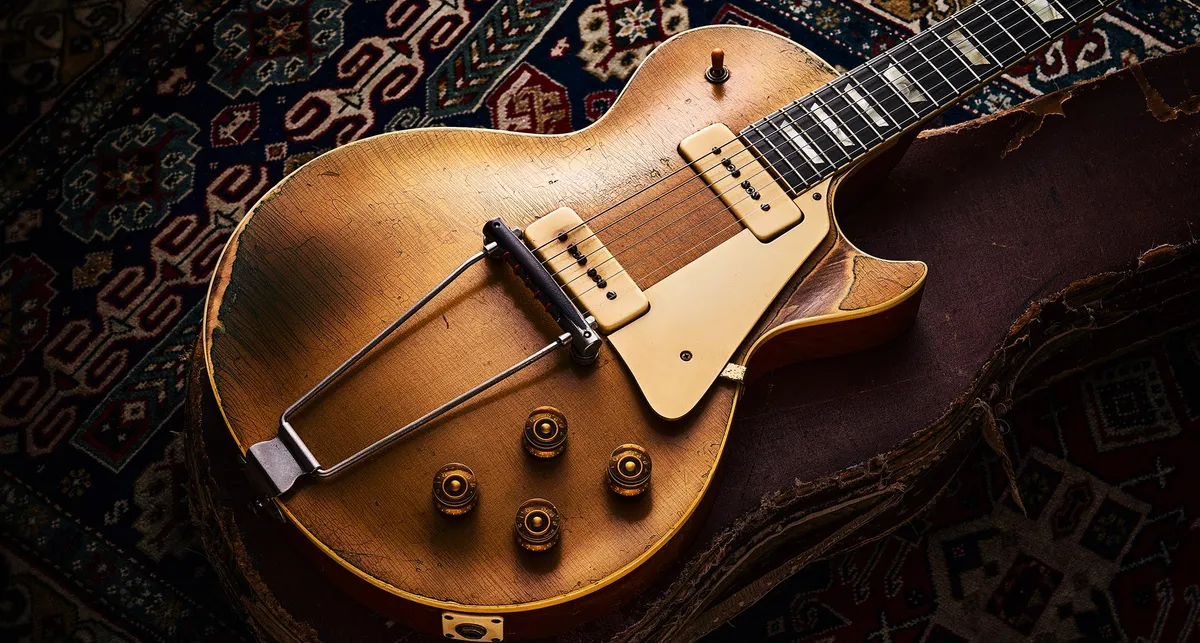
As the memories of World War II began to fade and the 1950s arrived, Gibson noticed that the novel solidbody electrics Leo Fender and his team were making over in California were becoming popular. The firm’s bosses decided to compete by developing Gibson’s own electric solidbody, and then made a signature deal with Les Paul, the best-known guitarist in America.
Les had chopped up several guitars in an effort to get nearer the kind of electric instrument he wanted and the sounds he had in mind. But of prime importance for Gibson was his fame. He’d bagged a No 1 hit with Mary Ford, the 1951 multi-vocal multi-guitar How High The Moon.

At Gibson, the design team came up with the new Les Paul Model (apart from Les’s own trapeze tailpiece, which was soon replaced). This typifies the approach of many guitar makers before and since: slapping a famous name on an instrument that the company either already made or devised itself.
It was a step beyond the ads and catalogues of the ’50s featuring this well-known player with that particular guitar: Laurindo Almeida and a Vega E-300, say; perhaps Jimmy Bryant and a Broadcaster; or maybe Mary Osborne and a White Falcon.
Other brands sought their own Les Paul and associated model as the decade progressed. An early one was the Framus 5/120 Billy Lorento (aka Bill Lawrence) archtop, introduced in 1953.
Also in ’53, Hofner’s UK agent Selmer unusually opted for a combined effort, introducing the aptly named Committee, designed with six leading British guitarists: Frank Deniz, Ike Isaacs, Jack Llewellyn, Freddie Phillips, Roy Plummer and Bert Weedon. In ’57, Kay introduced a trio of Barney Kessel models, complete with the brand’s wonderful Kelvinator headstocks.

A little later, when Barney shifted his allegiance to Gibson, Kay simply omitted the ‘Barney Kessel’ pickguards and kept the Kessel-less model names.
Naturally, it was exciting to be honoured with a signature model – a promo boost rarely does a musician any harm. Gretsch launched its Chet Atkins 6120 and solid 6121 in 1955 and the Chet Atkins Country Gentleman and Tennessean three years later. Chet recalled some 40 years later how much it meant to have a signature model.
“I was thrilled to have my name on a guitar,” he told this writer, “like Les Paul had his name on the Gibson. I was so thrilled by that – and now I don’t know why. Now, it wouldn’t mean that much to me.
“At the time, I was fired up with ambition and I was so anxious to be known all over the world, to be known as a great guitarist. And that deal with Gretsch was one brick in the edifice that would help that happen.”
Band Aid

The modern idea of the signature guitar was taking shape as the 1950s rolled into the ’60s. More artist models hit the shops, tempting players who wondered if some of their hero’s fairy dust might be lurking under the frets or inside the pickups of the instrument bearing the big star’s name.
In the ’60s, as rock and pop exploded, a slew of new signature models appeared, and one new trend underlined the popularity of the band over the individual musician: Mosrite gave us its Ventures model in 1963, Gretsch introduced a Monkees guitar in ’66, and Guyatone hooked up with Japanese heroes Sharp 5 a year later.
Is it the player, or is it the guitar? That debate around the value of a signature model will run and run. In the meantime, it wouldn’t be a bad idea to start practising your signature. There’s a knack to make it fit snugly on the headstock of your choice without grazing the brand logo or the tuners. Why not do some advance planning? Then when the call comes you’ll be ready.
- This article first appeared in Guitarist. Subscribe and save.
