


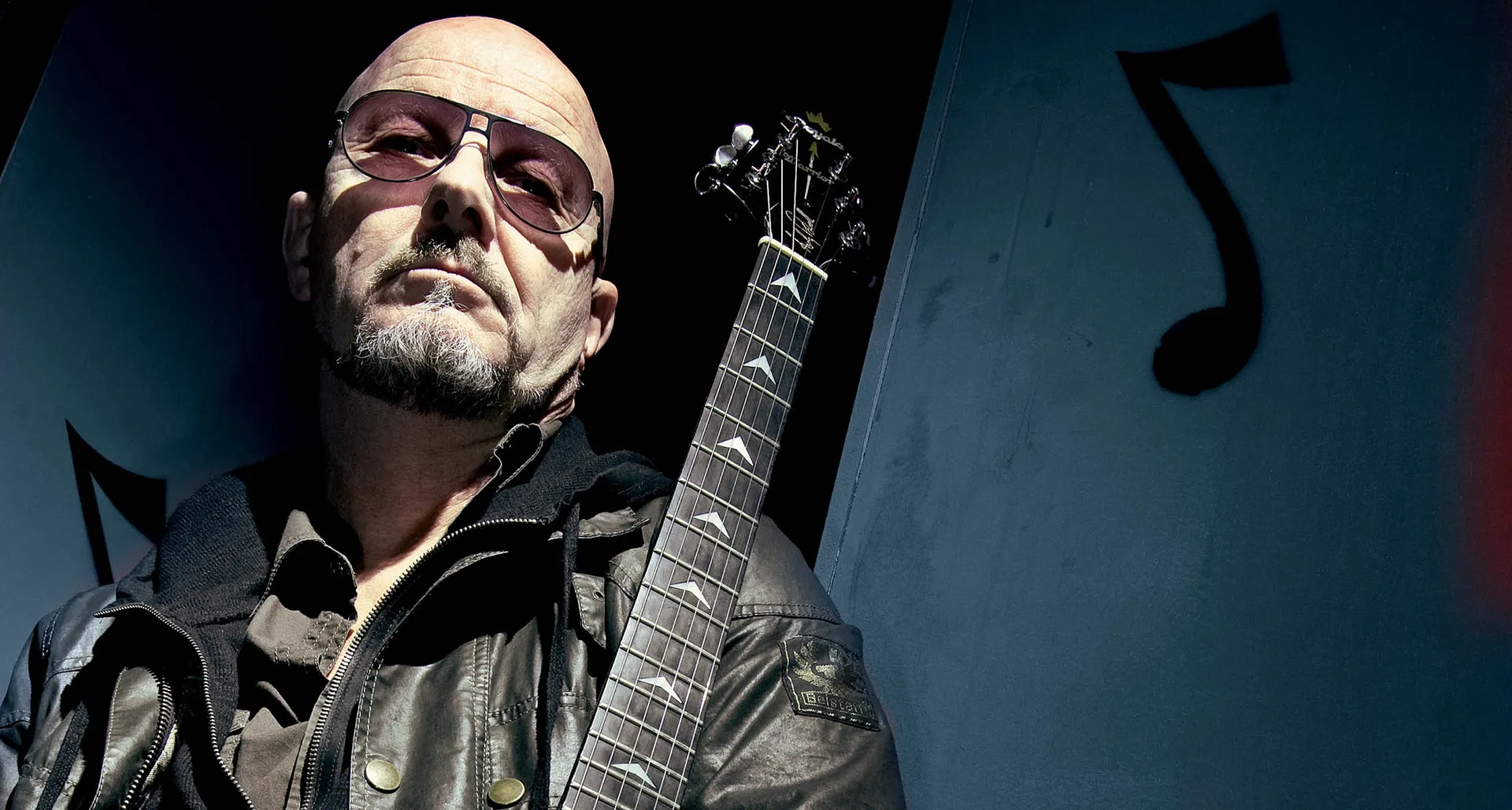
This month on Bought & Sold, Andy Powell of Wishbone Ash fame drops in to talk all things guitar, from first loves to his current live rig, gear regrets and the answer to some of the guitar world's most difficult questions…
What was the first serious guitar that you bought with your own money?
It was a Burns jazz guitar. Burns hooked up with, I think, Rice Krispies and if you entered this competition on the back of the cereal box, you could win this guitar. There was no chance that I would win, although I think I did enter the competition. But, like a lot of kids in the ’50s, I had a paper round and I managed to save up money.
Somebody had won one of these guitars – this must have been about a year or two later – and wanted to sell it. So my mother pinned all the money I’d earned from the paper round to the inside pocket of my school blazer, and I went down on the train and I bought this guitar off this boy and came back on the train.
And that was my first serious guitar. It was a great guitar, it was a short scale and it had a tremolo arm on it, so I was able to emulate my hero, Hank Marvin.
Later, just before I joined Wishbone Ash, I decided I was going to go on a big adventure to Morocco overland. I’d had the guitar for a few years and played in bands with it, but I decided that I needed to travel more than I needed the guitar and I sold it.
I went up to London, sold it to Macari’s Musical Exchange and I believe at the time they gave me 40 quid for it, which was enough to go on this overland trip in a Land Rover with a bunch of strangers and end up in Marrakesh with food poisoning!
What was the last guitar you bought, and why?
Well, I’m known for being a Flying V player, but the last really good guitar I bought was a Fender Custom Shop Stratocaster. I used to collect guitars and I had a collection of about 85, and I had Stratocasters all the way from ’54 through to the early ’60s.
Anyway, I bought this Stratocaster and it’s the closest I’ve found to some of the vintage ones. It’s a good one, you know? It has a resonance to the body and you can get all the Strat tones out of it, and it’s just absolutely brilliant. They finally figured out how to remake them. I paid way too much money for it, but it will find its way onto an album.
What’s the most incredible find or bargain you’ve had when buying gear?
Probably the most incredible guitar I got was a ’58 Flying V. Later on, I got a ’59. So those two would be the most amazing guitars that I was offered. I was playing a ’67-style V; different concept, really, but also a great guitar. I never realised, but they only made about 100 of [the ’59s], but the ’58, I think they made about 98 of them.
They were subsequently sold, and I made good money on selling them. But I would say the first ’58 I got, I just couldn’t believe it. I think I appreciated these things as works of art, actually – as well as being guitars, they played great and they sounded fabulous.
What’s the strongest case of buyer’s remorse you’ve experienced when buying gear?
I had two Firebird VIIs. The most gorgeous-looking one that I bought was an original white Firebird VII with gold hardware, and I tried and tried to make that guitar sound good.
But what had happened was, at the Gibson factory, they had put so much paint on the guitar – there was probably about 3lb of paint on that guitar – it would come off in chips a 16th of an inch thick.
I tried to bring it into the stage show, but it was a thin-sounding guitar because the lacquer had simply killed the tone of the wood. I never really regretted it, I loved having it as an artefact sitting around the house, but eventually it got sold to Stephen Stills.
Have you ever sold a guitar that you now intensely regret letting go?
Well, that would be the ’58 V. I mean, I could have put my sons through college with the money from that! I could have bought a house for that! Well, times two because I had the ’58 and the ’59.
They sounded amazing and they were great, but they had big old necks on them. Albert King had big hands, he could master one of those things. I’ve got small hands, you know? So it was quite a beast, but as a thing, as a beautiful instrument, as an investment, as a piece of history, yeah, I pretty much intensely regret that.
What’s your best guitar-buying tip?
Well, first of all, don’t plug it in. Just put it on your knee and play it. Does it feel as if the whole thing is resonating? Is it responding to your touch?
I’ve got a ’59 Bassman sitting over there in the corner. That’s been on many albums, and if you plug a cheap guitar into that amplifier, it would sound very good
And if that’s happening, then plug it into an amplifier, preferably an old tube amp, and then see if the pickups are matched with each other. Does it seem balanced? I’d say those are my two big tips. The guitar has to work acoustically, it has to give you something back.
If forced to make a choice, would you rather buy a really good guitar and a cheap amp, or a cheap guitar and a top notch amp?
Oh, that’s a really tough question. If you were looking to make a big, good sound on stage, and you were looking to make the right kind of sound on an album, probably the amplifier would make a big difference.
You could compensate for a lot of things that were wrong with the guitar with your fingers. I mean, I’ve got a ’59 Bassman sitting over there in the corner. That’s been on many albums, and if you plug a cheap guitar into that amplifier, it would sound very good.
Andy’s Go-To Rig
I’m doing a lot of festivals in the summer, so I have gone over to using a semi-digital amp called a BluGuitar made in Germany by Thomas Blug. I can throw it in a backpack, and then no matter what speakers they give me at a festival, I can plug that in. I met Thomas and he’s shown me how to do a few tweaks on it. And so, yeah, that amp with two 2x12 speaker cabs. I do prefer 10-inch speakers, to be absolutely honest with you.
I’m using fewer pedals compared with what I used to. My main overdrive is an Analog Man King of Tone. It’s got two channels and I use one as a crunch and one as an overdrive, and then if I really want to go berserk, I bring in an Ibanez Tube Screamer on top. Then it’s just a standard Boss Delay and I use an Analog Man chorus unit.
Oh, I use an [Xotic] EP booster, too. I use that a lot, especially if I want to bring the level down and I want more definition for picking. I went through a whole phase of using piezo pickups on the guitar.
I had some Flying Vs made with piezo pickups in the bridge, and I would often take a signal off and run that through the PA system. But these days I’ve found I’m going simpler and simpler. It’s all about gain management: how much do you need? When do you need it? And how do you manage it?
As far as guitars are concerned, I have to play a V. I mean, I have no choice!
- This article first appeared in Guitarist. Subscribe and save.

