




Guitar World Verdict
While admittedly difficult to get excited about, the Fender Strobo-Sonic Pro Tuner Pedal does its single job extremely well. It’s sensitive enough to cater to those who demand the utmost accuracy, while remaining simple enough to use that the gigging player will appreciate it. The switchable bypass and multiple tuning modes mean it will slot nicely into any pedalboard.
Pros
- +
The dual strobe and needle tuner mode is really useful.
- +
Auto dimming display easily visible in any environment.
- +
Tone nerds will appreciate the easy true bypass/buffered switching.
- +
Lightweight but feels very well put together.
Cons
- -
Can’t be run on a 9V battery.
- -
Side-mounted USB-C not the best for busy ‘boards.
You can trust Guitar World Our expert reviewers spend hours testing and comparing guitar products so you can choose the best for you. Find out more about how we test.
What is it?
Guitar tuner pedals are never going to be the most exciting pedalboard-based purchase, but they are essential, and the Fender Strobo-Sonic Pro Tuner Pedal wants to steal your attention. It arrives at an interesting moment for the company, but boardroom antics and internet discourse aside, it’s my job to look at the gear objectively. Ignoring the logo on the box, is this tuner pedal able to compete in a part of the market with some already very established names? Let’s find out.
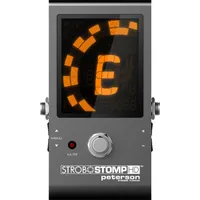
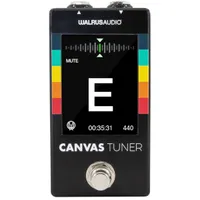
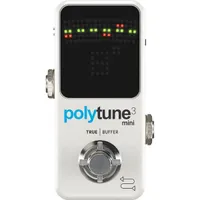
The Strobo-Sonic promises a tuning accuracy of just 0.01 cents, which, on paper, is better than the TC Electronic PolyTune, the legendary Boss TU-3, and even the benchmark for accurate tuning, the Peterson StroboStomp HD. Like other competitors in the Walrus Audio Canvas Tuner and TC PolyTune, the Strobo-Sonic features dual modes, so you can use it in a combo strobe/needle mode, or in the more familiar needle mode.

The large, 2.3 x 2.1” screen is second only to the Walrus Audio Canvas tuner, providing plentiful real estate to view the notes you’re aiming for. It also has an auto dim function that adapts to the ambient light condition, getting less blinding when you’re on stage in the dark versus a brighter mode when playing in daylight.
It also has a switchable buffer. You can run it in true bypass, buffered bypass, or an always-on mode, which is what you’ll find with the Peterson, Canvas Tuner, and TC PolyTune. In the always-on mode, the footswitch acts as a mute button, but the tuner is always active, so you can see which note you’re on whilst playing.
The Strobo-Sonic Pro can be powered via a traditional pedalboard power supply, drawing 9V 180mA. You can also run it with a USB-C connection if you’ve got a modern PSU that features a USB-C port.
Specs

- Launch price: $129.99 | £99 | €102
- Type: Tuner pedal
- Controls: Footswitch, bypass switch, mode button
- Features: Auto dim display, strobe mode, needle mode, always on mode, bypass switching
- Connectivity: 1 x 1/4" (instrument), 1 x 1/4" (main out), 1 x USB-C
- Bypass: Buffered, true bypass, buffered always on
- Power: 9V DC, 180mA, USB-C 5V
- Dimensions: 4.53 x 2.57 x 1.73" (115 x 65.3 x 44mm)
- Weight: 0.5 lbs, 0.22 kg
- Options: N/A
- Contact: Fender
Build quality

Build quality rating: ★★★★½
Pulling the Strobo-Sonic tuner out of its box, it’s a pretty unassuming bit of kit. The all-black fascia is very toned down, with just the silver footswitch, retro-gaming inspired white logo, and the classic Fender ‘spaghetti’ logo. It’s very lightweight at 0.5 lbs, weighing no more than a smartphone in the palm of my hand.
It’s got a very low profile in terms of height too, with a 1.73” (44mm) thickness. The footswitch sticks out a good amount and features a modern, quiet-click operation that doesn’t have the loud ‘clack’ of older pedals. It has a nice balance of easy press and feel, so you know you’ve engaged it, and sticks out enough from the chassis that it’s easy enough to hit from a variety of angles.

On top of the unit are two 1/4-inch jacks, and nestled in between the 9V DC power input. All are marked with bold white text so there’s no doubting what does what. This theme continues on the right-hand side of the unit, with a bypass switch, tuning mode switch, and the USC- port nestled here. The bypass switch moves solidly if unspectacularly, and there’s a nice click to the small, circular mode button when you engage it.
Usability and features

Usability and features rating: ★★★★½
The aim is to get the blocks to stop moving, which signals that your guitar is perfectly in tune
Plugging the Fender Strobo-Sonic at the front of a pedalboard of cheap pedals I’m testing at the moment, the display lights up dimly, showing the reference pitch before going to black. Plugging in a Baum Core Verve electric guitar into the front of it, I engage the footswitch, and I’m greeted with the pedal in dual strobe-and-needle mode.
The strobe portion of the tuner display consists of blocks of LED dots that drift left or right across the screen, depending on the string's pitch. If drifting to the left, it’s flat; if drifting to the right, the note is sharp. The aim is to get the blocks to stop moving, which signals that your guitar is perfectly in tune. Strobe tuning allows you to be more accurate than a needle tuner, because it’s an overlay of the exact pitch of your string. It means even if you’re out by 0.03 cents, the blocks will still move ever so slightly.
Above and below the blocks that drift across the screen is the more familiar needle tuner. This works like the tuners most of us know, turning blue when flat or sharp and going green when it reaches the center of the screen, indicating the pitch is correct. Needle tuners have some guesswork in them, however, because this kind of tuner is constantly sampling your note and doing a little smoothing to make it readable for the human eye.

Having the option for both makes the Strobo-Sonic Pro incredibly useful. Use the needle for quick check-ups in between songs, but you have that strobe accuracy for recording sessions or set-up work, allowing you to get as close to perfect intonation as possible. Interestingly, there’s no strobe mode on its own as you’d get with a Peterson tuner, so your options are either traditional needle on its own, or both strobe and needle together.
The display itself is fantastic, super bright, and readable from any angle. I used the tuner both in my home studio and in a dingy rehearsal room, and had zero issues reading it from any angle. I didn’t really notice the auto-dim function, which is probably a good thing, and although I didn’t try it in bright sunlight, I don’t have any qualms about the readability of it.
Another plus is having the switchable bypass modes on a physical switch. These are often hidden inside the pedal or inside menus, so the ability to change at will is a nice feature. There’s a very slight sonic difference between the true and buffered modes. I can definitely sense a little less high-end on the true bypass mode, as the signal is running through a decent amount of guitar cable and several patch cables.
It’s not going to make a huge difference overall to your tone, but having the switch on the outside makes it very easy to check exactly what effect it’s having when you're rigging it up with a bunch of other pedals.
Verdict

I think it has enough features to compete with the more established names
My overall experience with the Fender Strobo-Sonic was a good one, and I think it has enough features to compete with the more established names like Boss, Peterson, and TC Electronic. I love the dual strobe/needle tuner mode, which combines super accuracy with quick convenience, and the price feels right for what it is, especially as strobe tuners, like those from Peterson, are generally a little pricier.
It’s a shame then that it doesn’t have some of the other quality of life options found on other tuner pedals, like an additional power out or the ability to be run on a 9V battery. I also think the side-mounted USB-C isn’t the best placement for powering the pedal, particularly if it’s going onto a tightly packed pedalboard.
Guitar World verdict: While admittedly difficult to get excited about, the Fender Strobo-Sonic Pro Tuner Pedal does its single job extremely well. It’s sensitive enough to cater to those who demand the utmost accuracy, while remaining simple enough to use that the gigging player will appreciate it. The switchable bypass and multiple tuning modes mean it will slot nicely into any pedalboard.
Test |
Results |
Score |
|---|---|---|
Build quality |
A very lightweight but well put-together pedal |
★★★★½ |
Usability and features |
Does the job well with some incredibly useful features |
★★★★½ |
Overall |
A great tuner pedal that can compete with more established names |
★★★★½ |
Also try