




Hello, and welcome to my new column for Guitar World! Over the course of these lessons, I will be sharing many of the techniques and approaches I use for creating effective melodies and rhythm guitar parts for both recording sessions and live performances.
I’d like to kick things off with a look at some of the ways in which I incorporate the technique of hybrid picking into my playing. As you may know, hybrid picking combines flatpicking with fingerpicking and can be used to create and perform otherwise impossible sounds and techniques.
Hybrid picking is a big part of country guitar playing, and I’ve studied a lot of country players, but I’m primarily a blues-rock/Americana player, along with R&B and jazz. I’ve developed an approach to hybrid picking that I think you will be able to apply fairly quickly to what you’re already comfortable with.
A good place to start is with chords, as demonstrated in Figure 1. For each chord – Dm, A and C – the low root note is flatpicked with a downstroke while the higher three notes are picked upward with the bare middle and ring fingers and pinkie.
This produces a piano-like simultaneous note attack and a different sound than a strum, which is an arpeggiation, no matter how quickly you perform it.
For single-note playing, a great way to practice hybrid picking is to play a simple A minor pentatonic scale (A, C, D, E, G) and alternate between the pick and a finger repeatedly.

In Figure 2, all of the notes that fall on the downbeats are flatpicked and all the notes on the upbeats are picked with the middle finger. My goal here is to achieve a smooth, uniform note attack, so that there’s almost no difference between the sound of the flatpicked and fingerpicked notes.
In Figure 3, I demonstrate how I can get some speed with hybrid picking. Alternating between the pick and a finger in this way can be at least as fast as straight flatpicking, if not faster, and also easier to do.

My incorporation of hybrid picking started when I was about 15 years old. I’d been emulating Jimi Hendrix and Stevie Ray Vaughan with licks like Figure 4, using only a pick. I then switched to using fingerpicking on the top two strings, with my middle and ring fingers, respectively, as shown in Figure 5.

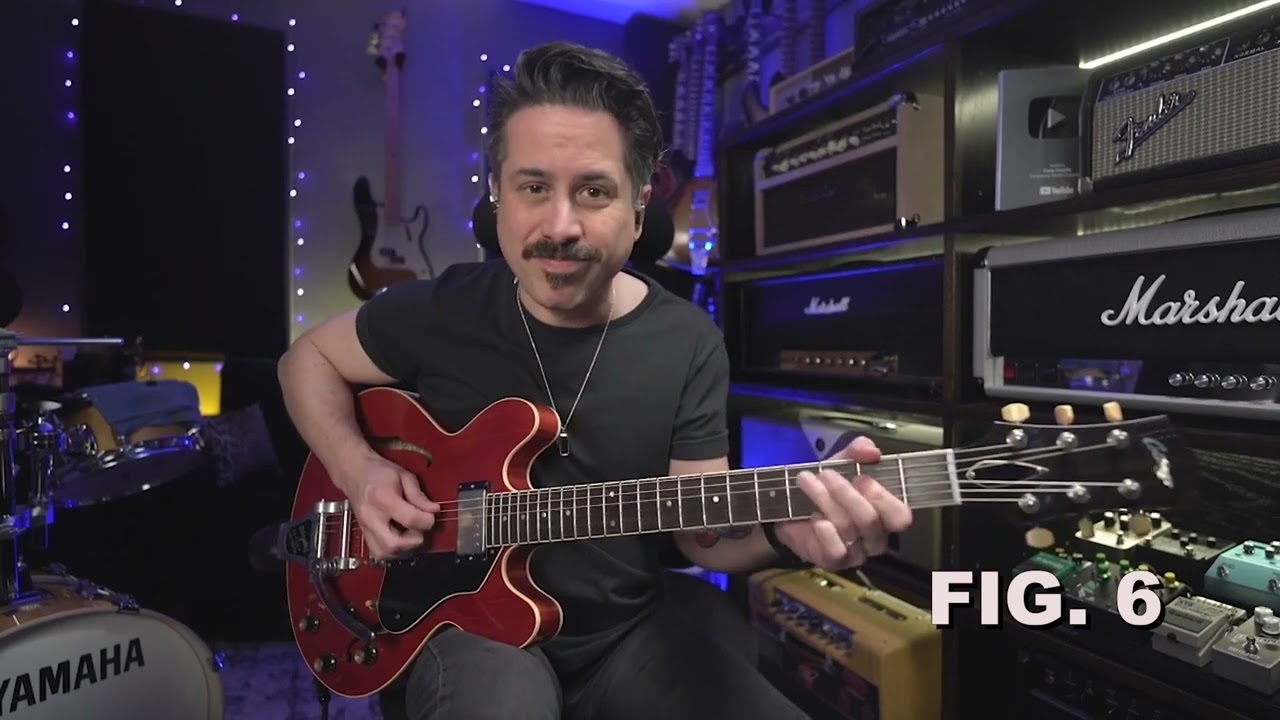
I find hybrid picking especially useful for faster tempos, such as the country/rock-type riff shown in Figure 6. As I play the solo line in Figure 7, I articulate the notes on the lower strings with the pick and the notes on the higher strings with my available fingers.
Hybrid picking also works very well with double-stops (two-note chords), especially if I want the sound to be very pinpoint and accurate.

In Figure 8, I fingerpick the double-stops on the B and G strings and flatpick the single notes on the D string. In Figure 9, I move more freely between flatpicking and fingerpicking, which I think yields an expressive sound.

This is a great way to get started with hybrid picking; move from scales into more inventive lines, and you will discover many great sounds that this technique will facilitate.
- This article first appeared in Guitar World. Subscribe and save.

