


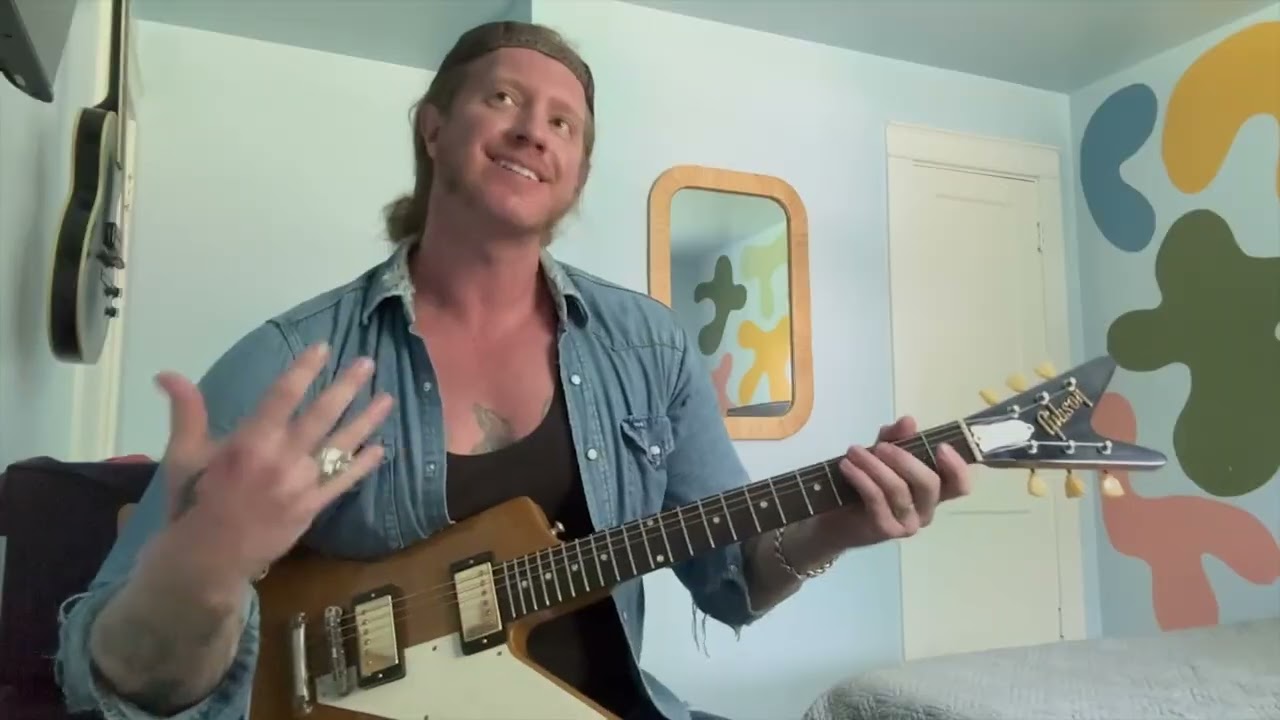
Last month, I discussed some of the advantages of playing in a power trio, such as the open harmonic canvas that it affords me as a guitar player. Threw Me to the Wolves is a song of mine that presents many opportunities to explore and exploit the creative freedom that the three-piece ensemble allows.
With the song’s solo section, my mindset is that we’re at the start of a musical journey, and it’s my mission to “tell a story” that will take the audience from one place to another. In this lesson, I’d like to share how I go about doing that.
Let’s first look at the solo section’s chord progression. As shown in Figure 1, we’re in the key of A minor, and the progression begins with the bVI (flat six) chord, F(sus2), which moves to the bVII (flat seven) chord, G5, then resolves to the tonic, or root, chord, Am. Each chord lasts for two beats, so the first bar is Fsus2 to G5, and the second bar is Am to G5. This two-bar pattern then repeats throughout the solo.
For the F and G chords, no 3rd is played, which gives me more melodic freedom when soloing. This sense of “open harmony” allows me to hold long, sustaining notes over all three chords, and then travel through the progression with melodic freedom, in my quest for memorable, singable solos.

Figure 2 illustrates how I get into the solo. Taking an Eric Clapton/Albert King-inspired approach, I begin with a whole-step bend from D, the 4th, up to E, the 5th, which I hold and shake, after which I slowly move back down to the A root note via the notes D and C, as well as the 2nd, B. The overall scale I rely on here is A minor hextatonic (A, B, C, D, E, G), which is A minor pentatonic (A, C, D, E, G) with the note B, the 2nd, or 9th, added.

Another thing I love to do here is reference the chord progression with double-stops, specifically 6th intervals, or 6ths. Figure 3 has me sliding into a C-A double-stop over Fsus2, a D-B double-stop over G5 and an E-C double-stop over Am.
Figure 4 demonstrates a neat little trick I picked up from Joe Bonamassa: when playing a 6th or 10th interval as a double-stop, instead of fretting the higher note normally, play it one fret lower then bend it up a half step and add some vibrato, to make it really sing.

Another cool way to elaborate on 6ths is to create a “pedal tone”-type melody. In Figure 5, I begin with straight 6ths over Fsus2 and G5 then use the lower note as a rearticulated pedal tone against a melodic line played on higher strings.
I also like to reference each chord with simple triad arpeggios. In Figure 6, I play F, G and Am triads on the top three strings while adding vibrato in an Otis Rush-type manner.

Figure 7 and 8 illustrate a tremolo strumming technique I picked up from Stevie Ray Vaughan: Figure 7 shows Am, Bm, Csus2 and Dsus2 triads played on the top three strings. In Figure 8, I create a tremolo effect by lightly strumming the strings with the tip of my pick-hand index finger as quickly as possible.

This is the last installment of Hardwired for now. I hope you’ve been able to incorporate some of my ideas into your own playing and hope to see you at a show soon!
- This article first appeared in Guitar World. Subscribe and save.
