



Extended chords can be great for open, strummed acoustic accompaniment, but some are more suited to jazz or funk – or as shapes to play with when soloing.
These minor 9th and 11th chord examples are extended chords, which means they go beyond the initial Root-3rd-5th of the scale. Those named Em9 add both a b7th (D) and a 9th (F#) to the minor triad, giving us Root-b3rd-5th-b7th-9th (E-G‑B‑D-F#).
Just to mix things up a bit more, extensions such as the 9th and 11th don’t need to appear in the strict scale order as written here, so the 9th can be lower than the 7th as you strum across the chord – see Example 1. The Em11 chords are basically Em9 plus an 11th (A), giving us: E-G-B-D-F#-A. Check out the examples for more info.
Example 1. Em9
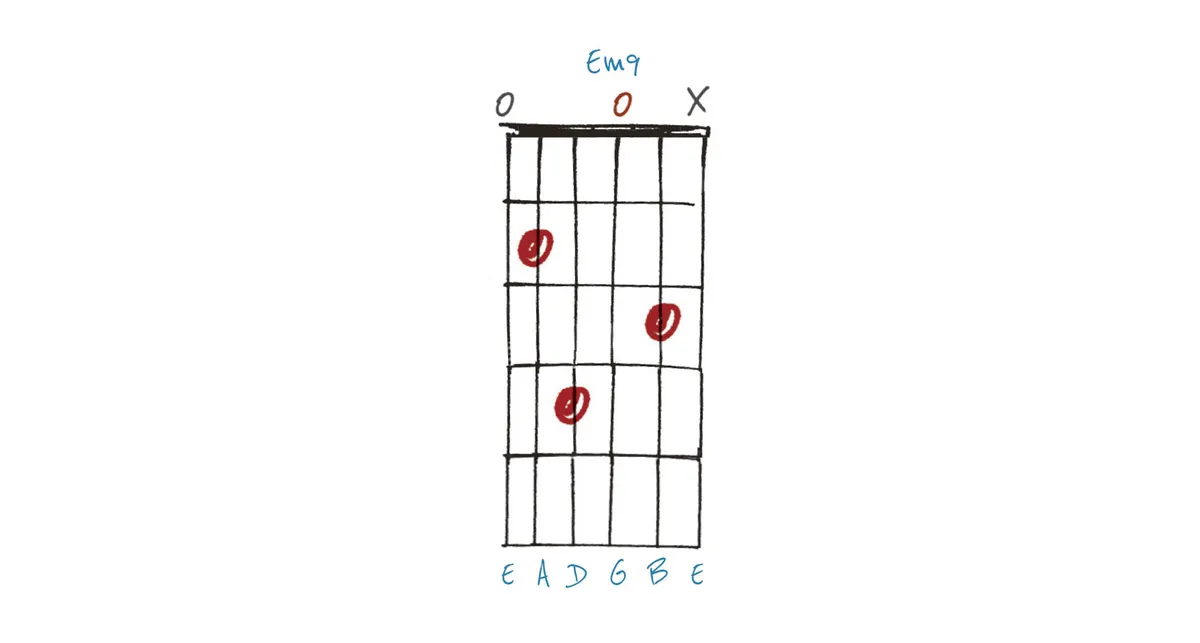
This Em9 contains the b7 and the 9th, but not in the order you might expect to find them if thinking in terms of scales. From low to high we have: Root-5th-9th-b3rd‑b7th or E-B-F#-G-D. I could have included the open first string for another E at the top, but it seemed nicer like this. All down to personal taste!
Example 2. Em11

An Em11 such as this adds an A, but as you can see this isn’t appearing on top of the chord as counting through the scale might suggest – this is merely a way to name the sound of this combination of notes. From low to high we have: Root-5th-b3rd-11th-b7th-9th or E-B-G-A-D-F#.
Example 3. Em11

Another take on Em11, this one largely preserves the scale order of the notes (low to high): Root‑Root‑b3rd‑b7th‑9th‑11th or E-E-G-D-F#-A.
As in both Examples 1 and 2, I’ve used the open sixth string to give these a strong base (and bass), but this one is movable complete with its root. We have no 5th (B), but this isn’t uncommon in extended chords like this.
Example 4. Em9

Back to Em9. Looking at this from the CAGED chord concept, what would be a Cmaj7 shape in open position is here moved above a 7th-fret barre.
The open sixth string gives us our root, but this shape could still be moved around using just the top five strings, leaving the root to the bass or another instrument.
Example 5. Em11

This Em11 spells out a D major triad (low to high: F#-A-D) on the top three strings, giving an insight into how players such as Larry Carlton superimpose different triads over chords when soloing. There’s also more than a hint of Gmaj7 in the G-D-F# found on the fifth, fourth and third strings.
- This article first appeared in Guitarist. Subscribe and save.

