


Eric Johnson is one of those rare artists who has created a unique style from classic elements of blues, jazz and rock.
His playing covers a diverse range of sonic bases, from delicate harmonics and super-clean crystalline chords to edgy rhythms and roaring distorted solo lines. He delivers all these using a vintage or signature model Strat, according to his preference of the moment.
His modest pedalboard features a few carefully chosen pieces, plus the switching for his multi-amp setup – a rig that has hardly changed since his debut solo record, Tones, dating back to 1986.
Although Eric is renowned for his forensic approach to getting the perfect tone, he certainly isn’t one to jump on the latest fads looking for shortcuts and isn’t seduced by the novelty of new gear.
It’s worth noting that Eric has more recently been experimenting with modern digital units, so clearly has an eye on the future when it comes to his rig, but in the meantime recently shipped his whole backline to Europe, to avoid compromising his sound. That’s commitment to the art over profit!
The example solo, though split into four sections, was played as a continuous take. It borrows heavily from Eric’s approach to pentatonics, arpeggios and touches of Texas blues. And while I don’t claim to have duplicated Eric’s tone or style definitively here, this solo is very much inspired by him.
It contains quite a few ideas that can hopefully be of use should you wish to incorporate a bit of the ‘EJ magic’ into your own playing.
This isn’t a fast ‘shred’-type affair, but it does require sustained accuracy and concentration. Very much a case of building up to it, rather than expecting to jump straight in… Hope you enjoy and see you next time!
Example 1.

This first example aims to establish the feel, featuring a Texas blues shuffle-style riff with some pentatonic fills. As there’s a fairly sparse backing here of just bass and drums (echoing the line up of Eric’s live band), it felt important not to rush into a single-note solo immediately.
The feel is fairly loose – though there are some staccato notes, you’ll hear the open fourth and fifth strings ringing occasionally, such as in bars 1 and 3.
Example 2.

The ascending run during the first two bars features some wide intervallic skips based around D-Em-D7-G-Am chord shapes – all superimposed over a D on the bass. I’ve opted to pick these, but Eric will sometimes use a hybrid pick-and-fingers style, as he does on Cliffs Of Dover.
We break out of this into a more melodic D major based run, then some bluesy doublestops and 6ths (F#) as we move back to A in the bass.
Example 3.

Over the C major and D major chords I’ve opted to play a line influenced by Eric’s playing on the track Camel’s Night Out, then changed position with a few slides and legato moves to land at a D major arpeggio, which is played in triplets.
This is one of those moments that can be deceptively difficult to articulate, but running it through slowly (in fact, very slowly is surprisingly helpful) while maintaining a relaxed posture will definitely get you there. More haste, less speed…
Example 4.

Jumping down for that low E helps fill the gap between solo guitar and bass, followed by an E pentatonic/Mixolydian run and an E major arpeggio-based pattern. Framing the chords with arpeggios like this can also help with filling in any harmonic ‘information’ in this trio format, as we saw in Example 3.
The pinched harmonic at the end can be a hit and miss affair. Eric has a pretty good hit rate on these, but it’s important to be realistic – try just behind the neck pickup and you’ll find it somewhere there!
HEAR IT HERE
Eric Johnson – Ah Via Musicom

From Eric’s second solo album, we’re coming in here with the most obvious first choice, Cliffs Of Dover, a track that definitively demonstrates Eric’s blazing lead tone and cascading pentatonic lines.
Also, check out Desert Rose for more of his unique take on pentatonics, plus chord harmony in his solo lines. While you’re there, have a listen to Trademark to hear Eric switching between tones/amp rigs to great effect. Finally, Righteous is a great demonstration of Eric’s approach to a fast Texas blues shuffle.
Eric Johnson – Venus Isle
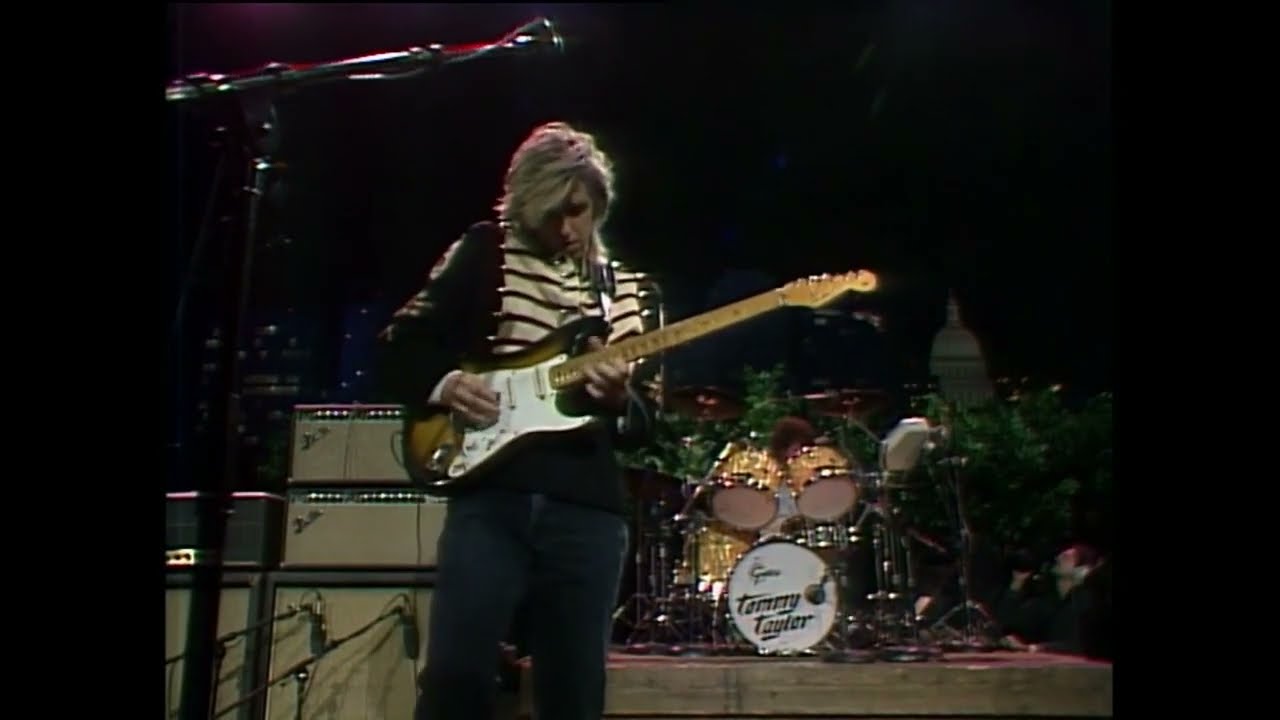
A lot to check out on this record. Firstly, Eric’s Hendrix-style chord accompaniment and stratospheric solo on the title track. There’s also a lovely extended solo at the end of All About You. Elsewhere, it’s well worth a listen to Camel’s Night Out (apparently played on a Gibson Flying V) and When The Sun Meets The Sky.
You’ll hear some switches in tone – sometimes a switch between amps, sometimes maybe a punch-in during the recording process. Whatever, the results speak for themselves!
Eric Johnson – Live From Austin, TX
It’s always interesting to check out the live versions of tracks for extra insight into the creative process and production/arrangements. Here, it also demonstrates that Eric is every bit as astonishing live as he is in the studio.
We hear him switching between amps, tones and techniques in real-time on tracks such as Trail Of Tears and an extended intro on Cliffs Of Dover. Live versions of Righteous and Zap feature lots of fluid solo playing. It’s worth noting that many of these tracks are available on video, too.
- This article first appeared in Guitarist. Subscribe and save.

