

I’d like to address the fact that not all Les Paul Juniors are created equal. Specifically, I’m talking about the three different variants of the guitar model that were offered by Gibson between the years 1954 and 1961.
In past columns, I’ve talked about the value in the creativity that can be inspired by working with just one single pickup; in the case of Les Paul Juniors, the pickup in question is a P90, which is a large single-coil pickup, in the bridge position.
All you’ve got is one volume and one tone control. But, for some players, such as the great Leslie West, this is all that’s needed to express a wide range of musical riffs and solos.
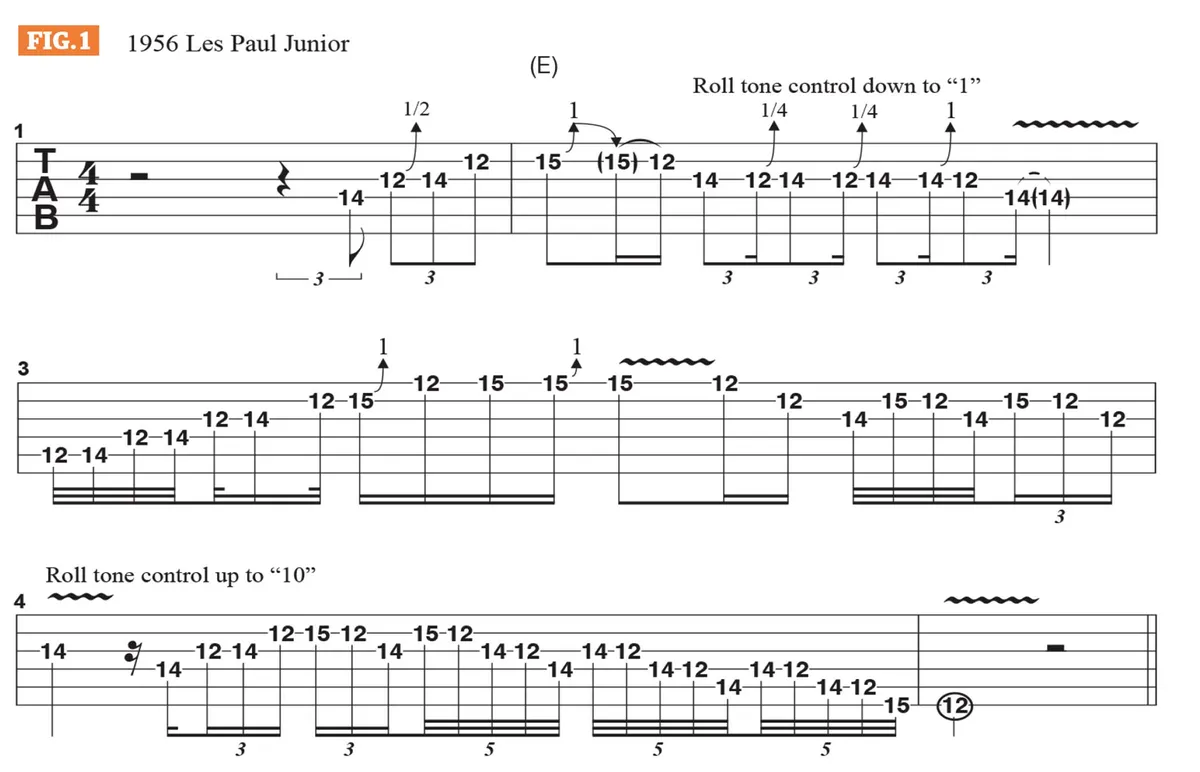
Figure 1 presents a four-bar improvised solo played on a 1956 Junior, one that I bought from my friend Jay Jay French from Twisted Sister. The patterns I’m playing here are based on the E minor pentatonic scale (E, G, A, B, D), and I begin with the tone on 10 (full treble) with straightforward blues phrases played in 12th position.
On beat 2 of bar 2, I roll the tone knob down to 1, or “zero” (no treble), in order to demonstrate the drastic difference in the sound and feel of the phrases. Setting the tone knob on zero is something Eric Clapton “patented” in the early Cream days, on songs such as I Feel Free.
At bar 4, I roll the tone knob back up to 10 and the end phrase with one of my favorite licks, descending through E minor pentatonic in groups of 32nd-note quintuplets.
One pickup, two knobs – what more do you need? Well, some of us need a front (neck) pickup, too! But don’t get me wrong, as I love Juniors of every type.
Figure 2 offers another example played in the 1956 Junior; it sounds just as good for the opening power chords as it does for the single-note blues licks that follow.
This version of the Junior is a single cutaway and is all mahogany. If one were to put a contoured maple cap on this slab body, the result would be a Les Paul Standard.

In 1958, Gibson decided to change the design to what is known as a “double cut” Junior, which has two cutaways, one on both the treble and bass sides of the body. These guitars were primarily offered in cherry red.
Figure 3 is played on a 1960 double-cut Junior, and again I am favoring licks in the key of E, based on E minor pentatonic. It’s basically the same guitar as the single-cut in that it’s all mahogany with a single P-90 pickup, but, as you will discover, not all P-90s sound the same. Generally speaking, they all sound big and fat with a massive amount of midrange.

In 1961, Gibson decided to switch up the Junior once again and offered a redesigned “SG”-style Junior, featuring a much thinner body with a body contour around the guitar’s top. Because of the loss of mass, SG Juniors tend to sound a bit slinkier and brighter, but they still rock.
If you ever get the opportunity, sit down and compare these three different types of Les Paul Juniors. They are all fantastic guitars, and Gibson offers true-to-vintage reissues of them all.
- This article first appeared in Guitar World. Subscribe and save.

