



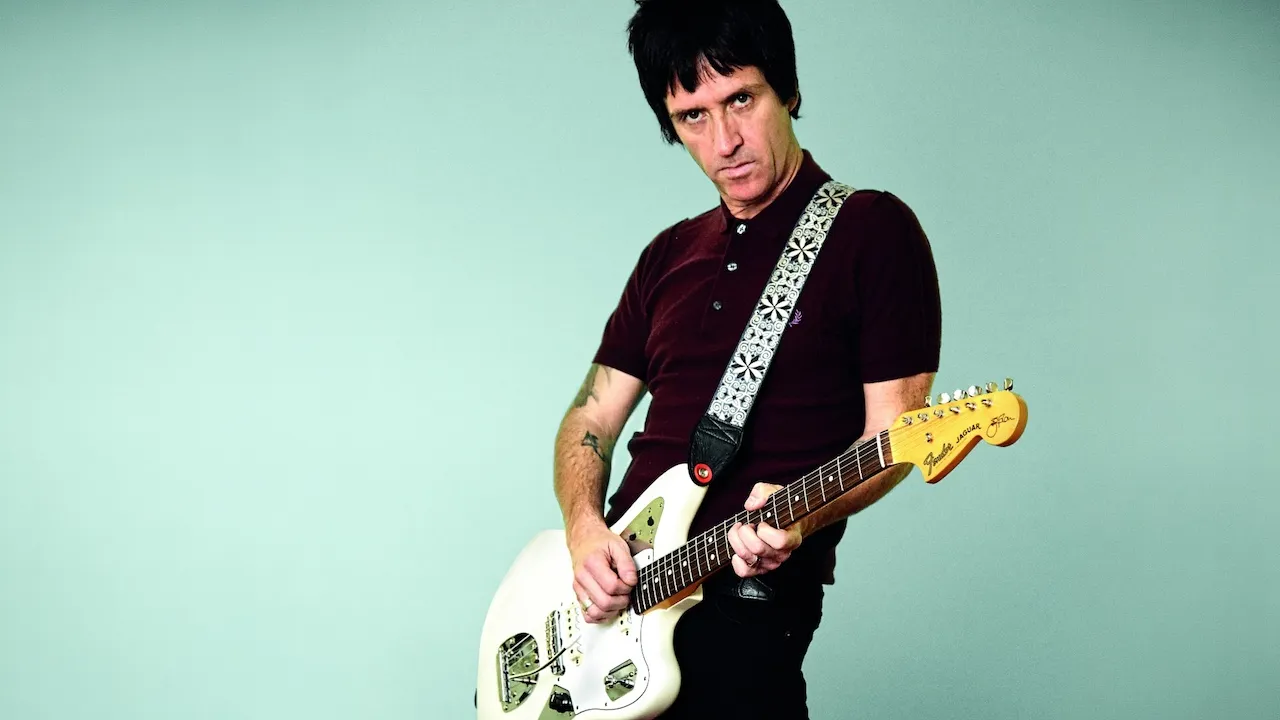
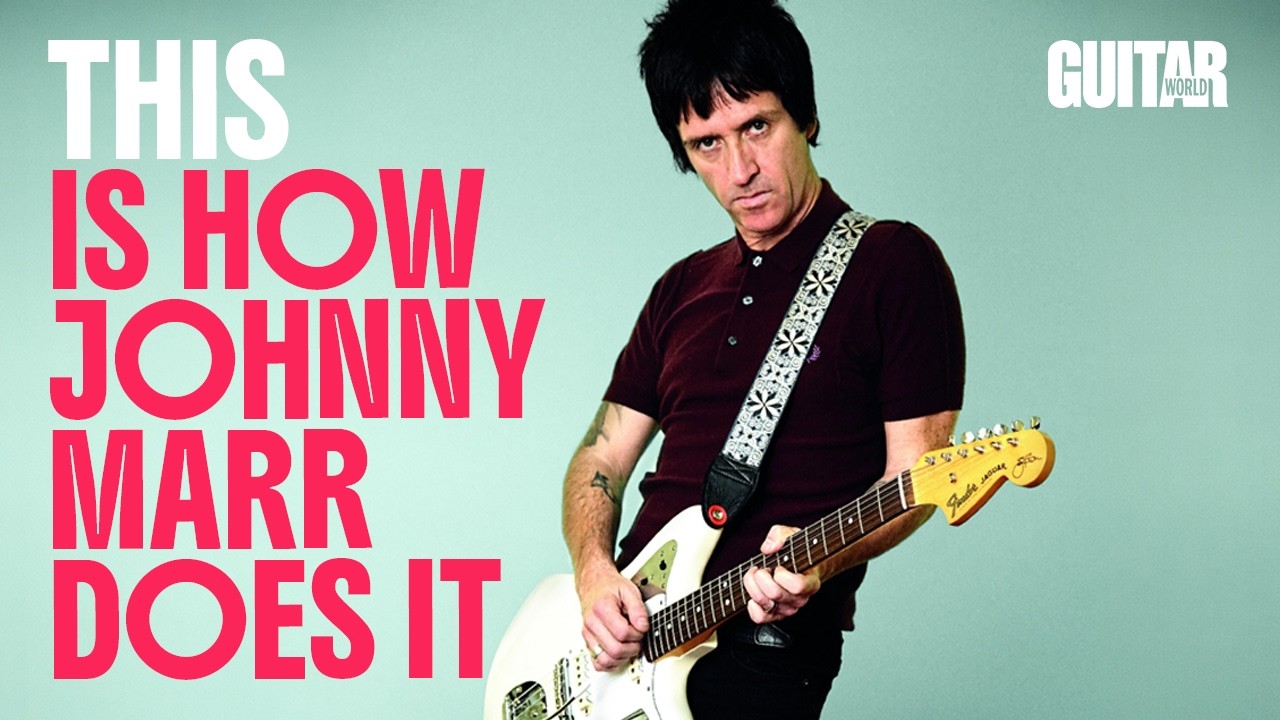
One of the most individual guitarists of the 1980s, Johnny Marr is a master of rhythm guitar.
One of the hallmarks of his style in the Smiths is his extensive use of open strings. You can tell he spent time working on his chord voicings and developing exciting vocabulary that often combines rhythm and lead approaches.
There are two main approaches to Marr’s use of open strings which are covered in the following examples. Sometimes the open strings are applied to common major and minor chord shapes. In this case, the open strings are adding extensions of 6ths, 9ths or 11ths on top of Marr’s modified chord shapes.
As you’ll see, he frequently re-shapes a barre chord – instead of barring across all six strings he’ll re-finger the chord and then use an open string or two. It’s a simple way of obtaining jangly chords that have a lot of personality. Check out Heaven Knows I’m Miserable Now to hear how this works in action.
At other times Marr will use two-finger chords with open strings, fleshing things out to create a big and colorful sound. This approach is particularly effective on uptempo tracks where he can move around the neck rapidly, using deft crosspicking to create lively rhythm parts.
The open strings remain consistent whilst the two-finger chord shapes move against them, creating sounds that are full of color while remaining consistent. There’s much to learn from Johnny, so let’s get started!
Match My Sound: play-along enhancements
For this lesson, we've partnered with MatchMySound to offer the ability to record yourself and see how close you are. MatchMySound is a great tool to help track your progress.
Click on the word 'options' (lower left, below the tab/notation) to select from 'demo audio track' (just guitar), 'backing track' (just the backing), 'full audio' (backing and real guitar audio) and 'metronome' (just a click to play along to).
Below that, select 'options' for how you can record your performance.
At the upper right, the magnifying glass images let you alter the playback speed for learning and pushing your playing onwards.
Follow the cursor to keep up with the tab/notation accurately on screen.
Lastly, to view the music better by filling your desktop/tablet/phone screen, click on the square brackets at the top right.
Johnny Marr open string examples
Example 1a - Modified barre chords (0:59 in the video)
Here’s an example of Marr’s modified barre chords. The open strings serve two purposes here; on the A and C chords the open first (E) string is already a chord tone but doubling this with an open string creates a bigger ‘jangly’ sound.
On the G and D chords, the open first string is adding more color: E is the 6th on the G chord and the 9th on the D.
Example 1b - Condensed chords (1:20 in the video)
Here, chords are condensed onto just two strings, with open strings ringing around them.
This is a great way to move around this chord progression quickly – simple open chord shapes or barres would make this more difficult, and the open strings add a consistency and jangle that other chords can’t provide. This is also a great example of Marr’s deft picking hand technique.
Example 1c - Using triads (2:02 in the video)
This example is based on Em, D and C triads played against open strings. The resulting chords are Em, D6add11/F#, and Cmaj7.
Example 2 - Top four strings (4:00 in the video)
In this example, we see how Marr often focuses on the top four strings for chords. He can move these shapes around, change notes in them quickly, and release fingers to add open strings.
Essentially it’s all triads with open strings and extensions adding more color Using this stripped back approach, you can create a busy sounding rhythm part that won’t stifle the rhythm section and low end. You can also hear his funk influence in the picking hand's 16th note strumming patterns.
Example 3 - Capo at 4th fret (7:18 in the video)
Marr does play larger chords over five or six strings, but using open strings in these chords does open up the sound of the chord. If the results sound too muddy, he’ll use a capo, typically at the 2nd or 4th fret. In this example, the capo is at the 4th fret and it serves to brighten up the sound considerably.
Instead of sitting on one chord, he will often utilize different voicings or those with color. His parts often feel like they are moving around, even though there may be only one underlying chord in the harmony. To get this sounding right use the capo, preferably use a brightish sounding guitar (Tele, Jaguar, Jazzmaster) and a clean amp tone.
Example 4 - Full track example (9:29 in the video)
Here's a fuller example that demonstrates how Marr's approach works over bass and drums. You're after a jangly sound that uses modified triads moving up and down the neck, staying away from the bassline. Open strings are used as much as possible.
Johnny Marr in action
The Smiths - This Charming Man
Syncopated and uptempo picking are prominent here as well as enriching open strings, making the chords more unique than full barre shapes would provide.
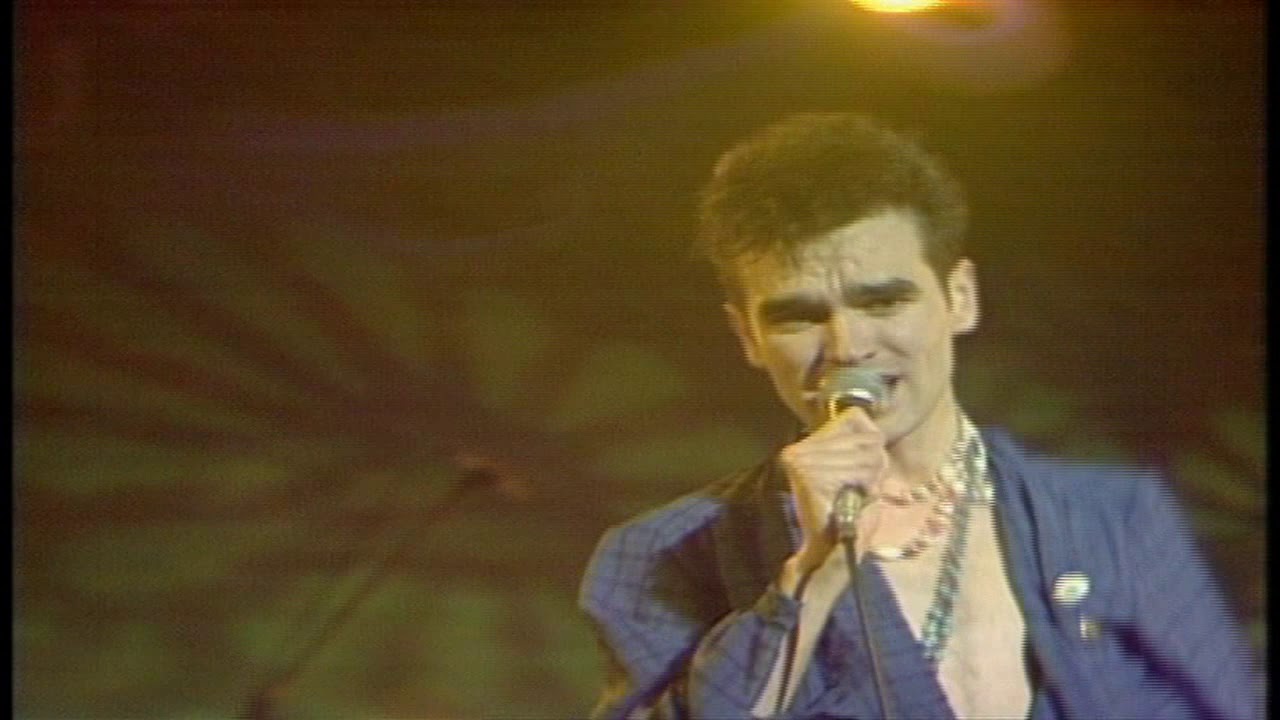
The Smiths - Heaven Knows I'm Miserable Now
Major 7ths, chiming strums, intricate cross picking and open strings feature clearly in this live performance.