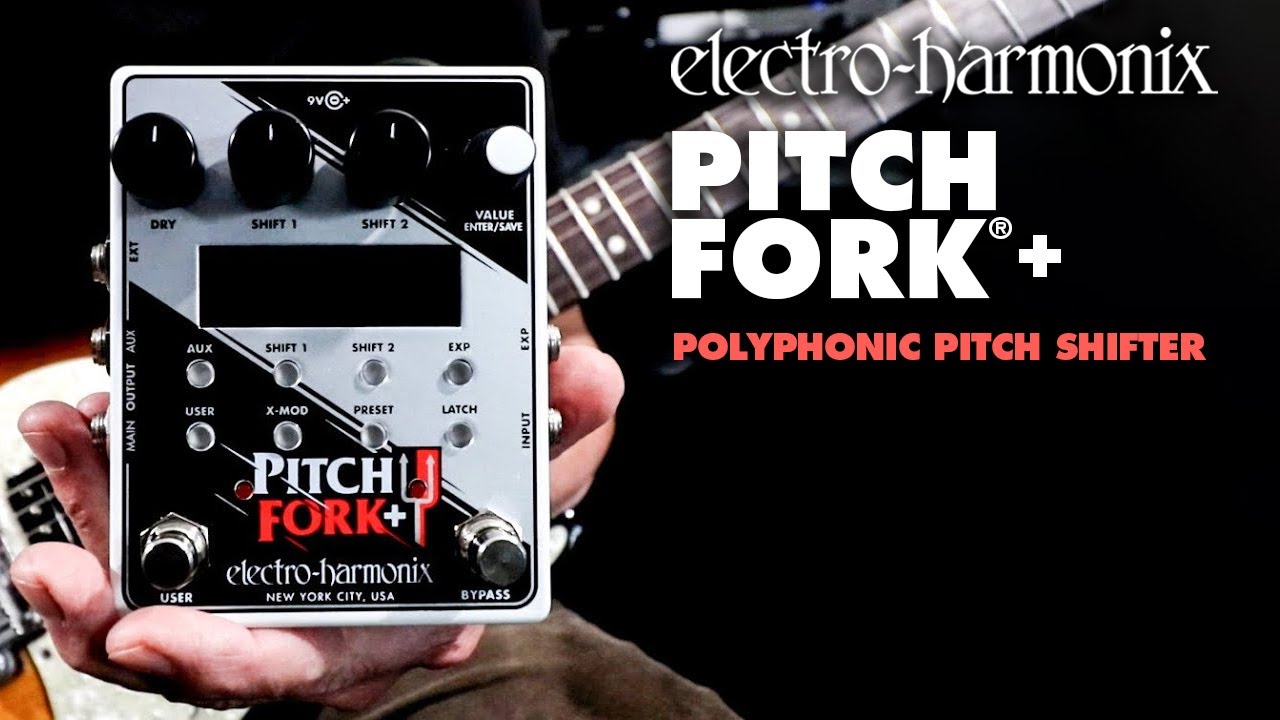
Electro-Harmonix has announced the Pitch Fork+ polyphonic pitch-shifter/harmony pedal, which ranks among EHX’s most fully featured pitch pedals yet.
The Pitch Fork+’s key selling point is two independent pitch-shifting engines, each capable of shifting +/-3 octaves and detuning +/-99 cents.
Individual volume controls are on hand for each shifted voice, as well as the dry signal, while these can be routed in a variety of ways via the main and aux outputs.

There are eight modes, among these X-Mod, which creates FM and ring mod-style sounds, plus an enhanced Momentary mode.
Up to 100 presets can be saved and cycled via the User footswitch, which can also be assigned to functions including muting a shift voice or crossfading modes.
An expression input is onboard for expression or CV control over frequency, glissando and volume, while an external input can be used with foot controllers to scroll through presets.
The Pitch Fork+ is available now for $213.80, including a 9V power supply.
For more information, head over to EHX, or check out the reliably stellar work of Bill Ruppert in the video above. Major props for opening with Rollin’, sir.