Shortlisted for the 2026 Mercury Prize, up-and-coming jazz outfit Knats have carved out a sound that feels as much about storytelling as it does sheer musicality.
Their latest album, A Great Day In Newcastle, brings together contemporary jazz and hip-hop, capturing the energy and character of their home city in the North East of England.
At the low-end is bassist and frontman Stan Woodward, who, alongside drummer King David Ike-Elechi and trumpeter Ferg Kilsby, has pushed the group’s identity further than ever.
“When I was writing this record I really wanted to tell stories,” says Woodward. “We’d never used spoken word before, so I had this idea of bringing Cooper Robson in to do an opening monologue.
“Cooper wrote some incredible words for a track called War Jackie, and after that we just thought, ‘Fuck it, let's get him on the whole record.’ It's completely transformed the band.”
Evidence of that transformation was brought home by a memorable TV appearance on Later... with Jools Holland.
“I remember my bass was slightly out of tune, which was driving me mad, but the nerves were the biggest thing. We thought we were on second, then every time another act finished we’d think, ‘Right, we’re next.’ Then somebody else would walk on, so the nerves built and built.
“Before we knew it, Shania Twain was on playing You're Still the One, but as soon as we started playing, the nerves disappeared. It ended up being one of the most surreal experiences of my life.”
For Woodward, finding the right bass wasn’t simply a case of choosing an instrument – it was about finding something that felt genuinely his. The answer came in the form of a Gibson SG, a bass he’d previously dismissed as “a bit ugly.”
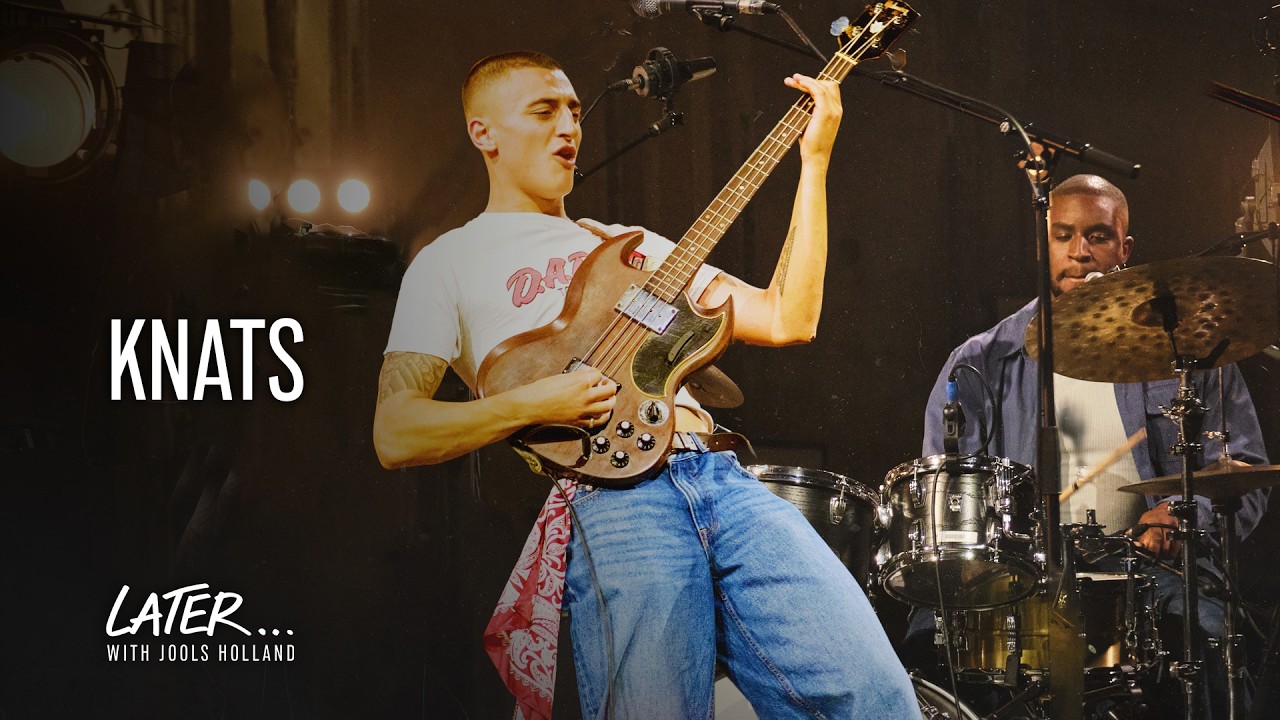
After hearing about vintage Gibson basses from Black Midi frontman Geordie Greep, who also produced their debut album, Woodward decided to take a chance on a 1968 model he found on eBay. What began as an unlikely purchase quickly became a revelation.
“I’d never really considered them, but then I found a ‘68 Gibson SG on eBay for about £1,500. The neck has snapped three times on tour, but it's still the best bass I've ever played. It's been repaired, and somehow it still sounds incredible.
“You’ve got the Mudbucker pickup at the neck, which has this huge, almost piano-like low-end, then the bridge pickup gives you all the clarity you could want for solos. I tend to roll in the bridge pickup almost like it's a built-in boost.
“I've since picked up a 1972 SG as well, although the late-'60s ones are definitely my favourites. The necks are incredibly thin, they're ridiculously comfortable to play, and they've just got this character that I haven't found in anything else.”

Was bass always your first instrument?
I actually started on guitar when I was about 10 or 11. I was completely obsessed with Arctic Monkeys. My mum bought me this cheap little acoustic for Christmas – I think it was about 60 quid – and that was it.
I was about 16 when I started taking it seriously. I got obsessed with jazz, walking basslines and transcribing bebop. I remember trying to learn Donna Lee at that age and absolutely butchering it. But I just kept at it and improved pretty quickly.
How much thought do you put into your bass tone?
Less than people think. The biggest part of my sound is still the SG. That said, I don't think the instrument is what makes the player. You can hand somebody the greatest bass in the world, but your sound is still in your fingers.
Lately I’ve been playing through Orange amps with just a touch of grit, because the band’s getting a bit heavier and rockier. That slight crunch sounds amazing.

Is that what I'm hearing on War Jackie?
That’s actually this cheap Ibanez I bought as an experiment. I completely gutted it – new pickups, new bridge, new tuners – the lot.
I stuck a set of flatwounds on it and ended up recording with it. It’s a bit of a weird-sounding bass, if I’m honest, but that’s kind of why I like it.
The War Jackie bass solo was almost an afterthought. We’d recorded the song on the first day, but I wasn’t happy with the solo, then completely forgot about it.
Right at the end of the final session, after we’d had a couple of drinks, Geordie just turned to me and said, ‘You need to do that solo again.’ I went in, played two takes, and that was it.
It sounds like you’ve got some effects on your solo on Azure Blues.
There’s a phaser on that one, and halfway through we kick in a chorus effect as the band gets louder, just to help the bass push through the mix. I was still using that cheap Ibanez with flatwounds, so I really had to dig in to make it speak.

I was improvising during that solo, but there's quite a lot of Messiaen in there. There's one point where I'm basically superimposing an E-flat minor triad over C major. It's incredibly nerdy, but I remember thinking it sounded cool.
A lot of the material on this record actually started from Olivier Messiaen's modes. The main riff in Carpet Doctor is built almost entirely from Mode 3. War Jackie is the same – the melody stays in Mode 3 almost until the very end.
Do you worry that talking about all that theory makes people see you as the music theory guy?
Not really. I don’t actually talk about it that much unless someone asks. The theory is just part of my process. It isn’t the point of the music. If people are interested, I’m happy to explain it, but I don’t expect listeners to hear a tune and think, ‘Oh, that's Messiaen Mode 3.’ I just want them to feel something.
What advice would you give to bass players who want to build the kind of career you’ve built?
I think writing is one of the most overlooked skills a musician can develop. You can spend years transcribing, practising and becoming an incredible player, but if you want your own artistic identity you have to write your own music.