

The story of the Minutemen is one of the most tragic in the annals of ’80s indie rock.
Led by guitarist/vocalist D. Boon and bassist Mike Watt, and rounded out by drummer George Hurley, the Minutemen were unlike any of their contemporaries.
Their pace was relentless – their masterpiece, 1984’s Double Nickels on the Dime, featured an incredible 45 songs over barely 80 minutes. Contained within was a roller coaster of musical styles – frenzied punk outbursts like Corona (which will be instantly familiar to anyone who’s ever seen Jackass) shared space with an earnest Steely Dan cover.
As they softened their punk edges (musically, mind, not politically) in 1985, it seemed like the band might be primed to travel the road of college-rock-to-mainstream success laid down by R.E.M. Sadly, just as they seemed to be on the threshold of that well-deserved wider recognition, tragedy struck.
On December 22, 1985, while laying in the back of his van without a seatbelt as his girlfriend drove down the highway, the vehicle suffered a sudden structural failure, sending it off the road. Boon was thrown out of its back door, and killed instantly. He was just 27 years old.

Boon’s bandmates were devastated – Watt, always Boon’s foil, lost all desire to play music.
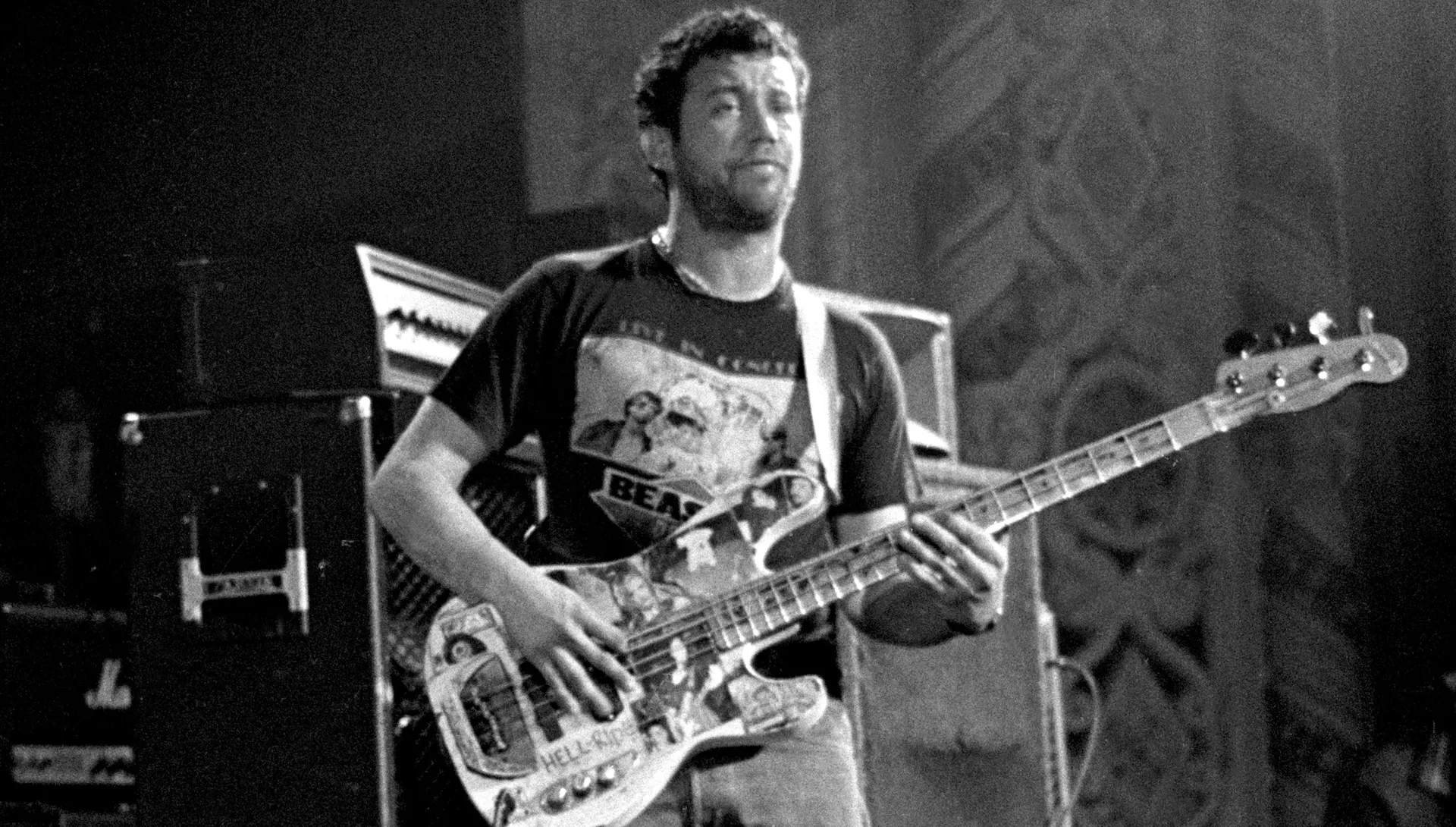
On that note, in a 1995 interview with Guitar World, Watt detailed his beloved Minutemen-era bass, and its fate after the band’s dissolution.
“I got this Gibson – I think it was in 1976 – an EB3-L, like the one Jack Bruce played, but with a slotted headstock,” Watt told GW. “What was important was that it had a thin, three-quarter-scale neck. I played that thing like crazy – it played faster than a guitar – and the strings were so close to the neck that I could really wail on it.
“After D.Boon was gone, I didn’t feel right playing it anymore, so I just gave it away to Flea.”
It was Sonic Youth, with whom Watt was close, who brought the bassist back into music. They recruited him to play on two tracks on their landmark 1986 album, EVOL. Lacking his own bass after the hand-off to Flea, Watt used Youth bassist/vocalist Kim Gordon’s four-string.
Re-energized, Watt teamed up with Hurley to form Firehose, a band that would go on to achieve some of the mainstream success the Minutemen never got the chance to see.
“Mike’s innovative, melodic, and hardcore, all at the same time,” Flea – the recipient of Watt’s Minutemen-era bass – told Bass Player in 1995. “He can also play the simplest thing in the world and imply that he can play anything. He’s one of the greatest bass players ever.”

