


Brian Robertson has been reflecting on his short stint in Motörhead and admits that the signs were there from the beginning that he was not the right man for the job.
Robertson was well acquainted with Motörhead frontman and bassist, the late Lemmy Kilmister. They moved in the same circles. They both enjoyed a good boozer.
“I’d known them for years, hanging out at the same clubs,” says Robertson, speaking to Classic Rock. “Lemmy was always on the one-armed bandits at The Embassy.”
Robertson might have known Lemmy but he didn’t know Motörhead. If he had, he might not have taken the gig. This was always going to be a poisoned chalice. Iron Fist was received with mix reception. Lemmy would go on record as saying it was a mistake to have let the soon-to-exiting guitarist Fast Eddie Clarke produce the album.
Also, Clarke leaving Motörhead in 1982 was officially a big deal. The Three Amigos was a much-loved lineup – and who could replace Fast Eddie Clarke?
Robertson admitted that it was a culture shock. He had to fly out and join them mid-tour, and you get the impression he would have asked the pilot to turn the plane around if he could.
“I wasn’t aware of it, because I wasn’t a fan,” says Robertson. “The only thing I knew was Ace Of Spades. I knew it was going to be rough when I started trying to listen to the material on the flight, because I couldn’t distinguish one track from another.”
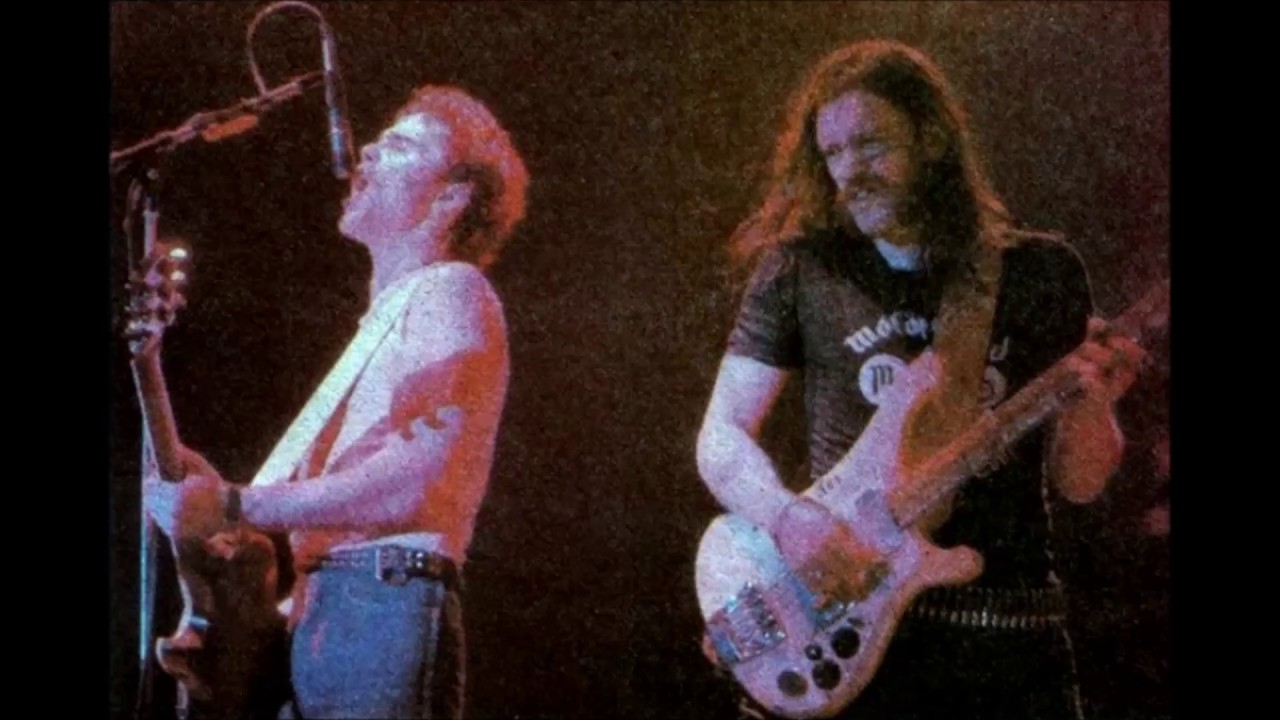
That panic would later manifest itself onstage. When you can’t distinguish one track from another, it puts you at a disadvantage. But what is it about Thin Lizzy guitarists and in-flight epiphanies? Midge Ure, recruited at the last minute to replace Gary Moore, tried to learn the set during a three-hour Transatlantic flight on Concorde.
“[I had] A ghetto blaster and big headphones,” Ure told MusicRadar. “It was pre-Walkman. I sat on Concorde, sipping vintage Dom Perignon – which I’d never had before in my life – trying to get the structures in my head.”
Ure’s fellow Scotsman might have needed something stronger than Champagne. It would have prepared him for the madness ahead. Motörhead were the “total opposite” of Thin Lizzy.
“They didn’t like rehearsing, didn’t like soundcheck, didn’t like being in the studio much,” says Robertson. “We liked to party [in Lizzy], but Motörhead was non-stop.”
Motörhead also had their own internal logic. It was a well run ship. They had ways of doing things that didn’t always make logistical sense – as Robertson found out when he arrived in the States for the tour.
“I went to Toronto first, trying to sort out the visas,” recalls Robertson. “When I eventually got to [New York], I was met at the airport, straight into the rehearsal place, with Lemmy going into his bag of speed. After the rehearsal, they said: ‘We’re getting on the bus.’ We went back into Canada, all the way to Calgary, for the first gig.”
But those gigs went okay, to a point. No, Robertson couldn’t work out which song was which. He’d ask drummer Phil “Philthy Animal” Taylor what to do, but Taylor was in his own world.
They didn’t tell Robertson there was pyro onstage – “I ran to the front of the stage, hit the first chord, and I was standing over a fucking flash bomb!” – and by the time the set was finished Robertson had the suspicion that he had just played the same song the whole time.
He only recorded one studio album, Another Perfect Day, during his time in the band. But even if it wasn’t a good fit, Robertson says all wasn’t lost. He argues that Another Perfect Day was a strong album and opened Lemmy’s mind to more melodic material. He also remembers Lemmy living up to his reputation.
“I didn’t really clash with Lemmy. I enjoyed my time with Motörhead,” says Robertons. “He was such a great lyricist. He’d just do it on the fly.”
When the time came to leave the band, Robertson had no complaints. The band was struggling. Ticket sales were down. And they had allegedly cooked up a scheme to cancel the tour on health grounds and claim the insurance. Robertson, it was agreed, was to be the fall guy, and that was okay by him.
“I stayed up for two nights with the road crew in my room,” says Robertson. “They got this doctor – who the promoter had in his pocket – to come in and sign a certificate for the insurance company. I was obviously fucked up at that point. We came back to London, and [Lemmy and Philthy] came down and said: ‘We should part company.’ I was totally okay with it, because I was looking out for other things. We never really fell out.”
It's not the first time this year Robertson has looked back on one of his departures. In February, he set the record straight on his Thin Lizzy exit.

