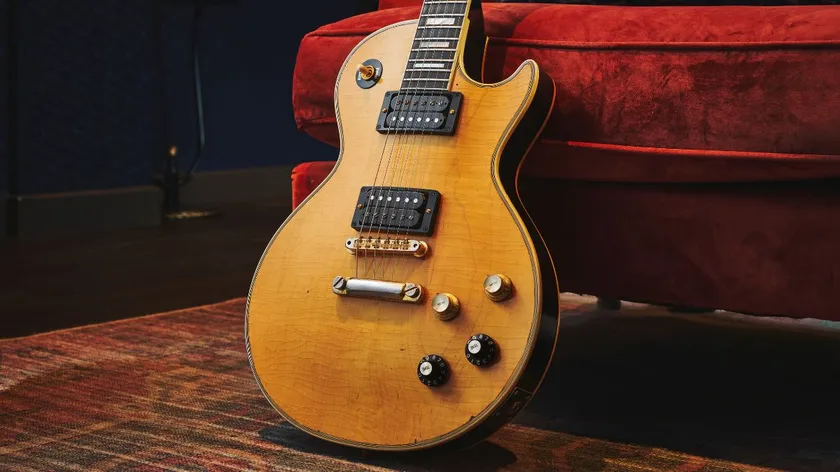





Guitar World Verdict
Having played some pretty off-looking, feeling and sounding versions of these guitars over the years, getting them back pretty much as they were (and in the affordable USA line-up) is more than worthy.
Pros
- +
Good build.
- +
Lively and resonant sound.
- +
Good weight.
- +
Good‑sounding P-90 pickup with a simple drive
- +
The Special gives you that extra pickup and controls.
Cons
- -
The Junior's pickup might be in need of a shim.
- -
It should be wired vintage style.
- -
Unfinished ’board binding on the Special.
- -
Shame it’s not hum-cancelling in mixed position; P-90s can get noisy!
You can trust Guitar World Our expert reviewers spend hours testing and comparing guitar products so you can choose the best for you. Find out more about how we test.
Guitar World Demo
What is it?
As history buffs will know, the first Les Paul Junior launched in 1954, the most affordable ‘economy’ Les Paul below the standard Les Paul model and the top-line Custom. A ‘TV’ Junior model followed, then the twin-pickup Special launched in 1955.
With an eye on sales, the new double-cut Junior and TV were launched in 1958 (the Special was announced then, but production samples weren’t shipped until ’59).
While the new outline didn’t last long before what we call the SG took over in 1961, it was a radical redesign of the single-cut and more traditional Les Paul shape, and in the wake of the Flying V, Explorer and the ES-335, you had access to all its 22 frets. It was a pivotal design, bridging the gap between that old-looking Les Paul and the more progressively shaped SG.
While the Junior was a sales success, in reality neither were in production for very long, not least the double-cut Special, which placed the neck pickup directly at the end of the neck and created an unstable joint.
During 1959, the neck pickup was moved back a little, a new scratchplate was designed, and even the control layout was adapted – and that’s obviously the style Gibson has gone for here.
The design almost seems like a work in progress, then, but one that’s more than earned its place in the classic guitar era aka the Golden Age. So just how do these antiques stand up in the contemporary world?
Specs
Gibson Les Paul Junior Double Cut

- PRICE: $1,699/£1,499 (inc case)
- ORIGIN: USA
- TYPE: Double-cutaway, solidbody electric
- BODY: Mahogany
- NECK: Mahogany, SlimTaper profile, glued-in
- SCALE LENGTH: 624mm (24.6”)
- NUT/WIDTH: Graph Tech/43.4mm
- FINGERBOARD: Rosewood, acrylic dot inlays, 305mm (12”) radius
- FRETS: 22, medium
- HARDWARE: 1-piece wraparound bridge/tailpiece, Kluson-style Gibson Deluxe tuners w/ white buttons – nickel-plating
- STRING SPACING, BRIDGE: 51.5mm
- ELECTRICS: 1x Gibson Dogear P-90 single coil, volume and tone control
- WEIGHT (kg/lb): 2.96/6.5
- LEFT-HANDERS: Not this model
- FINISHES: Vintage Cherry (as reviewed), TV Yellow, Ebony – gloss nitrocellulose
Gibson Les Paul Special Double Cut

- PRICE: $1,999/£1,699 (inc case)
- ORIGIN: USA
- TYPE: Double-cutaway, solidbody electric
- BODY: Mahogany
- NECK: Mahogany, SlimTaper profile, glued-in
- SCALE LENGTH: 624mm (24.6”)
- NUT/WIDTH: Graph Tech/43.4mm
- FINGERBOARD: Single-bound rosewood, acrylic dot inlays, 305mm (12”) radius
- FRETS: 22, medium
- HARDWARE: 1-piece wraparound bridge/tailpiece, Kluson-style Gibson Deluxe tuners w/ white buttons – nickel-plating
- STRING SPACING, BRIDGE: 51.5mm
- ELECTRICS: 2x Gibson Soapbar P-90 single coils, 3-way toggle pickup selector switch, individual volume and tone controls
- WEIGHT (kg/lb): 3.28/7.22
- LEFT-HANDERS: Not this model
- FINISHES: TV Yellow (as reviewed), Vintage Cherry, Ebony – gloss nitrocellulose
- CONTACT: Gibson
Playability and sounds

Each of the new models is offered in Cherry, TV Yellow and Ebony, and essentially these are the same guitar with the exception of the pickup complement and subsequent control count.
There are no forearm or ribcage contours, of course, but more so than the single-cut design these feel less brutal and both are well weighted, our Junior dropping into lightweight category
The 45mm thick slab bodies are nicely centre-joined slabs of mahogany, with a good radius to the edges, which does get a bit tighter in the cutaways. There are no forearm or ribcage contours, of course, but more so than the single-cut design these feel less brutal and both are well weighted, our Junior dropping into lightweight category. It’s a big change compared with the increasingly weighty Les Pauls we’ve encountered over the past few reviews.
The one-piece quarter-sawn mahogany necks on both are identical, too, as are the dark rosewood fingerboards, the acrylic dot inlays and fret gauge (both are 22-fret guitars with the shorter Gibson scale, which measures under the quoted 629mm/24.75 inches). The only difference is the cream binding on the fingerboard edges of the Special, but not the headstock.
Here, both have model name gold-paint legends: the Junior’s ‘Gibson’ is the same, while the Special’s brand logo is a posher-looking unspecified shell, presumably inlaid.
Hardware is mirrored. Both use the Advanced Plating lightweight aluminium wrapover bridge/tailpiece; the neck angles are identical so neither bridge sits particularly high off the body face, although typically both do slightly tilt forward.

Meanwhile, instead of the ‘three-on-plate’ style of the ’50s originals, the tuners are individual units, stamped Gibson Deluxe with Kluson-style backs but the more modern front nut-mounting. Both retain the cream plastic buttons.
The Junior is beautifully gloss-finished and deeply coloured. There’s slightly more grain sinkage on the TV Yellow Special, but it’s minimal
The Junior’s single-ply and unnecessarily sharp-edged black plastic scratchplate is redrawn from the single-cut model and has become quite a design classic, finding its way onto plenty of contemporary guitars, not least Nik Huber’s Krautster, which inspired designs such as PJD’s Carey. It leaves plenty of room for the old-style dog-ear covered P-90.
The Special’s ’plate? Well, it’s a black/white/black three-ply plastic and is distinctive, if a little odd, with its outpointing bass-side line that’s clearly derived from the single-cut Special’s narrower scratchplate.
But don’t forget, to cover up the ‘moved’ neck pickup this was (perhaps hastily?) redrawn from the original, itself not exactly a masterpiece.

The Junior is beautifully gloss-finished and deeply coloured. There’s slightly more grain sinkage on the TV Yellow Special, but it’s minimal, while the colour is more mustardy than banana bright-yellow. There’s some slightly unlevel small finish areas on both, on the top either side of where the neck joins the body, which does look a little careless.
Also, the top edge of the Special’s fingerboard binding is left very sharp and we struggle to understand why: surely any seasoned guitar player involved in the production and QC would have gone, ‘Hang on a minute, this isn’t finished.’ It takes minutes to roll the binding – and, frankly, we couldn’t resist – instantly improving the feel. Speaking of which…
This Junior is a guitar you can get lost in. The light weight, good setup and lively, vibrant unplugged voice make it the perfect couch noodler
This Junior is a guitar you can get lost in. The light weight, good setup and lively, vibrant unplugged voice make it the perfect couch noodler. Strapped on, the balance is perfect – the guitar disappears. The Special is little different, especially after we’d sorted those binding edges.
But it’s all about the details, right? And the first thing to shout out here are the SlimTaper neck profiles. Whether or not it’s the long unsupported-by-the-body neck length, these feel slimmer than Gibson’s usual SlimTaper, although both have well-shaped shallow C profiles.
Dimensionally, however, they’re only marginally different from the recent Noel Gallagher Les Paul’s SlimTaper, for example, which measured 20.9mm deep at the 1st fret, 23.6mm by the 12th. Here, the Junior’s neck measures virtually identically, 20.4mm and 23.5m, and the Special’s is fractionally slimmer at 20.3mm and 23.3mm.

Both necks do have a little flex, certainly compared with our original ’57 single-cut Junior neck, which is girder stiff. And although we have the all-access neck, like the SG, here the neck feels less extended than the later design, played seated or strapped on.
Fretting on both is from Gibson’s standard gauge, which is more medium than medium jumbo, as we’ve pointed out before. We’ve also noticed the low height on some samples, though here it’s just about okay – but they’re not big, let alone tall frets.
The Junior’s are slightly higher, nicely dome-topped, too; the Special’s are very slightly lower in height with marginally flatter tops, presumably a result of the levelling process. It’s minor, though. Both Graph Tech nuts are well cut, although both D strings stick a little and need easing, but otherwise tuning is pretty solid.

What about intonation with the wrapover bridges? Well, there’s always a compromise with these bridges, but checking the guitars over with a Peterson Strobe tuner they’re pretty close and importantly both sound musical.
Just be aware of that neck flex we mentioned because it means you can easily pull chords marginally sharp or push them flat, especially on the Special. Some players use that to their advantage; others, well, don’t.
Despite the similarities, in their common bridge positions our Double Cuts do sound slightly different. There’s no height adjustment on the Junior’s dog-ear P-90 aside from raising the polepieces, which, in this writer’s experience, can brighten the voice as opposed to raising the whole pickup with the poles just protruding from the cover, which we can do on the Special.

So with the Junior’s P-90 sitting a little further from the strings, it’s the more single-coil-sounding of the two; the closer-spaced Special’s pickup seems to pull back the brightness, adding more thickness and a smidge more output. With our trusty ’57 single-cut as reference, the Special gets closest, although neither has quite the output of the ’57; they sound a little softer, less in your face.
But the Special’s extra sounds created by the neck pickup, not to mention the combined mix, really broaden its voice. Voiced on its own, the neck moves from clean jazz comping with the volume pulled back, to Clapton-y/Santana-like cream at full volume.

Kick in some basic pedals and it’s all here if you have to cover different sounds and styles. The mix seems to enhance the upper-end Fender-y character, possibly because the pickups are slightly closer-spaced: it’s a lovely old-soul rhythm sound, plus it can be shaded by the four controls.
If you just run everything full up, you get three distinct voices. Use the volume and tone and there’s a lot more, but we do have to warn you that the toggle-switch placement isn’t the best. It gets in the way of those volume controls. Just saying…
Overall, then, both our Double Cut models have a different sonic footprint, not only from their older single-cut siblings but different again and lighter than the girth of a ‘proper’ Les Paul. Nevertheless, the P-90’s character really shines here – the fat single coil with its rawer midrange is not only a classic voice, it’s rather addictive.
Verdict
Verdict: ★★★★½

These are lighter weight, slightly more delicate-feeling (and sounding) guitars compared with the single-cuts, and both are lively, vibrant instruments.
The Special is a vastly expanded vision. It still does dirty rock ’n’ roll, but the neck pickup allows you to stretch out, the pickup mix is superb
Every rock ’n’ roll guitarist needs a Junior, and while this sits on the slightly brighter side of the tracks, just crank it up and there’s clarity with that midrange push. Yes, we might be tempted to quickly swap to vintage wiring (a very simple mod) to uncover some more sounds, but as is it’s hard to argue with. A lovely piece.
The Special is a vastly expanded vision. It still does dirty rock ’n’ roll, but the neck pickup allows you to stretch out, the pickup mix is superb and, of course, you have the extra controls. It’s a real journeyman guitar, great for function players but with a host of very classic Gibson voices.
Price-wise? Well, compared to their single-cut versions, while our Special DC here is the same price, our Junior DC is actually cheaper. Then there’s considerable choice from Gibson USA in this price area from the Original Collection’s dual-P-90 SG Special, like our DC’s with a hard case, to the Modern strand’s all-humbucking Les Paul Modern Lite, Les Paul Studio and Les Paul Music City Special with soft-shell cases.
Yes, there are a few Gibson-isms with slightly patchy detail-finishing and the Special’s pickups need more support, and not everyone gets on with the one-piece bridge or indeed the potential noise from the P-90 single coils. For others, though, that’s all part of the appeal of slab-body Les Pauls, and these are very welcome reminders of the evocative and influential original designs. After all, choice is good, isn’t it?
Guitar World verdict: Having played some pretty off-looking, feeling and sounding versions of these guitars over the years, getting them back pretty much as they were (and in the affordable USA line-up) is more than worthy.
Hands-on videos
Peach Guitars
- "Some might say this is far from a valid Oasis signature guitar, having only come into play earlier this year": Gibson Noel Gallagher Les Paul Standard review
- This article first appeared in Guitarist. Subscribe and save.

