


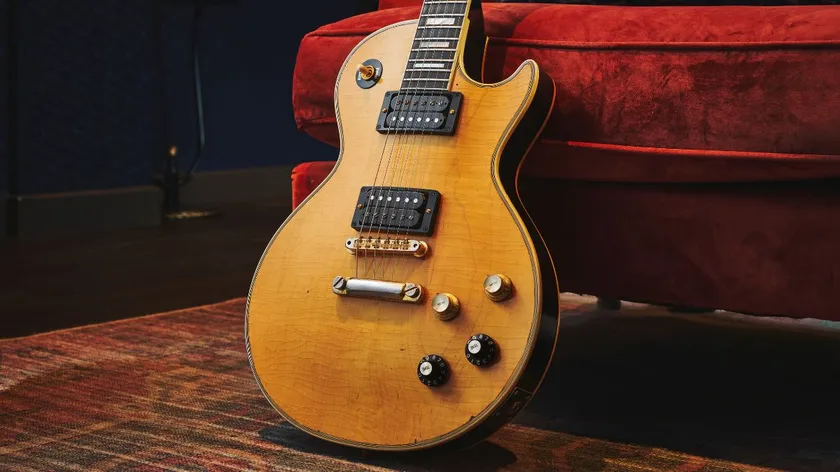


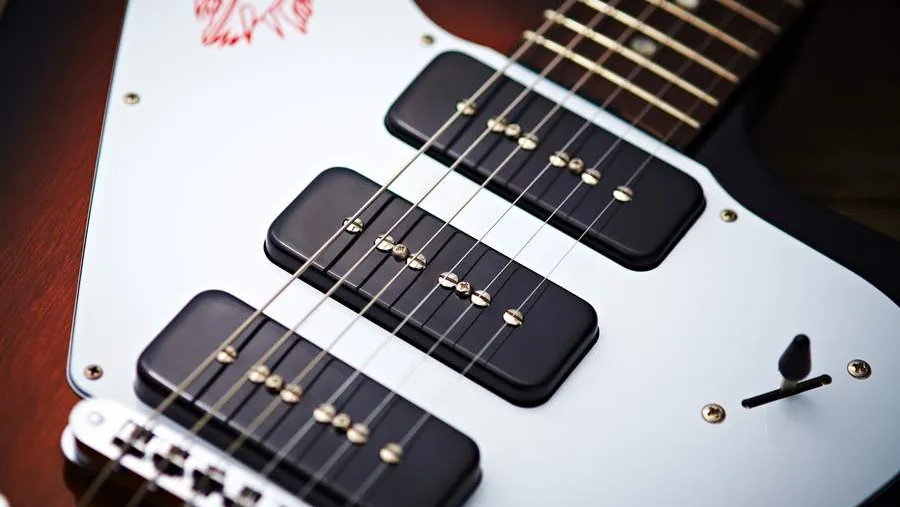
Guitarists will argue until they're blue in the face about every minute detail of the electric guitar. From the role tonewood plays in the overall sound, to which tone capacitors will allow you to achieve sonic bliss and everything in-between. Thankfully, there's one thing guitar players universally agree on – P-90 pickups are among the most versatile tone generators in the world.
Introduced to guitarists in the 1940s, Gibson's wide bobbin single coil is just as popular today as it was all those decades ago. These days, there are many pickup designers and manufacturers looking to showcase their own unique take on this iconic concept, and I've listed a selection of my favorite examples in this guide to the best P-90 pickups.
Since installing a P-90 Soapbar in my Nashville Telecaster years back, I couldn’t believe I didn’t do it sooner. If you want a classic P-90, look no further than Gibson’s P-90 Soapbar. Straight from the originators, it’s as authentic as you can get. For something a bit more versatile, the Fishman Fluence Greg Koch P-90 is this single-coil pickup at its fullest degree.
I've also chosen vintage throwbacks from Seymour Duncan, hi-tech options from Lace, as well as hum-canceling pups that allow you to crank the gain without fear of excessive noise. So, join me as I walk through a slew of P-90s that are sure to seriously improve your tone.
My top picks

Seymour Duncan is arguably the most popular and well-known electric guitar pickup designer ever – and with their decades of experience, knowledge and thirst for better tone, Seymour Duncan is our go-to place for epic-sounding P-90s.

While we all love the bright, shimmery nature of single coil pickups, we can all do without that dreaded 60-cycle hum. This excessive noise has the ability to ruin a perfectly beautiful guitar sound, and it can drive some players mad.

If you are seeking the authentic P-90 tone of early '50s six-strings, then it makes sense to go straight to the source, Gibson. Over the course of the last few decades, Gibson has defined the sound of blues, punk and hard rock with their soapbar single coil and you can easily achieve this legendary sound by installing this pickup in your guitar.
Best overall

✅ Buy if you want a classic vintage tone: The Seymour Duncan Antiquity P-90 are perfect for blues players who want a bit of bite.
❌ Avoid if you want contemporary sound: The clue is in the name, so if vintage tones aren't your thing, look elsewhere.
Seymour Duncan is arguably the most popular and well-known electric guitar pickup designer ever – and with their decades of experience, knowledge and thirst for better tone, Seymour Duncan is our go-to place for epic-sounding P-90s.
While I had a lot of P-90s to choose from, my top pick has to be the Antiquity. This vintage reissue pickup has been a guitar modders staple since the '90s and is a firm favourite among vintage guitar chasers.
Utilising a twin set of Alnico II bar magnets, this soapbar pickup yields a retro tone that sounds like it jumped straight out of an early '50s Les Paul – and just like those vintage examples, the Antiquity has plenty of bite and a mid-range bark that's perfectly suited for those bluesy lead lines.
Most versatile

✅ Buy if you like mixing up styles: The Greg Koch P-90 offers three tone settings, making it a flexible pickup for your playing.
❌ Avoid if you're locked into a single style: That variety is great, but it won't suit players who are happy with a singular style.
Video instructor, best-selling author and guitar player extraordinaire, Greg Koch, is one of the guitar communities most well-respected personalities – oh, and he just so happens to have lent his name to a rather spectacular P-90 pickup.
Now, this isn't Koch's first venture into Fluence technology. After seeing success with his Telecaster Gristle-Tone pickup set, Fishman and Koch would team up again, taking on the legendary sound of the soapbar.
Fishman offers a unique take on the P-90, giving users a trio of voices. In position one, you'll be met with a vintage-inspired soapbar, while in position two, the sound will be more aggressive as it imitates the tone of an overwound, modded P90. Finally, in the third position, you can expect a bright and jangly single coil tone.
Best ceramic P-90

✅ Buy if you want a solid set of ceramic pickups: The DiMarzio Soapbar provide vintage tones - and you can pick them up in a variety of colors.
❌ Avoid if you play a more aggressive style: The tone here probably won't appeal to shredders.
Perhaps best known for the devilishly popular Super Distortion humbucker, DiMarzio is a leading force in aftermarket pickups. However, it isn't all high-output shred-ready humbuckers at DiMarzio, they make a pretty stellar P-90 as well.
The simply named DiMarzio Soapbar is a fairly faithful take on the vintage P-90s of yesteryear, but with one major departure – the use of ceramic magnets.
While these pickups are designed to sound as close to the originals as possible, the switch to ceramic means the pickup's magnetic field won't deteriorate over time, so neither will the tone.
This brilliant-sounding P-90 is available in various color options, so you'll be sure to find one to suit your current six-string – and it even comes in the dogear format, too!
Best noiseless

✅ Buy if you want a set of stripped-back P-90s: The 56 Quiet Coil P-90s are a nice set of pickups which offer a no-fuss, classic tone.
❌ Avoid if you like to play your guitar loud: These are not suited to those who like to crank things up and notch or two.
While we all love the bright, shimmery nature of single coil pickups, we can all do without that dreaded 60-cycle hum. This excessive noise has the ability to ruin a perfectly beautiful guitar sound, and it can drive some players mad.
Luckily, Mojotone has the perfect option for those not willing to compromise on a true vintage tone but are desperate to eliminate the extra noise – the 56 Quiet Coil P-90.
Unlike other noiseless options, the Mojotones 56 Quiet Coil P-90 doesn't use any fancy modern tech to eradicate the noise.
You'll find no PC boards, batteries or stacked coils here, just 42 gauge coil wire, lower Gauss Alnico magnets and vintage braided leads.
Best classic

✅ Buy if you want to dive into that original Gibson sound: You'll get wonderful warm tones with the Gibson P-90 Soapbar.
❌ Avoid if warm, vintage tones aren't quite your thing: These Gibsons suit a particular sound which might not be your thing.
If you are seeking the authentic P-90 tone of early '50s six-strings, then it makes sense to go straight to the source, Gibson. Over the course of the last few decades, Gibson has defined the sound of blues, punk and hard rock with their soapbar single coil and you can easily achieve this legendary sound by installing this pickup in your guitar.
Gibson has designed this replacement pickup to be as authentic to the originals as possible. From the warm vintage tone to the braided two-conductor wiring, this pickup will transport your guitar back in time.
So whether you have a Gibson guitar in need of an upgrade or you just want to add a little Gibson magic to your current axe, this is the pickup for you.
Best for hard rock

✅ Buy if you want a big and bold sound: The Supermassive 90s offer a contemporary tone and deliver a huge wall of sound.
❌ Avoid if you're after something a little more gentle sounding: If hard rock doesn't float your boat, then something else from my list will definitely suit you better.
Bare Knuckle aren't concerned with trying to replicate the past with the Supermassive 90, instead focusing on a modern tone that delivers extra output and body – and boy, this stunning P-90 pickup hits you in the face like an ungloved fist.
At the heart of this pickup are custom-made Alnico V magnets and 43AWG wire, resulting in a P-90 that contemporary rock fans will adore. The Supermassive 90 takes gain like no other P-90 we tried, managing to handle the most outrageous fuzz tones with ease.
So if you aren't on the hunt for the retro tone of vintage guitars and are instead looking to make an impact with truly gigantic-sounding riffs, you need to give the Bare Knuckle Supermassive 90 a try.
Best Neodymium

✅ Buy if you want to give your playing an edge: These P-90s are a neat choice for rockers and blues players thank to their raw performance.
❌ Avoid if you're looking for a rounder tone: That bold, in your face delivery simply won't suit some play styles.
The Lindy Fralin Hum-Cancelling P-90 is a triumph. This pickup sounds bold and raw, with just the right amount of mids to cut through the densest rock track – and better yet, there's no 60-cycle hum!
Utilising USA-made Neodymium magnets, this pickup delivers a feisty tone that will most certainly please hard rockers and blues rock aficionados.
Each pickup is perfectly hand-wound and Lindy Fralin is so confident in his work that you also get a 10-year warranty against manufacturing defects.
So, if you're looking for a boutique approach to the P-90 tone, it's worth seeking out the Lindy Fralin Hum-Cancelling P-90.
How to choose a P-90

Choosing a new P-90 can be a tricky job. There are plenty of variables to consider and, without first-hand experience playing the pickup you’re looking at, it can feel like a bit of a shot in the dark. The good news is I’ve been through the same dilemma and I came out the other side happy with my choice. Here are the points I considered that helped me make the right decision.
Playing style
Although the best P-90 pickups are incredibly versatile, it’s important you consider your playing style, tastes and genre you typically play in. Personally, I play plenty of pop-punk and emo, so I wanted something that had bite, could retain clarity and feel warm when I needed it to.
If you are a bluesy player looking for true ‘50s tone, then the Gibson P-90 Soapbar is a great choice. On the other hand, those playing massive, in-your-face riffs will likely prefer the Bare Knuckle Supermassive. Considering your playing style will help whittle down the choices out there.
Magnets and Resistance
Pickup performance and tone are largely down to the materials used, with none more important than the magnet. The metallic alloy used to construct the magnet has a big impact on what you hear. For example, an Alnico II magnet will typically sound warmer than Alnico V, which is generally more punchy and aggressive.
Output, often referenced by a pickup’s DC resistance, can also give you a great indication of what to expect tonally. Lower resistance pickups tend to sound cleaner and more open, but may lack some punch. On the other hand, higher resistance pickups usually suit more driven, gritty tones. Without physically playing the P-90 you are interested in, these ‘under the hood’ specs are your best bet of understanding the pickups’ tone.
Fit
This is a practical consideration, but perhaps the most important. Installing a P-90, or any pickup, can be a tricky business. Ideally, finding a P-90 that’s a direct swap for your current pickup is the easiest solution. Routing can be done to create space, but it’s a temperamental job that will need to be done by a professional.
There are humbucker-sized P-90s that can slot directly into a humbucker cavity, making them a good choice if you’re replacing a humbucker. Dogear P-90s, on the other hand, may require additional work to install. Trust me, choosing the correct size P-90 will make your life much easier and far less expensive.
FAQs

What is a P-90 pickup?
While it may not look like it, the P-90 is actually a type of single coil pickup. Yes, it may share a similar bulky exterior to its more aggressive cousin, the humbucker, but under that large plastic cover is a sweet-sounding single coil that delivers a sizzling high-end and piercing mid-range.
Unlike other single coil pickups, like those found on the Fender Stratocaster and Telecaster models, the P-90 utilizes a wider, shorter bobbin and this is what gives the soapbar pickup its fat, rich and assertive tone.
The P-90 was originally developed by guitar legends Gibson in the late 1940s. Originally designed to replace the Charlie Christian pickup on the company's luxury hollowbody guitars – such as the ES-150 – the P-90 would prove very popular with the post-war audience and would go on to be the standard pickup throughout Gibson's entire line, that is, until the humbucker would be unleashed in 1955.
When should I replace my guitar pickups?
Okay, so you love the way your guitar feels to play and it has the look you're after, but there's only one problem – the sound. Well, in that case, it might be time to think about changing the pickups.
Installing a brand-new set of pickups in your guitar can drastically change how the guitar performs, transforming it into a completely different instrument.
Is your guitar signal a little too weak to drive your tube amp? Well, a higher output P-90 will give you that extra power needed to push your amp into sweet distortion. Perhaps you're seeking a little extra clarity or note definition. Well, there's a pickup out there that'll do just that.
What genres are P-90 pickups good for?
The versatility of P-90s makes them a strong choice for a wide range of genres. They cover the classic ‘guitar’ styles incredibly well, from hard rock and blues to pop-punk and even metal. With more bite and midrange push than a standard single coil, P-90s often show up in heavier, more distorted styles where a Strat-style pickup might fall short. That said, for modern, ultra high-gain metal, you may want to look at active or higher-output options.
Sitting somewhere between a traditional single coil and a humbucker, the P-90 sits in a very useful middle ground. That balance makes it an excellent all-rounder for players who want one pickup that can cover a lot of bases.
What are the downfalls of a P-90?
Being a single coil pickup, it won’t come as a surprise that a P-90 can get a bit noisy, particularly under high-gain scenarios. Although the coil is wider than a traditional single coil, there’s still only one. Unlike a humbucker, which uses two coils with opposite polarities to cancel out hum, a P-90 simply isn’t designed to do that.
Speaking from experience, a neck-position P-90 can also sound quite bass-heavy, which can be a little tricky to clean up. If you’re only planning on installing a single P-90, that’s something worth bearing in mind.
Do P-90 pickups have more clarity than humbuckers?
Yes. Generally speaking, P-90 pickups have more clarity than humbuckers. Since a P-90 is a single-coil pickup, it comes with the clarity and brightness you’d expect, although it’s a bit beefier thanks to its wider bobbin and coil. Humbuckers tend to sound warmer but can sometimes get a little muddy, as they have a more pronounced low end, largely due to their double-coil construction.
Can you play metal with P-90s?
Absolutely. There are plenty of metal players who use P-90s, none more famous than the grandfather of metal himself, Tony Iommi. The gritty, aggressive character of a P-90 deserves a lot of credit for helping shape the early metal sound, and without it, things might have turned out very differently. There are also heavier bands that appreciate the P-90’s bite, such as Sunn O))) and even death metal outfit Carcass.
That said, for metal styles that demand an ultra-tight low end, particularly more modern iterations of the genre, P-90s may not be the best fit. These styles tend to favor a more focused bass response and scooped mids, so if that’s your sound, it may be worth looking elsewhere.
Can a P-90 fit in a humbucker?
Traditional P-90s won’t fit into a humbucker cavity without additional routing work. They’re wider than humbuckers and require more space to be carved out of the guitar’s body.
However, there are humbucker-sized P-90s that have been designed to drop straight into a humbucker route, with no luthier work required. As with any pickup swap, it’s worth getting the measuring tape and spec sheet out to make sure the P-90 you’re looking at will fit your guitar properly.
Which guitarists use P-90s?
There are many iconic guitar players that have been seduced by the mid-range bark of the P-90. Everyone from classic rock legends to punk rock trailblazers, every genre has its fair share of P-90 fans.
The grandfather of metal, Tony Iommi, has used a P-90 loaded SG for some of the heaviest riffs ever recorded, while Billie Joe Armstrong, Mick Jones, Johnny Thunders and Steve Jones rely on this fierce pickup to achieve their chaotic punk tones.
Elsewhere you'll often spot the likes of John Lennon, Carlos Santana and Neil Young with a P-90 in their iconic guitars in the studio and on stage.
Glossary
Active pickup: A type of pickup that's powered, instead of passive. Active pickups typically have a higher output and a more controlled frequency response.
Alnico magnet: The magnet found in guitar pickups, made from an alloy of aluminum, nickel, and cobalt. It is known for a warm and dynamic tone.
Bobbin: This is the component of a pickup that the copper wire coils are wound around. A P-90’s bobbin is wider and shallower than a traditional single coil.
Coil wind: This refers to the copper wire windings wrapped around the bobbin in a guitar pickup. It creates an electromagnetic field that converts string vibrations into an electrical signal.
DC resistance: This is the electrical resistance of a pickup’s coil windings. Measured in ohms, it can give an indication of a P-90’s output and tonal characteristics.
Dogear P-90: A traditional style of P-90, the “dogear” refers to the extra pickup casing at the sides, which is used to mount the pickup directly to the guitar’s body.
Hum-canceling: A hum-canceling P-90 is designed to reduce the 60-cycle hum typical of single-coil designs. This type of P-90 usually features a dual-coil design, often stacked on top of one another.
Magnet type: There are several different magnet types used in pickups, each made from a different metallic alloy that influences tone, such as Alnico, ceramic, and neodymium.
Neodymium magnet: Otherwise known as a rare earth magnet, this type of magnet produces a much stronger magnetic force than traditional Alnico magnets.
Output: This refers to how strong a pickup’s signal is. Higher-output pickups will drive an amplifier harder, while lower-output pickups tend to sound cleaner and more dynamic.
Passive pickup: A traditional type of pickup that doesn't require power to convert string vibrations into an electrical signal.
Pole pieces: These are the parts of a pickup aligned with each string that act as magnetic conductors. Pole pieces can be screws, slugs, or metal rods, depending on the pickup’s construction.
Soapbar P-90: Unlike a dogear P-90, the soapbar comes in a rectangular-shaped casing, resembling a bar of soap. The soapbar was released a few years after the dogear, making it the younger sibling.
Wax potting: This describes the process of dipping a pickup into melted wax to fill air gaps between the coil windings, helping reduce feedback and create a more stable pickup.
How we choose

Here at Guitar World, we are experts in our field, with many years of playing and product testing between us. We live and breathe everything guitar and bass related, and we draw on this knowledge and experience of using products in live, recording and rehearsal scenarios when selecting the products for our guides.
When choosing what we believe to be the best P-90 pickups available right now, we combine our hands-on experience, user reviews and testimonies and engage in lengthy discussions with our editorial colleagues to reach a consensus about the top products in any given category.
First and foremost, we are guitarists, and we want other players to find the right product for them. So we take into careful consideration everything from budget to feature set, durability and value for money to come up with a list of what we can safely say are the best P-90 pickups on the market right now.
Read more about our rating system, how we choose the gear we feature, and exactly how we test each product.
Why trust Guitar World?
☑️ A global audience of 3.8 million guitarists monthly
☑️ 1,200+ reviews on GuitarWorld.com
☑️ 30+ years of product testing at Guitar World
Guitar World boasts more than 44 years of expertise and stands as the ultimate authority on all things related to guitars. The magazine and website feature expertly written gear round-ups and top-quality, authoritative reviews penned by a team of highly experienced industry professionals.
Guitar World's inaugural print issue hit the shelves in July 1980, and ever since, it has been captivating players and enthusiasts with engaging lessons, insightful interviews with the biggest guitar heroes, and priceless buying advice for newbie players.
Furthermore, GuitarWorld.com continues this legacy online and serves as the hub of the world's foremost authorities on guitar playing. The site not only hosts content from Guitar World but also showcases articles from respected publications such as Guitarist, Total Guitar, Guitar Techniques, and Bass Player. With a reach extending to 3.8 million players each month, GuitarWorld.com is a go-to destination for guitar fanatics globally.
Meet the experts

I'm Guitar World's Senior Deals Writer. In this role I create and maintain the 200+ buyer's guides you'll find on the site, find the best deals on guitar products for our readers, and test the latest gear. My reviews have been featured in prominent publications including Total Guitar, Future Music magazine and MusicRadar.com.
During my career, I have been lucky enough to talk to many of my musical heroes, having interviewed Slash and members of The Offspring, Foo Fighters, Sum 41, Thrice, and more. Prior to joining the Guitar World team, I worked in music retail, at Kenney's Music in Dundee, Scotland. For a decade, I advised everyone from absolute beginners to seasoned pros on the ultimate gear for their needs, from beginner acoustic guitars, to top-end modelers.

Ross has been a music lover and guitar player since the age of 8. He has spent the five years since graduating from university working in music retail, selling guitars, amps and more. Ross is particularly interested in electric guitars, pedals and amplifiers and his current rig includes a trusty 2009 American Standard Stratocaster and Vox AC30S1 with a few Walrus Audio and Way Huge pedals in between.
Latest updates
14/01/26: The guide now includes "At A Glance" panels telling you the pros and cons of each of the products featured. The FAQ section has been significantly expanded, while a new glossary section has been added highlighting the key terms you'll come across while shopping for a new set of P-90 pickups. A section on why you can trust the Guitar World team has been added, alongside a "meet the experts" section telling you more about the authors of the guide.
Read more
You can trust Guitar World Our expert reviewers spend hours testing and comparing guitar products so you can choose the best for you. Find out more about how we test.
- Boost your tone with the best pickups for metal
- Play live with the best acoustic guitar pickups
- Find your favorite with single coils vs humbuckers
- Got the blues? Check out the best blues guitars
- Go down low with the best baritone guitars
- These are the best electric guitars under $1,000
- Active vs passive pickups: what's the difference?

