




Guitar World Verdict
What can we say? Both these revisits to Gibson’s acoustic heritage have hit the mark in their individual ways, and those modern touches have enhanced playability and aligned two vintage models with a more contemporary mindset.
Pros
- +
Vintage appeal in spades with modern touches that enhance, rather than detract.
- +
Good range of toothsome tones on hand.
Cons
- -
The 12th-fret neck join is not for everyone.
You can trust Guitar World Our expert reviewers spend hours testing and comparing guitar products so you can choose the best for you. Find out more about how we test.
What is it?

It was 1926 when acoustic flat-tops first entered the Gibson catalogue and so, to celebrate this really quite significant centenary, the company has released a trio of guitars, two of which we see here.
In order of original production dates, the Century models comprise an L-00, which was first introduced in the early 1930s, a J-45 from the 1940s and a J-185 from the 1950s. But these are not meant to be faithful recreations of those decades-old guitars, rather than a glance back at the past with feet firmly planted in the present.
Certain traditions have been observed, such as using hide glue in the construction, but modernity has crept in where the necks are concerned with Gibson opting to install its SlimTaper profiles on all three models.
But possibly the most obvious veer away from original spec is the fact that all three have necks that join the bodies at the 12th fret, rather than the 14th. This might seem to be a curious move to some, perhaps, but Gibson’s reasoning is that these are “fresh interpretations” of these legendary guitars.
Of the pair we’re reviewing here, the J-45 needs no real introduction from us, having reached the same workhorse status as Martin’s D-28 throughout its long life.
But, to recap, the J-45 was introduced in 1942 and, to quote Gibson itself: “Since the 1930s, Gibson’s full-size, round-shoulder acoustics have shaped the sound of American music, becoming the most frequently recorded acoustic guitars thanks to their rich warmth, expressive character, and remarkable balance across every note. Among these celebrated instruments, the J-45 has earned iconic status.”

It has been seen in the hands of artists like John Hammond, Bob Dylan, Vince Gill and, legend has it, that Monty Python’s Eric Idle used a J-45 to compose Always Look On the Bright Side of Life. And you can’t really get any more iconic than that.
The J-185 isn’t quite as well known, but since its introduction in 1951 it has gained a lot of fans and is regarded as a sort of best-kept secret among the acoustic cognoscenti. Its body profile harks back to another Gibson legend, the L-5 from the 1920s, and could be looked at as being a slightly smaller and more compact version of the SJ-200.
Like our J-45, this version of the J-185 has a 12th-fret body join, which Gibson tells us “shortens the neck and moves the bridge plate farther from the waist and closer to the body’s widest point, enhancing top movement and improving playing comfort. The result is a warm, lively, and responsive voice that especially suits fingerstyle players and anyone with a lighter, nuanced touch.”

Looking at specifics and turning our attention back to the J-45, we find that the build is pretty much standard fare for the model. But like everything that remains functional for decades, simplicity is the key here.
With a top of Sitka spruce – a very nice bookmatched piece with characteristic rippling in the grain – and backed with mahogany, both woods are enhanced by the satin nitrocellulose finish that has been applied so thinly that it’s almost possible to feel the grain under your fingers, especially on the guitar’s back. It certainly promotes the 45’s vintage ambience and actually feels very good under the fingers.
This isn’t the first time we’ve seen a 12th-fret neck join on a J-45, but Gibson tells us that such models have been limited to “artist collaborations or limited Gibson Custom runs”, and so it looks far from being in any way odd or out of place. In fact, it has the effect of making the guitar look (and feel) more compact and, as we’ll see later, it balances incredibly well, too.

Mahogany is used for the neck, with the aforementioned SlimTaper profile instead of the tree trunks of yore, and the fretboard is rosewood, as you’d suspect.
The older Gibson logo sits atop the guitar’s headstock, but without the banner found on originals that reads, “Only a Gibson is good enough”. Tuners are the vintage-inspired ‘Golden Age strap’ variety with simple white buttons, and both nut and saddle are made from bone.
We noticed that there was no second strap button on the guitar’s heel – an odd omission these days – but when we rifled through the glove compartment of the very nice purple-lined tweed case, we found that Gibson had provided one for the player to install if desired.
That won’t be anything other than a few minutes with a drill and a screwdriver for all the jolly modders out there, but if you’re a little squeamish about wielding sharp objects around $/£2k guitars, it’s probably best to have a professional do the deed for you.

Moving over to the J-185, construction details are very similar, with the same Sitka spruce and mahogany combo for the top, back and sides. The former is camouflaged in a very nicely applied vintage sunburst, which gives the guitar that extra dose of vintage chic and, looking at its outline, it’s possible to see that family resemblance to the revered L-5.
We’ll admit that we’re not as familiar with the J-185 as we are with the J-45, but concede that it’s a very attractive‑looking instrument without any of that bulbousness that jumbos can acquire. In fact, with that classic figure-eight profile, you wouldn’t really think you were looking at a jumbo. It just looks classic.
Neither guitar comes with any electronics onboard, and so it’s time to fire the guitars up and hear how they sound.
Specs
Gibson J-185 Century 12-Fret

- Price: $2,499 | £2,149 | €2,379
- Origin: USA
- Type: Jumbo
- Top: Sitka spruce
- Back/Sides: Mahogany
- Max Rim Depth: 123mm
- Max Body Width: 405mm
- Neck: Mahogany
- Scale Length: 629mm (24.75”)
- Tuners: Golden Age strap
- Nut/Width: Bone/44mm
- Fingerboard: Rosewood
- Frets: 19
- Bridge/Spacing: Rosewood/56mm
- Weight (kg/lb): 1.63/3.6
- Options: Finish only – Vintage Amber or Ebony
- Left-Handers: Yes, same price
- Finish: Vintage sunburst satin nitrocellulose lacquer
Gibson J-45 Century 12-Fret

- Price: $2,399 | £2,049 | €2,279 (inc hard case)
- Origin: USA
- Type: Round-shoulder dreadnought
- Top: Sitka spruce
- Back/Sides: Mahogany
- Max Rim Depth: 123mm
- Max Body Width: 407mm
- Neck: Mahogany
- Scale Length: 629mm (24.75”)
- Tuners: Three-on-a-plate with cream buttons
- Nut/Width: Bone/44mm
- Fingerboard: Rosewood
- Frets: 19
- Bridge/Spacing: Bone/56mm
- Weight (kg/lb): 1.57/3.48
- Options: Finish only – Vintage Sunburst or Ebony
- Left-Handers: Yes, same price
- Finish: Vintage Amber satin nitrocellulose lacquer
- Contact: Gibson
Build quality, usability and sounds

It’s a very strange thing, but when we were fumbling with freeing the J-45 from its case, we balanced the guitar on our knees and it didn’t budge.
We thoroughly enjoyed the time we spent with them, and if we say that the J-45 just nudged past the winning post, be aware that it’s merely a subjective opinion
It was perfectly balanced and not a shade heavy on either the body or neck side. In fact, both guitars seem really light and would almost disappear on a strap. So it might be time to consider installing that extra strap button, after all.
Strumming a few exploratory chords on the 45 was like putting on a pair of comfortable slippers. Everything we love about the model is present in spades. There’s bags of volume to that familiar J-45 woody growl and campfire chords ring out with complex harmonics and tons of sustain. Gibson certainly got it right the first time with the J-45, and it’s no wonder that the model is so revered among singer-songwriters and fingerstylists alike.
We particularly liked the way we could feel lower mids and bass vibrate through the body – tone you can feel. And the range of dynamics is very good, too: played quietly, all the subtleties you need are present, but let it rip and there’s all the toneful power you’ll ever need. We very nearly had a ‘Dear Santa’ moment with this instrument…

The J-185 is a contrast in that the bass isn’t quite so strident. It’s more refined, more demure, and would definitely suit a fingerstylist who doesn’t want the full-on bombast of a dread but still needs a reserve of power for those fortissimo moments in their set.
Don’t get us wrong, all the tone is there – it’s just slightly more ‘polished to a shine’ than its roguish stablemate. Once again, singer-songwriters would find a very workable companion in the J-185, and fingerstylists alike would possibly find a soulmate.
Did the SlimTaper necks interfere with our test drive? Not one whit. We didn’t even think about it.
Verdict
Verdict: ★★★★½

We thoroughly enjoyed the time we spent with them, and if we say that the J-45 just nudged past the winning post, be aware that it’s merely a subjective opinion, based on that familiar woof and grunt that has served acoustic players for over eight decades. We’d urge you to check out both models and decide for yourself. Happy 100th, Gibson!
Guitar World verdict: What can we say? Both these revisits to Gibson’s acoustic heritage have hit the mark in their individual ways, and those modern touches have enhanced playability and aligned two vintage models with a more contemporary mindset.
Hands-on videos
TFOA Demos

Dirk Witte Music Store
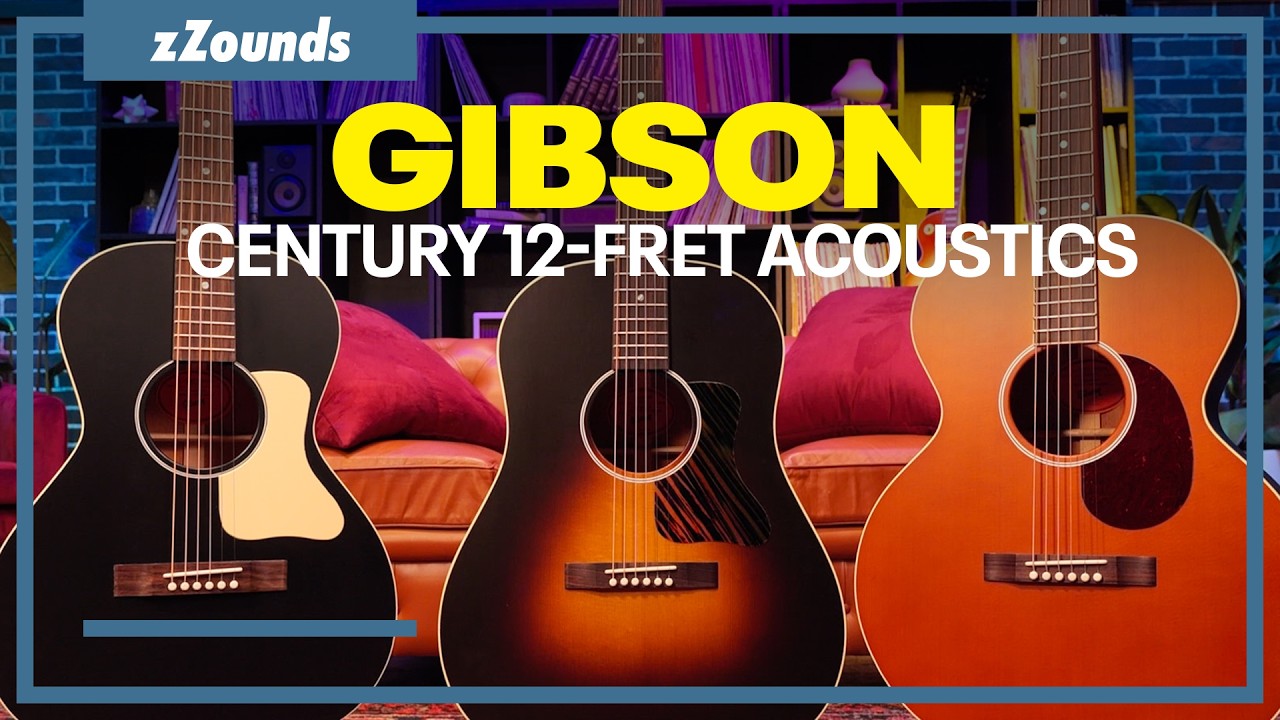
zZounds
- Best Gibson guitars: Our pick of the guitars that embody Gibson’s quality, prestige and innovation
- This article first appeared in Guitarist. Subscribe and save.

