


It’s impossible to hear the line “Do you have the time to listen to me whine?” without immediately conjuring the sound of Billie Joe Armstrong’s palm-muted modded Marshall tone. Over the last 30 years, Green Day’s 1994 major label debut, Dookie, has become not just a cultural touchstone, but a tonal one.
The ultimate distillation of producer Rob Cavallo’s rock sound perfectly partnered with the Green Day guitarist’s chunky power chords, producing one of the most familiar and beloved tones in modern history.
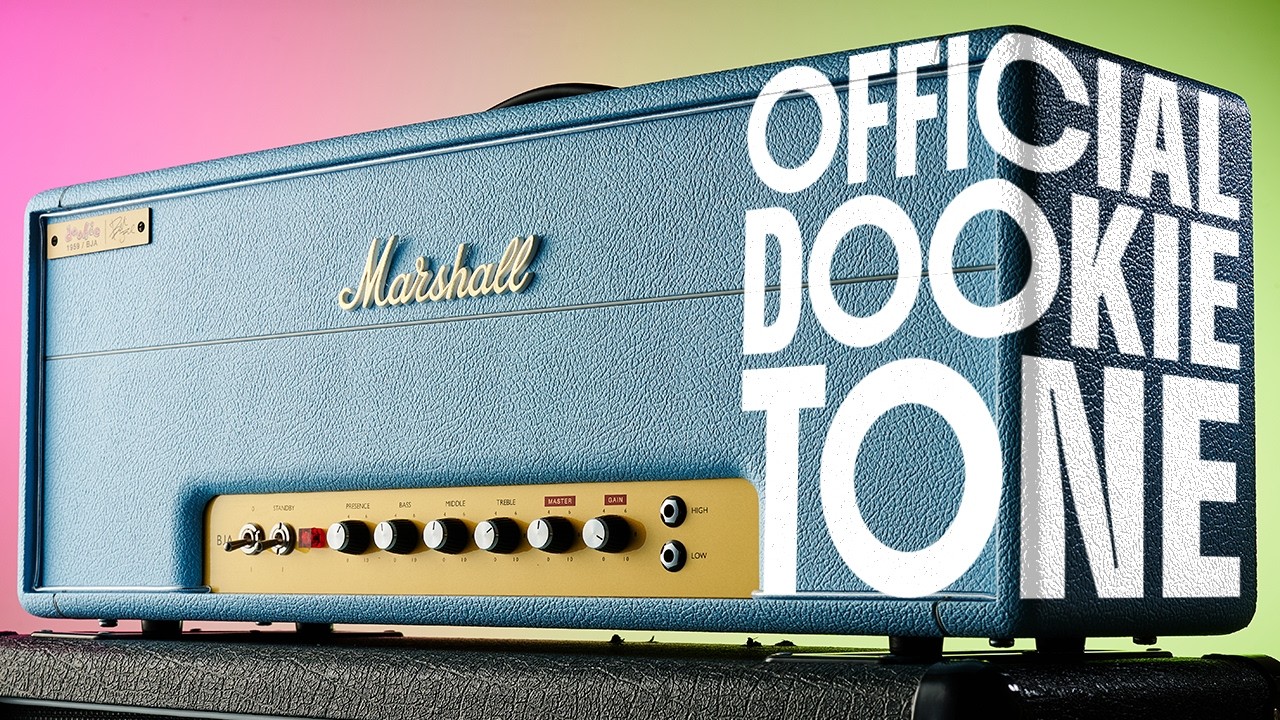
It’s not surprising then that Armstrong and Marshall have teamed up to bottle that sound on a custom handwired signature head – the 1959BJA Billie Joe Armstrong Artist Signature, lovingly finished in a colorway inspired by the guitarist’s iconic Fernandes Strat, Blue.
What is surprising is that it’s taken this long. After decades of stagnation, and with new investment courtesy of its flourishing home audio wing, Marshall is beginning to look like a brand reborn. Steph Carter, director of Culture Marketing, and Jon Magill, Director of R&D, Amplifiers, tell us how the firm’s first signature amp in well over a decade came to be.
This is Marshall’s first signature amp in 14 years. Why now?
Carter: It started when we had Billie in one of our campaigns for the Monitor headphones. Most of the comments in those posts were, “This is great. Where's the Dookie amp?” So we ran with that.
We thought, “What better way to re-kick off signature products for the company?” It’s an amp that's talked about in so many different ways, with a band who have transcended from being a punk rock band to being a household name.
Given the long gap since the last Marshall signature amp, was there an element of having to rebuild the infrastructure before this could happen?
Magill: Yeah, a lot of the people who would have been involved in these signature things had moved on to other places since that time. It all had to be worked out fresh.
We had to work out, “How was it done in the past?” and “How are we going to put all of this in place to make this work so that we can make a really great product, satisfy all of these customers and do it in a kind of time- and energy-efficient manner?” So a bit of a challenge!

What was the starting point for the design then? Were you using an existing platform, a Plexi build, as a base?
Magill: Starting with the schematics and photos, which were sent over from Billie's team, it was about making sure that we got all of the bits that were important – certain capacitors and things.
We knew that one of Billie’s amps is based on not the handwire we do now, but the old SLP reissue, which was built on the ST1 PCB board. We didn't know how much that was a factor in the sound. So we built up an amp that way, and we compared those.
Then there was a third variant involving some changed modifications; we built all of that and it was, “Now we've got to ship those over and see what Billie thinks.”
If someone opened up the original and compared it side by side, would it look the same inside?
Magill: No – that wasn't quite the intention. Certainly, one of Billie’s amps is based on that ST1 board. But in terms of what he thought of the sound, there was a preference for the handwired over the old PCB, which is fortunate because it's closer to what we’re producing now.

We could have gone down either route, but there was a strong preference for handwired, so maybe it looks slightly nicer on the inside than Billie's amp! But what we’ve ended up with is something with high-quality craftsmanship – UK-built, handwired, all that stuff – but which sonically reflects the character of that original amp.
How many iterations did you go through?
Magill: I think there was a rough prototype, then these three different versions, and then when we narrowed it down to one version, we had to go through the process of getting that production-ready. We were pretty quick. I think we managed to do it all within about three or four months, which is good.
Carter: It was quite easy. They were really on board from the beginning. They loved the idea of it. No one’s ever done an official version of this with their seal of approval.
We got to the final three for them to make the decision, “Do we go down a handwired route? Do we go down one that's based off like a 2203 board?” So we sent them all three. They plugged into the handwired one first, and they were like, “That’s the sound,” straight away.
They tried the other two; went straight back to the handwired one and A/B-ed against his rig and it was like, “We want this in the rig. It sounds better.”
It felt good for us that not only have we been able to make this work and deliver it quickly, but the feedback coming from their team was that this possibly edged out his number one. That was a really good starting point.
The first thing I did was play a Green Day riff. I was like, ‘It sounds like Green Day!’
What can you say about the mods and what they do compared to the traditional circuit?
Magill: The starting point was the 1959, which is the non-Master Volume, classic, very loud but maybe slightly uncontrollable Marshall sound. The mod converts it into a Master Volume model – something people did since the ’70s, converting them.
It’s kind of where the 2203 and then the Master Volume models come in – converting so that you have one gain and one master volume, rather than the two channels, which you can blend.

So it does that, but it also adds more gain and changes the filtering in the unit so you end up with something which sounds generally bigger and more exciting – more lively to play – than your standard Marshall Master Volumes.
I hadn't realized how much fun it was going to be to play until I plugged into one. It does its own thing. It’s incredibly versatile. It might be very much Billie’s sound, but it’s surprised so many people when they’ve plugged into it.
What sort of feedback have you had from Billie?
Carter: We took the amp over in January to shoot a video with him, and it was really interesting. He brought an array of guitars with him. He brought one of his Les Paul Juniors with him. I think it was a ’56 Custom, and he bought his Blue Strat.
His guitar tech, Hans Buscher, was doing a bit of a setup and playing through everything, then he turned around to everyone and was like, “Sounds good. Does anyone want a go on his guitar and amps?” I was like, “I'll have a go!” The first thing I did was play a Green Day riff and I was like, “It sounds like Green Day!”

Then Billie comes in a little later, plugs in, puts the guitar on, and plays When I Come Around. And he’s like, “That's the sound.” He just absolutely loved being with it, and it did exactly what we set out for it to do. This is the sound of that amp. Especially his hands with that blue guitar. It’s unbelievable.
It’s been great to see Marshall coming back into its own in recent years. This is another landmark moment. How has it felt working on this?
While this is the Dookie amp, it's such a versatile amp in its own right
Carter: It’s been amazing. Internally, we know the power of the brand and we know what we can achieve. It's been great to take what we know we can do and bring it to fruition. We've made some amazing jumps in the last two or three years since the creation of the Marshall Group, and we haven’t even gotten started yet.
Magill: It's great to be involved in these things which are related to iconic moments in music history – to be making something that’s going to excite the guitarist community, and allow people to have their own contact with those musical things which are so special to them. Modifying amps is also great fun! As Steph says, we want to see how much more we can do.

So what’s next for the Marshall signature series? There’s clearly more to come…
Carter: I think that's about as much as I can give you.
Magill: I think Steph's got a to-do list for me!
Carter: Me and Jon have got a lot of good conversations coming in the future. There’s so much love for the brand – there always will be – and the more we’re coming into this space and showing up for the musicians, the more musicians are saying, “Hey, I've got this thing,” or, “What about this amp in my collection?”
There’s lots of exciting things in front of us. I just need to give Jon a couple of heart attacks first on how big the list is and see what we can come up with. Then we can share with the world what kind of crazy, mad scientist stuff we're going to do.
This is obviously a handwired UK build and is priced at the higher end of the scale. Are there conversations around a more affordable option coming at some point?
Carter: Maybe… maybe not!

I’ll take that as “watch this space.” Is there anything else you’d like to mention?
Carter: Just going back to the things that Jon said about what this amp can do. When we did the video with Billy, we took it to Rob Cavallo. The history behind the amp is Billie used a modded Marshall in Rob’s studio that became the Dookie amp. Rob still has that amp.
We had the realization that while this is the Dookie amp, Rob has used that amp on pretty much every record he’s ever made. So this amp could also be the sound of My Chemical Romance, the sound of Paramore, the sound of the Goo Goo Dolls, the sound of Linkin Park. It's such a versatile amp in its own right.
- Find out more at Marshall.com.

