


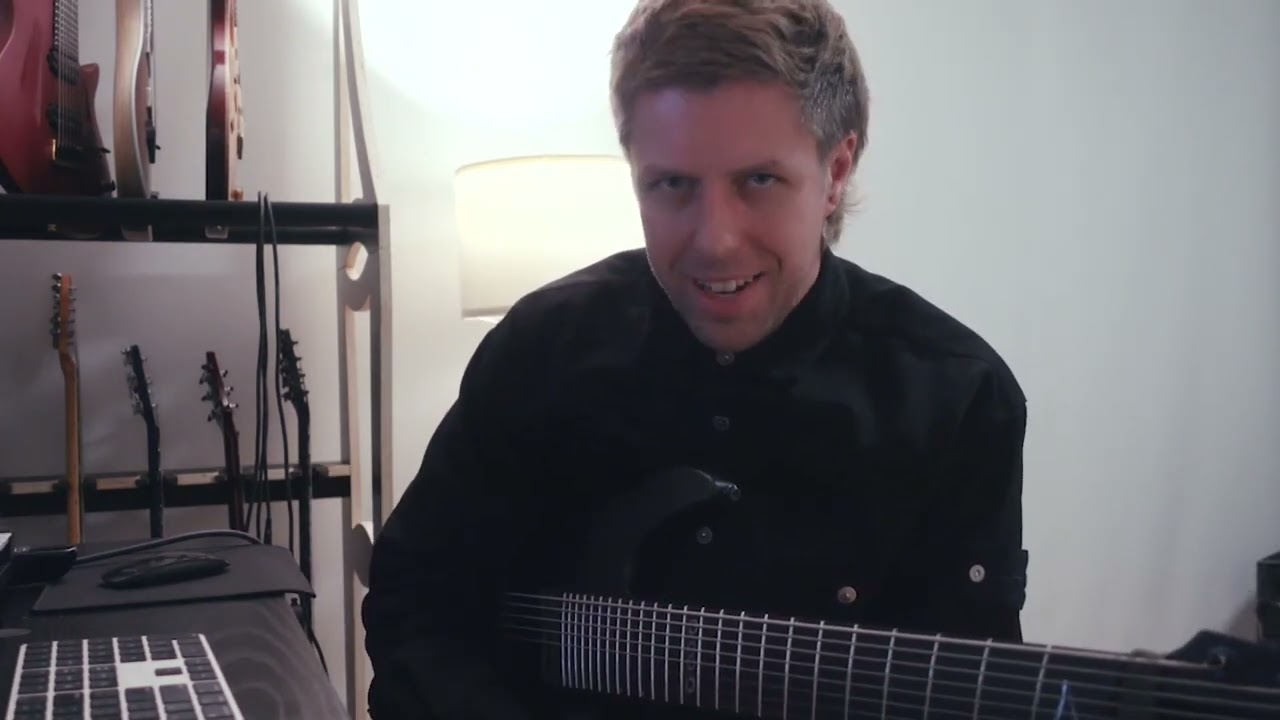
Although the 7-string guitar is my go-to instrument for virtually all of the music I write for Spiritbox, there have been instances where I was inspired to expand my range to 8-string guitar.
Even though I’m not all that familiar with the 8-string, I look at it as a cool tool that can enable me to compose riffs that are lower than anything else I’ve ever played.
To that end, I used an 8-string to come up with something powerful, to serve as the opening track to our 2025 album Tsunami Sea, Fata Morgana. We’ve been opening our sets with this song for the last year, and it has proven to be a fantastic way to kick off the show.
The 8-string tuning I use here is standard 7-string tuning down a whole step, and the eighth string is tuned down to a very low B. So, low to high, it’s B, A, D, G, C, F, A, D. In this tuning, I can play a B octave with the open 8th string and the B at the 2nd fret on the 7th string, using what looks like a power chord.
Figure 1 shows the song’s primary riff, which revolves around that low B octave figure sounded along with the tritone, F, sounded at the 3rd fret on the 6th string.
In bars 1-6, I alternate between this Bdim(no3) voicing and a high natural harmonic (N.H.) sounded between the 2nd and 3rd frets on the 7th string, notated as 2.4. In bar 4, I sound natural harmonics in this same position across the top seven strings with a quick upstroke rake.
While lightly resting a single fret-hand finger across these strings at the theoretical 2.4 location, I drag the pick in an upward motion, resulting in an aggressive “scrape” sound.

To me, the articulation of the Bdim(no3) chord needs to create a specific type of bloom wherein all of the notes morph together in an effective way. It needs to sound warm, heavy and disgusting! This is achieved by positioning the pick-hand with a slight amount of palm-muting while striking the strings in just the right place, which is above the bridge pickup.
At the end of bar 6 into bar 7, I play a series of big two-and-a-half-step bends on the 8th string, moving between the 4th and 3rd frets. Figure 2 offers a look at these bends and releases.

Proper intonation of these bends is essential; as shown in Figure 3, the notes we are looking to sound are G#, followed by a half-step bend and release on G one fret lower.

The manner in which you strike the strings when performing these bends and releases is very important, in order to achieve the type of clarity necessary for the phrase to jump out. The way to attain the right sound is by picking very hard. This is also true for the natural harmonics, in order for them to properly cut through the mix.
Overall, focus on your pick-hand attack throughout, and strive for consistency in sound as you move from one pattern to the next.
- This article first appeared in Guitar World. Subscribe and save.
