




Let’s not kid ourselves; one instrument and one alone will forever be tied to Paul McCartney in the minds of the masses – the Höfner 500/1 Violin Bass. It is to Macca what the Frankenstein guitar is to Eddie Van Halen, practically serving as an emoji for the man himself.
Be that as it may, the Höfner is just one of many instruments McCartney calls his own. That, of course, includes a host of guitars he has embraced throughout nearly seven decades of playing.
Paul has never been a gearhead or a self-styled guitar hero. From the moment he traded his trumpet for a Framus Zenith 17 acoustic as a teen, he has used the guitar as a tool for self-accompaniment, not for instrumental acrobatics or deep dives into the mechanics of sound manipulation. Nor has he made it a priority to accumulate the most expensive or sought-after instruments.
“The terrible thing about me is that I got locked in a mindset that I picked up from my dad,” he once told Guitar World Acoustic. “He really ground it in me to never be in debt, because while we weren’t on the poverty line, there wasn’t much money to go around.”
Even after all the sweet Beatle cash started rolling in, that mentality led the Cute One to continue choosing economy-class guitars over luxury gear. That said, when you’re Sir Paul McCartney, loved ones and admirers tend to give you an extravagant instrument here and there. Over time, that has helped him build a collection that reflects both his modest background and his present-day status as musical royalty.
Here, from the unassuming to the lavish, are six of the guitars most central to McCartney and his artistry.
1964 Epiphone Texan FT-79N
The Texan acoustic has been one of Macca’s pet instruments for more than six decades. It’s the guitar he used not only to write and record Yesterday, but also to play said song in an Ed Sullivan Show performance that fairly shifted the Earth’s crust. Much later, it helped bring solo cuts like Calico Skies and Jenny Wren to life.
The FT-79N (N for “Natural,” as in “natural finish”) is a close cousin of the Gibson J-45, but at 25.5 inches, it’s significantly longer. It has a slope-shouldered dreadnought body, a spruce top, parallelogram-shaped fret inlays and mahogany back, sides and neck.
Restrung and flipped upside-down for left-handed use, McCartney’s Texan still bears the Detroit Red Wings sticker he was given when Wings played Red Wings Stadium in 1976. Depicting a wheel with two wings, that emblem held obvious appeal for a man with a winged band and a heart like a wheel.
In 2004, McCartney worked with Gibson to create a signature replica of the Texan. While not radically different from the original, the updated instrument offered some fancy new frills. Not the least of these were an embroidered case and, in some cases, a soundhole label signed by the Big Mac himself.
1962 Epiphone Casino ES-230TD
“If I had to pick one electric guitar, this would be it,” McCartney has said of his fully hollow thinline Casino. Equipped with a Bigsby tremolo and an early Gibson-design headstock, it’s the axe that helped send his playing on tunes like Taxman and Paperback Writer into the red.

According to legend, McCartney bought his Casino in late 1964 on the advice of his close friend John Mayall, leader of the Bluesbreakers. In photographs taken backstage at the Hammersmith Odeon in December ’64, it still appears to be set up for right-handed playing. Paul would soon modify it for lefty use by changing its nut and bridge and installing a strap button on its upper treble bout.
Following McCartney’s lead, John Lennon and George Harrison quickly purchased their own Casinos. Not coincidentally, sales of the instrument nearly doubled between 1965 and 1966. The folk musician Donovan would later convince Harrison and Lennon to sand the finishes off their Epiphones for improved tone, but McCartney opted to preserve his guitar’s sunburst lacquer. To this day, the Casino remains one of his most cherished companions, original finish and all.
1964 Fender Esquire
As a more affordable precursor to the Telecaster, the Fender Esquire offered just one single-coil bridge pickup, with a three-way pickup switch serving as a tone selector. After taking one of these utilitarian instruments home while the Beatles were cooking up Revolver, McCartney turned it into a left-handed guitar in his usual way: by restringing it and moving the strap button to the upper cutaway horn.
Featuring a sunburst finish, maple neck and rosewood fretboard, it was his favored guitar on Sgt. Pepper’s Lonely Hearts Club Band. On songs like Good Morning Good Morning and the title track, its raw, cutting tone imbued his performances with a kick that threatened to send turntable arms flying.
1967 Martin D-28
With its dreadnought body, solid Sitka spruce top, rosewood back and sides, mahogany neck and ebony fretboard and bridge, the D-28 is an ordinary-looking acoustic with an above-average sound. The combination of spruce and rosewood helps give it a full-bodied voice, powerful projection and a crystalline top end.
Shortly after acquiring his Martin in 1968, Macca put it to use on Beatles cuts like Blackbird and Ob-La-Di, Ob-La-Da. It has stood the test of time, enhancing solo works such as 2005’s Chaos and Creation in the Backyard and popping up in McCartney’s current-day live sets.
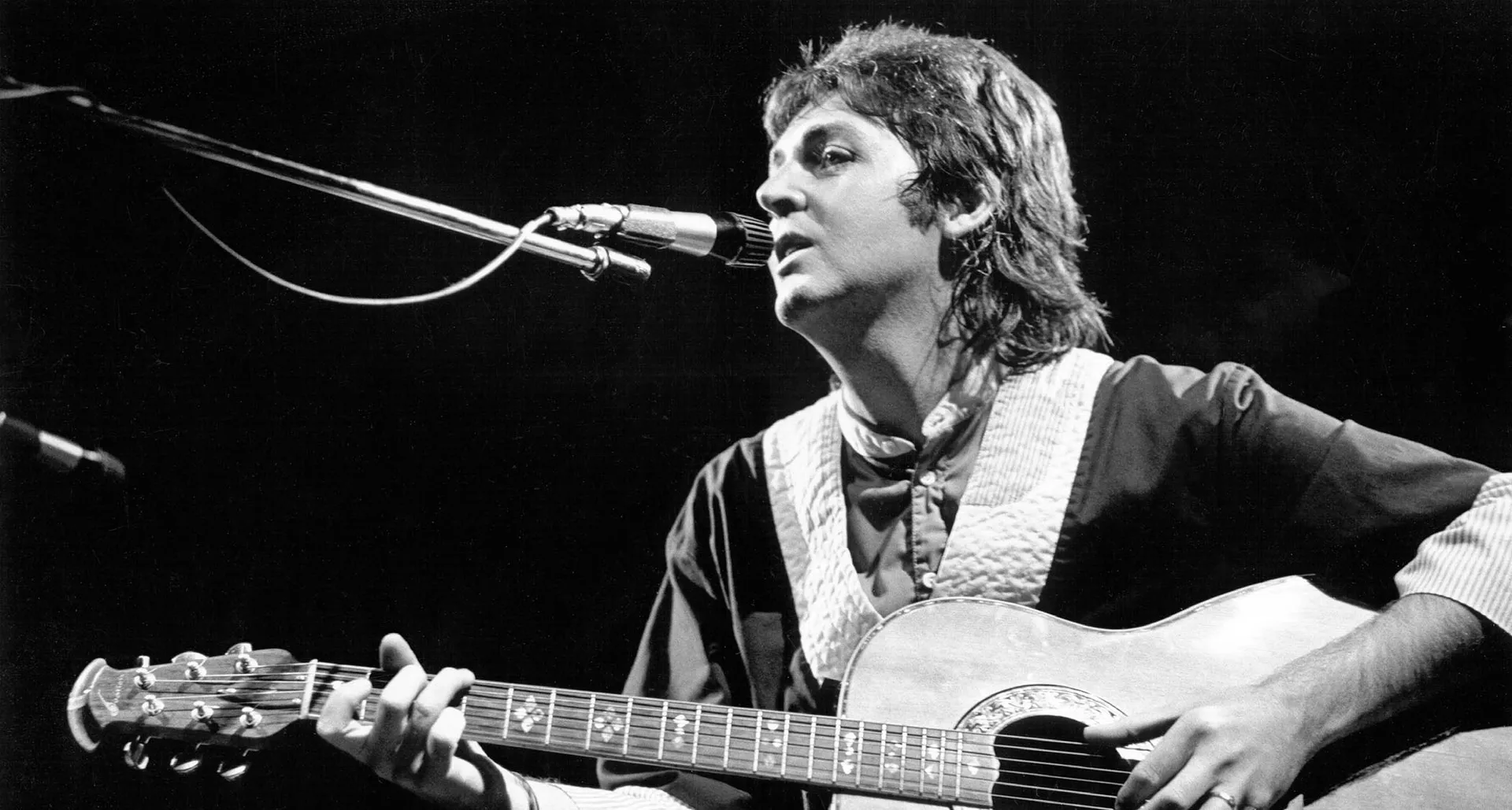
Ovation 1619-4 Custom Legend
In the early Seventies, Macca stepped back onto the concert stage after a long absence. By the middle of the decade, he and Wings were helping inflate the airbrushed zeppelin we now call arena rock. The new aesthetic demanded new sounds, as offered by the Ovation acoustic-electric guitar.
There’s some dispute over whether Paul’s Ovation is a Custom Balladeer or a Custom Legend. However, the Rock and Roll Hall of Fame’s Paul McCartney and Wings Exhibit unambiguously identifies it as a 1619-4 Custom Acoustic, part of Ovation’s Custom Legend series. It has a rounded back made of Lyrachord, an undersaddle piezo pickup system, a solid sitka spruce top, an ebony fingerboard and a neck made of a five-piece mahogany/maple laminate.
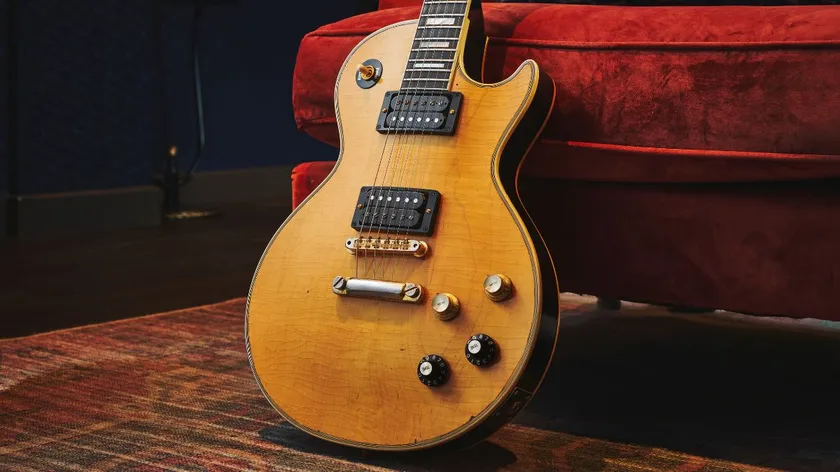
1957 Gibson Les Paul Goldtop
Fifties Les Pauls are already highly prized, but left-handed models are among the rarest of beasts… and when one of them happens to be a goldtop owned by pop music’s Mozart, it might as well emit rays of white light and a heavenly hum when its case is opened.
McCartney’s Les Paul has a Tune-o-matic bridge, which became a feature of the goldtop in 1955. In 1957, Gibson started equipping goldtops with dual-coil PAF humbuckers rather than single-coil P90s, giving this instrument a punchy tone, expanded dynamic range and greater responsiveness to attack.
Not to be confused with the coveted ’57 Les Paul that Brian Ray has been known to play during Macca’s live sets, McCartney’s goldtop is said to be a gift from his late wife Linda. This is a golden axe fit for a knight, demonstrating just how far he’s come from the “smoky bars and cheap guitars” he looks back on in his new song Days We Left Behind.
- This article first appeared in Guitar World. Subscribe and save.

