


When GW connected with blues road warrior Walter Trout, he was about to embark on a songwriting session for the album that would become late 2025’s Sign of the Times. Trout had set aside eight weeks to write the songs, prep his band and get the album recorded before heading back out on tour for the bulk of the year. For Trout, the live experience never gets old.
“Every night there’s the possibility of doing the best or worst gig you’ve ever done,” he says. “Every venue and crowd is different, and it never gets boring. This was my childhood dream. Now I’m living that dream.”
Unsurprisingly, given his long and colorful history, Trout has no shortage of anecdotes of a life spent playing the blues – including many he’d rather not immortalize in print.
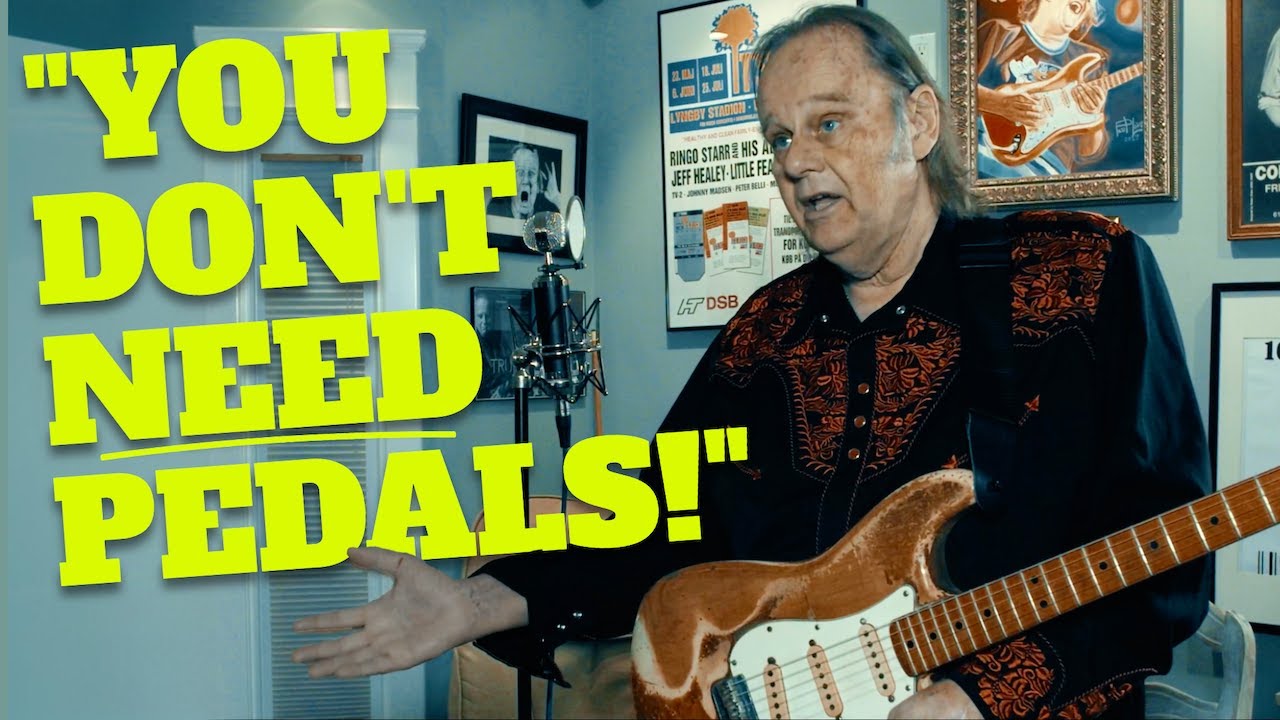
Trout confesses to being pretty much a “one-guitar guy,” and these days that’d be his signature Walter Trout model, built by Michael Delaney (Delaney Guitars) and modeled closely on the now-retired 1973 Fender Strat he’s played for most of his career. Unsurprisingly, that old Strat is one of the three most important guitars Trout has owned. We’ll let him take it from here.
1. Guyatone LG55W

The first guitar I had was an acoustic. After a while I wanted to go electric, and this was the only guitar I could afford. I have a picture of me playing it when I was 14, but I couldn’t remember what make it was.
I put the photo on Facebook ahead of this interview to see if someone could ID it, and a guitar builder contacted me. Not only did he tell me the model, but also which stores sold them in the ’60s. I don’t remember where or when I bought it, but I played it for a while.
The picture was taken in 1965 in my friend Steve’s basement; he was a drummer, and there was a bass player named Jeff. The three of us were probably trying to figure out a Beatles song; there are a lot of chords in those songs. I did a few shows with that guitar – at parties and basements.
I convinced our high school to let us play at a dance. We were about a minute into Born in Chicago by Paul Butterfield, and they pulled the plug on our amps and put on a record by the Supremes. I went to school on Monday and kids were shouting, “Hey, Trout – you guys fucking suck!” [Laughs]
In 1968, I bought a Les Paul. That’s when I moved into the guitar big leagues. The Guyatone was adequate for my first attempts at playing lead guitar; I wanted to play solos, and that guitar was my route into it. But there was a fire at my house, and I lost the Guyatone. I wish I still had it – just for the sentimental value.
On the plus side, with part of the insurance money I was able to buy the Les Paul. It was a reissue of a goldtop. My grandmother drove me to the store. There were racks of used Les Pauls.
No-one really wanted them then, so I’m sure there would have been some ’50s models. She was saying, “Buy one of those for $70. They look the same and they’re way cheaper.” Sadly, I insisted I needed a new one for $200.
2. Aria LW15TB

I bought it in 1981 in Sydney when I was touring Australia with Canned Heat. We were staying in a hotel, and I wanted to get an acoustic to play in my room. I found it in a pawn shop for $70. It looked brand new, and it played beautifully. The neck is amazing; it almost plays like an electric.
About 35 years ago, a friend borrowed it for a couple of days, but he sat on it and crushed it. I took it to Doc Pittillo at the Guitar Doctor in Costa Mesa, California, who’s been working on my guitars for decades, and he said it would be $300 to fix it.
I told my friend, and he couldn’t believe it, given how cheap the guitar was – but I insisted he pay me. Doc did an astounding job. The sound wasn’t affected at all, and it’s almost impossible to see the joint where he repaired it. I’ve written the majority of my songs on this guitar.
The other acoustic I treasure is a Martin D-28. Bob Dylan was a huge influence on me, and he’s what made me want to play guitar. I lived near Rutgers University [New Jersey], and every Friday night they’d have a coffee house called the Perimeter. I played there every week.
Everyone would get a turn and do about half an hour, but as I got better, people would ask me if I’d back them up. I really felt like I needed to get a good acoustic, so in 1968, with the help of my parents, I bought a D-28. The guy I bought it from worked at Martin; he was the inlay man.
It had been his guitar, and he’d experimented on it. He’d inlaid it to make it look like a D-45, so it has mother-of-pearl all over it. But he messed up a little around the sound hole, where he’d sanded a touch too hard and left indentations in the wood, so he sold it to me very cheaply. It has a wonderful sound. Whenever you hear any acoustic guitar on my records, it’s most likely the Martin.
1973 Fender Stratocaster

I dropped that first Les Paul, and the headstock broke off. I was so young and stupid that I didn’t realize they could fix it! The same guy from the Martin factory bought it from me for $80. He fixed it and sold it for a good amount of money. I bought an ES-335 after I broke the Les Paul, but soon after I got it, I was at a jam session in Philadelphia, and a guy asked me if I wanted to try his Strat.
I played it and thought I’d found the love of my life. Shortly after that, I moved to California. I had my D-28, my 335 and a Fender Super Reverb. I was in a VW bug, I had all my clothes, half a pound of weed, 30 hits of LSD and $50. I hallucinated my way across the country. [Laughs] When I got there, I got a job very quickly as the lead singer in a country band.
With my first paycheck, I bought the Strat, a new 1973 model. That’s been it for me ever since; it’s still the best guitar I’ve ever played. I won’t take it on the road anymore. I know you’re not supposed to like ’70s Strats, but when someone tells me what I should do or like, I do the opposite.
It's been re-fretted maybe 12 times. The only modification I’ve made is to hook up one of the tone controls to the bridge pickup, which means the neck pickup doesn’t have a tone control. I make that modification on all my Strats.
I sweated so much over the years that the middle pickup started to get really quiet because the wire inside rusted. Seymour Duncan told me that he had some of the actual wire that they used for those pickups, so he rewound it and made it exactly as it was. It started off blazing white, but now it’s yellow and beat to shit.
I was touring with Canned Heat in Alaska in a small, six-seater plane. It was 40 below zero and the Strat was in the hold under the plane. I got into the airport, opened the case and the finish cracked in a million places in front of my eyes because of the sudden temperature change. Those millions of cracks picked up the smoke in every bar I played – it’s fucking nicotine. You could scrape that guitar, smoke the residue and get strung out.
- This article first appeared in Guitar World. Subscribe and save.

