Guitar World Verdict
The SYN-20IR feels like a next-generation Synergy head, truly unlocking the potential of the technology. And they’ve played a blinder with the Marshall modules; the sound and fury of the classic amps, but in a format that’s incredibly easy to get the best from.
Reasons to buy
- +
Serious flexibility and tweaking potential, as well as ease of use.
- +
Those Marshall tones are just as thunderous as you’d hope for.
- +
It’s good value, considering the potential of the package as a whole.
Reasons to avoid
- -
The modules should be handled with extra care.
- -
The amp’s own clean tone is useful but not inspiring.
You can trust Guitar World Our expert reviewers spend hours testing and comparing guitar products so you can choose the best for you. Find out more about how we test.
What is it?

It’s the stuff of fantasy for tone-chasing guitarists – a tube amp that lets you remove the preamp and slot another one straight in. A single amp chassis that can be transformed from a Fender into a Peavey 6505, a Dumble clone, an Engl… it’d be quite something.
This is the idea behind Synergy Amps, part of the larger Boutique Amps Distribution roster operating out of California. Synergy’s bread and butter is its modular preamp system, with roots in designs by Bruce Egnater in the 1990s; that technology was also licensed by Randall for its MTS amplifier range in the 2000s. Both the Egnater and Randall systems still retain a following for their innovation and tonal quality.
As well as the company’s own preamp modules (mainly based on classic US circuits), there have been officially-licensed collaborations with several amp makers, often from the BAD group of brands. We’ve seen Fryette, Bogner and Soldano modules, to name just a few.
The most recent chapter, though, brings a classic British brand into the picture. So far, several Synergy preamp modules have been based on Marshall topology - the Friedman Brown Eye and Dirty Shirley, the Metropoulos Metro-Plex, and the Fortin Killer Kali. Today’s headline is that Marshall itself has now co-developed a pair of preamp modules with Synergy; and I'm putting both to the test here.
We need something to run them, though; the modules are neatly-packaged devices about the size of a large effects pedal, and contain all the essential components of a valve preamp, including a pair of 12AX7s, shrink-wrapped into a compact, uniform design. It’s truly innovative, and very accomplished. But the module itself has no form of power, so it’s not much use on its own.

Luckily, there’s another recent arrival in Synergy’s range for just this purpose. Last year, the SYN-20IR amp head broke cover - the smallest that the company has made yet. It’s also the most advanced, by quite a distance.
Specs

- Price: $1,099 | £999 | €1190
- Type: Tube amp head with modular preamp design
- Origin: China
- Output: 20 watts
- Channels: 3 (1x built-in clean, 2x channels on each available module)
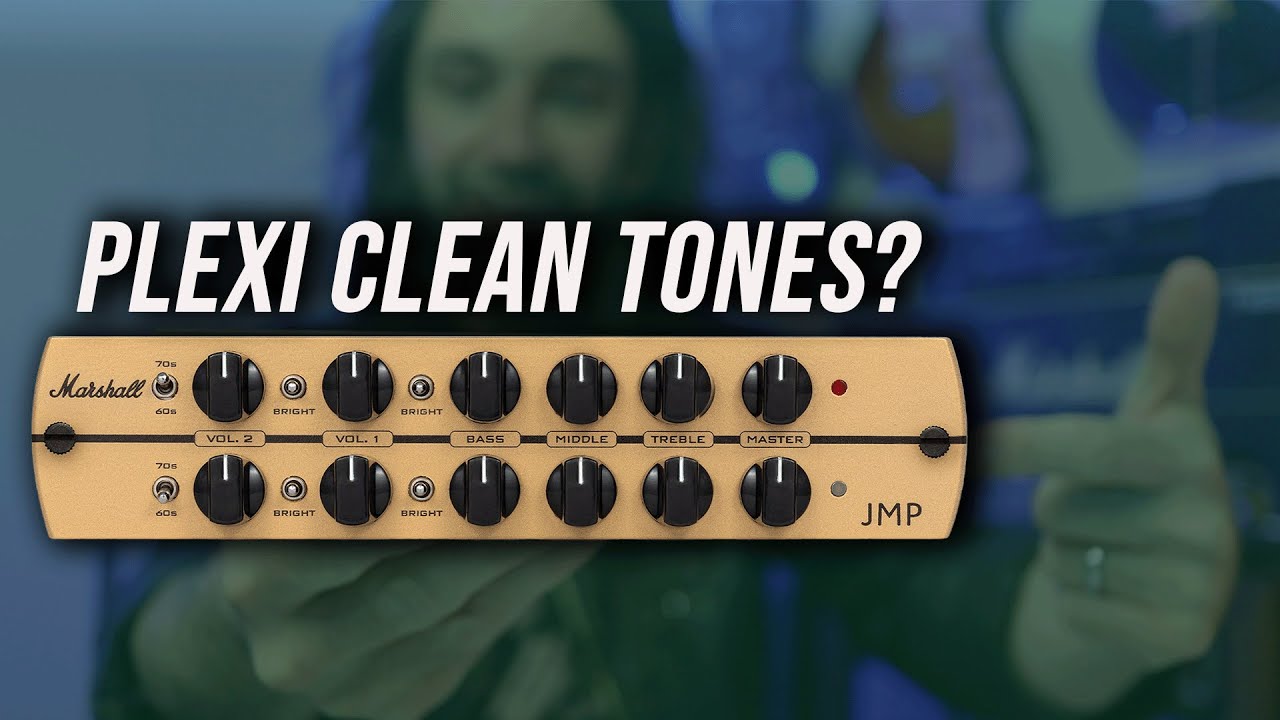
- Controls: Clean Volume, clean Tone, power amp Reactance, Master, power amp Structure push-button, Channel Store button, IR select/bypass button. Rear panel - Headphone level, Ground/Lift button. Preamp Module Controls for JMP Module (per channel) 60s/70s mini-switch, Vol 2, Bright switch, Vol 1, Bright switch, Bass, Middle, Treble, Master volume. JCM 800 Module controls (per channel) High/Low gain mini switch, Preamp gain, Bright switch, Bass, Middle, Treble, master Volume, Presence
- Connectivity: ¼” instrument in, IEC power in, USB out, MIDI in, XLR direct out, ¼” headphone out, Effects Return, Effects Send, speaker outputs (1x 16ohm, 2x 8ohm, 2x 4ohm).
- Footswitch: 3-button MIDI footswitch included
- Weight: 16.4lb/7.4kg
- Dimensions: 356 x 216 x 191 mm
- Options: Marshall JMP Preamp module (as reviewed) is priced $399 | £399 | €429; Marshall JCM 800 Preamp module (as reviewed) priced $449 | £449 | €459, see Synergy for full list of brands
- Contact: Synergy Amps
Build quality

Build quality rating: ★★★★☆
Its steel shell is sized like a typical ‘lunchbox’ amp head. It runs like one too, with dual EL84 power valves. The similarities end there. Instead of a front panel, there’s a gaping hole into which your choice of preamp module can be inserted.
The modules are quite intricate, with some exposed components at the rear, but most of the guts are housed in a sturdy metal enclosure.

These Marshall models’ faceplates are finished in the British brand’s trademark gold rather than the black of most others in Synergy’s range; a nice touch.
The head is smartly built and finished; little to criticize in terms of quality, certainly not in terms of spec – it’s stuffed with features.
Usability and features

Usability and features rating: ★★★★★
There are controls to either side of the module slot, dealing with the power amp response, overall master level, plus Volume and Tone for the in-built clean channel.
The rear panel plays host to a balanced XLR out, a headphone jack, an effects loop, and comprehensive speaker output options. There’s a MIDI socket into which the supplied three-button footswitch can be plugged. USB, too, for loading IRs and other deep-editing work.

Unlike the Marshall circuits they’re based on, each of these modules boasts two entirely independent channels
Slotted in, the module is secured by two thumb-screws – despite having its own cleans, the head won’t work without one installed.
From there, all the module’s controls can be dialed in just like any other amp. Unlike the Marshall circuits they’re based on, each of these modules boasts two entirely independent channels.
Sounds

Sounds rating: ★★★★½
You could run directly to an interface, or a powered cab, but I plugged into my 2x12 Marshall 1936 cab, with a Celestion Vintage 30 and Creamback. I primarily used my Tele and my Les Paul for testing.
The SYN-20IR is plenty loud enough
Before delving into the modules, let’s try that so-called ‘American-style’ clean channel. The description conjures up images of Fender Twin Reverbs; it’s not quite that. It’s perfectly serviceable, and far better to have it there than not, but with a single Tone control it’s not the richest or sparkliest of clean sounds. Add modulation or time-based effects for better results.
One thing’s for sure though - the SYN-20IR is plenty loud enough. Even with the master volume barely above zero, it’s punchy - I reckon even 11 o’clock on the dial would be more than sufficient for many shows. That’s certainly in keeping with the Marshall ethos, so it seems time to try out the first module.

The strident, hard-edged snarl of an overdriven Plexi is right there
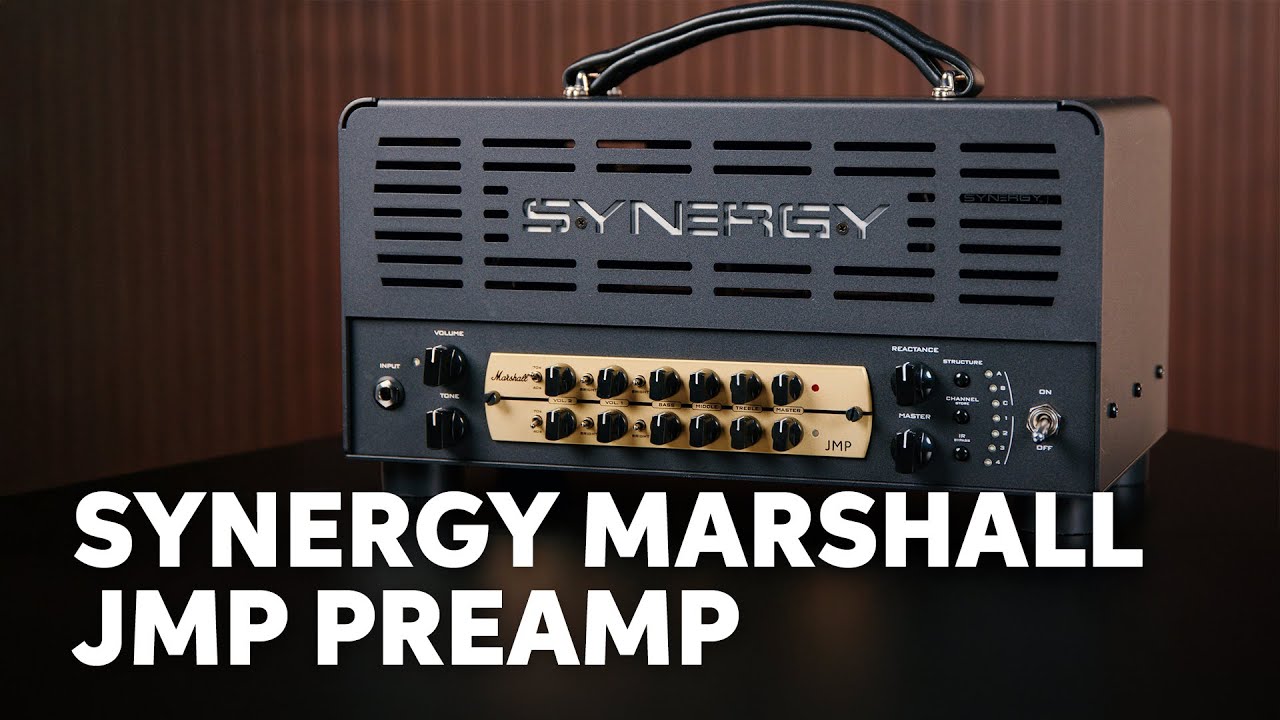
The JMP first – based on the classic ‘Plexi’ sounds of yore, each channel offering dual volumes to mimic the Bright and Normal inputs of the old non-master-volume amps. Each volume has a three-position Bright switch. Each channel, a ‘60s/70s’ mini-switch for overall response and gain structure.
I set one channel for a lower-gain break-up/’crunch’ sound and am immediately, dead impressed – the strident, hard-edged snarl of an overdriven Plexi is right there.
There’s higher-gain potential and, of course, a master volume, but the tone is unmistakable. The controls for power amp response and reactance on the head are great for fine-tuning too.

As I set the other channel to a much hotter, modded Plexi tone, it provides all the fabulous, harmonically-rich saturation one would expect – ideal for your best Van Halen or Malmsteen impersonations. The other party piece, true to Marshall form, is the touch-sensitivity; a very natural response to picking dynamics, and fabulous with the guitar’s volume backed off too.
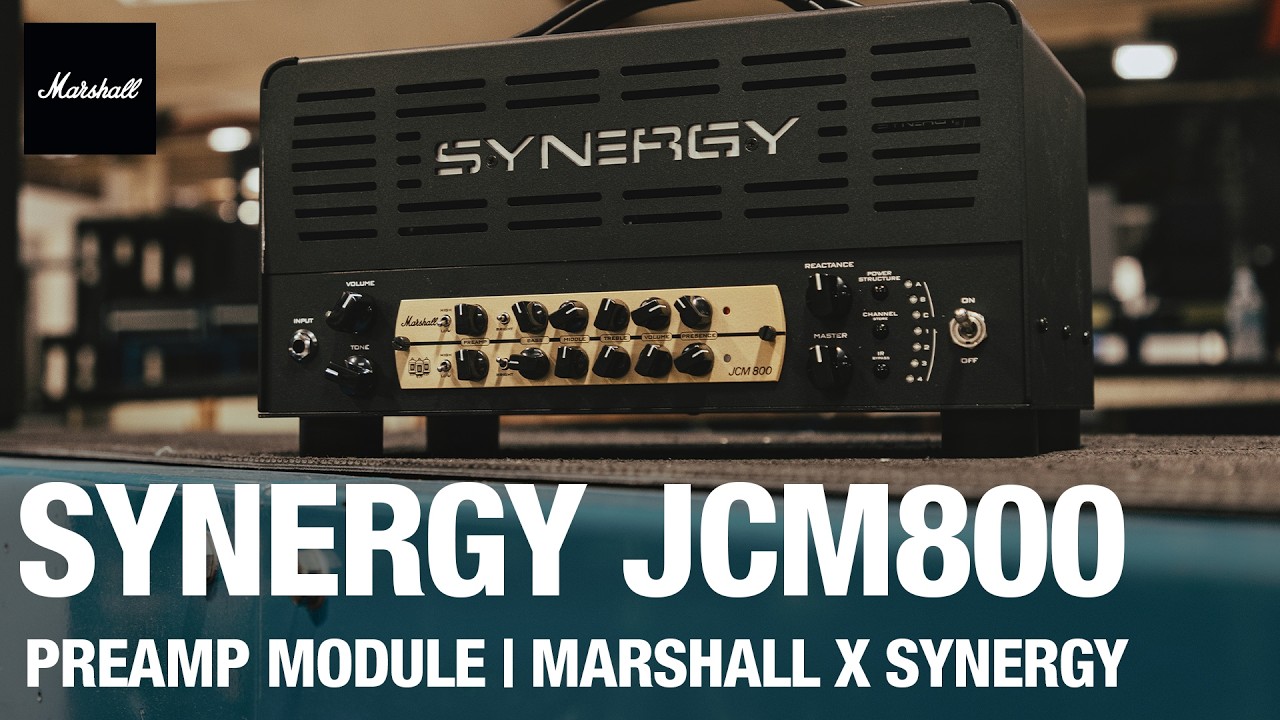
From there, I jump to the JCM 800 module. The same faceplate, with different controls – this time, each channel gets a High/Low input gain switch, emulating the dual inputs of the original amp.
From there, the Preamp gain pot and the Bright switches combine for a similarly broad range of gain structure – again, I dial in a lower-gain sound and am wowed by the glassy, defined crunch that pairs so brilliantly with a Telecaster. That same touch-sensitive quality is, if anything, even more pronounced and impressive here.

It’s no mere facsimile, it truly sounds and responds like the original
Moving to a high-gain sound, with Preamp drive around 1 o’clock and the EQ mostly flat with a slight Mid push, the Synergy emits a brutal roar. It’s tight, it’s percussive but it also possesses the same barely-controlled, feral edge as a real JCM 800 - it’s no mere facsimile, it truly sounds and responds like the original.
Verdict
The Synergy amp system is really impressive, and a fantastic solution for guitarists wanting multiple different amps without taking up too much space, or spending too much.
All in all, a fantastic package for those seeking versatile Marshall tones, while keeping options open for transforming their amp into a Dr. Z, or a Diezel, the next day
It’s still not the cheapest approach, but it’s certainly a lot more practical and financially viable than a collection of full-size original models. With its direct output and IRs, it’s great for recording too.
As for the Marshall modules – the two-channel design offers way more flexibility than the original amps. There’s masses of potential for tweaking, and the archetypal Marshall tone and response are present and correct – with higher gain on tap for those who want it, too.
All in all, a fantastic package for those seeking versatile Marshall tones, while keeping options open for transforming their amp into a Dr. Z, or a Diezel, the next day…
Guitar World verdict: The SYN-20IR feels like a next-generation Synergy head, truly unlocking the potential of the technology. And they’ve played a blinder with the new Marshall modules; the sound and fury of the classic amps, but in a format that’s incredibly easy to get the best from.
Test |
Results |
Score |
|---|---|---|
Build quality |
Everything certainly seems well-engineered and executed, but I’ve some slight reservations about the delicate-feeling modules. |
★★★★☆ |
Usability and features |
The tech works seamlessly, and it’s fabulous to have such nuanced control of a tone that’s usually found in a feral beast of an amp. |
★★★★★ |
Sounds |
The Marshall modules sound absolutely superb, nailing the tone and response with a wide range of gain. The built-in clean channel is useful, but not such an event. |
★★★★½ |
Overall |
The Synergy ethos is really interesting, and executed better than ever here – and those Marshall modules are amazing. |
★★★★½ |
Also try
Hands-on videos
Synergy x Marshall
Sweetwater
Leon Todd