

Johnny Marr’s latest record, The Age of Everything, with its mix of jangle-meets-abrasion, hits like a handcuff to the wrist. It’s so striking that, after all these years, the wizardry behind Marr’s licks begs the question: is he still some sort of sky-bound enigma?
“I just sort of throw paint on it,” Marr tells Guitar World. “And then I refine it. The results are what matters. But don’t get it wrong – sometimes, I plug in, nail it, and walk around like the bee’s knees. [Laughs]
“But on my own stuff, I value bypassing critical faculty, and engineering a sense of discovery. It’s the not knowing what you’re doing. I like using my ears and not my brains, you know?”
Indeed, we do know. It’s what makes new cuts like Spin and Ophelia as memorable as Marr’s work with The Smiths, Electronic, Modest Mouse, and The Cribs. “Like any craft,” Marr says, “You can’t lie to yourself.”
“Being a songwriter is a curious mix of massive megalomania, and egomania,” Marr laughs. “And really crippling insecurity! But despite it being schizophrenic, you get there in the end.”
What quirks or habits have become parts of your style?
One thing I’ve learned – which borders on eccentric – is that I like not knowing what the chords are. It’s a little tricky on my own songs, but certainly on other people’s songs. It started when I was playing on Beck’s album [1999’s Midnite Vultures], and I did the same thing with Talking Heads [on 1988’s Naked].

If someone wants me to play on their album I tend to say, “Don’t send it to me yet. Let me get my sound and plug in. Then I’ll listen to the song and react instinctively.” That means I’m probably going to make some mistakes, so it takes some ego management. It might sound sketchy for 10 minutes – but we’ll get there, and it’ll be worth it in the end.
You have to be okay with sounding like you suck for 10 minutes. The important thing is that it’s not my job to go in and dazzle; it’s about what it sounds like when I leave.
What’s been your greatest gear find?
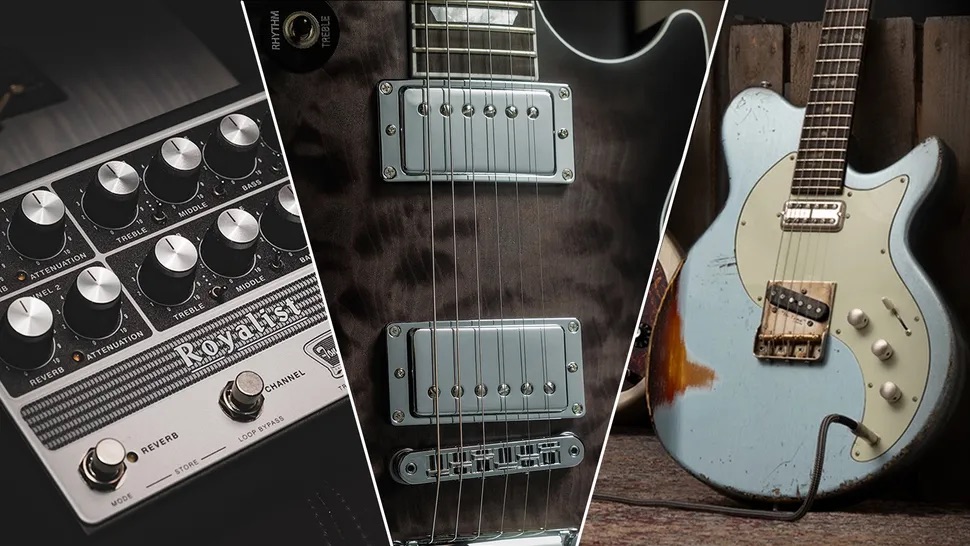
I’ve got this ‘60s Fender Deluxe Reverb, which I wouldn’t get rid of for anybody. For this album, we really wanted that pure Fender sound.
Which guitar do you have the closest relationship with?
The red 1984 Les Paul I bought for the Smiths album Meat is Murder, which I use exclusively clean. I changed the pickups out at some point in the ‘80s and I put a Bigsby on it. Those things make it behave and sound unlike a regular Les Paul. That guitar absolutely makes me play in a way that people seem to like. People like Noel Gallagher and Gorillaz seem to want me to play that on their records.

But I also put so much work and obsession into the design of my signature Jaguar, and it really does a big job. The thing with the Jag, the new and the original one, is that by accident – or maybe intuition – it sounds like a Rickenbacker crossed with a Gretsch, but plays like a Fender. It’s like 50 shades of treble!
I’m by no means a dogged purist in any way; it’s just that the quality has to be good
What’s a piece of gear you own that might surprise people?
Funnily enough the Les Paul surprises people, because it’s almost exclusively thought of as being a rock and blues thing. But I’m always looking to do on any guitar what that guitar brings out in me.
What’s your number one tone tip?
You have to be very deliberate and know what you’re looking for. You can plug into so many types of amps now. I’m by no means a dogged purist in any way; it’s just that the quality has to be good. It might have different tonal aspects, but the bottom line is, “Is it good?”
All of us have options now. If you just pull up a bunch of plugins, you might tell yourself it’s great, and it might be – but it might not be as good as it could be]. What I’ve found with Synergy amps that the stereo is really good; it has a musical sound. With Kempers, I’ve started to hear the Kemper-ness! Again, it’s not dogmatic, or hanging on for the old days.
I marvel at guitar technology. I absolutely love it. If it aids creativity, and makes me a better player and it’s good quality, it’s a really good thing. Just as long as it doesn’t sound like crap!
Tell me about a a lightbulb moment you had.
Nils Lofgren said, ‘Don’t mess up the singing, because people notice.’ I think when you’re as good as Nils Lofgren, you say that!
I have friends who just write and write and write, then, when they’ve got enough songs for a record, they go and record. But I go into writing and making an album knowing that’s what I’m doing. I’m going to use a dedicate a chunk of time in my life to writing. Birthdays are forgotten, anniversaries get forgotten, the dogs get locked outside the house by mistake!
But with this record, we went and gigged and played the songs live. It was a bit scary, but when you’ve play things live and they’ve gone down well, you’re thinking, “We know this one’s a banger” when you record.
We knew Spin was happening, and Ophelia. I knew they were in the bag; because when you record, there’s things like getting it in the right key and all that – but when you’re in front of an audience you make those decisions real quick!

Who’s the most exciting guitarist out there today?
Ella Feingold is great. She never talks it up too much, and she always makes it accessible for people who want to learn. She’s so generous. She’s got that real down-home funk attitude, but she’s also a bit of a scientist on the sly. It bends my brain when she starts talking about her intervals and tunings. She’s the best guitar player I’ve seen for years.
What’s the hardest or toughest time you’ve had as a musician?
With writing songs, we’d all like to think it’s all about inspiration – but some of it’s tenacity and craft. I can finish a song at 2 o’clock in the morning, thinking it’s the greatest thing I’ve ever heard, which is the way it should be. Then in the morning I listen back, and I’m thinking, “Oh. Okay…” It can be emotionally up and down.
You’d be forgiven for thinking my name had the words “jingle” and “jangle” in it You’ve got to be philosophical about it
When I’m writing, I’m not casual about it; it means a lot to me. So when I think about the tough things, it’s probably having to come back and work on melodies. Riffs come easily to me. I’m pretty decisive with my guitar parts because I’ve been doing it for so long. Sure, I like to experiment, but I tend to know what I’m going for.
Which of your songs do you find most challenging to play?
With some of the Modest Mouse stuff, luckily, I was in the right band. That’s when I started working with the Jag, and my job was to come up with so many diverse sounds. And because I wasn’t a founding member, I was reproducing their older material, which a Jaguar had no business going near! But I had to do it – and I was competing with Jazzmasters.

I was also competing with Isaac Brock, who plays so loud through his Fender Super Sixes, and has these crazy tones. He’s a really remarkable artist and he kept me on my toes. So, songs like Doin’ the Cockroach and Bury Me with It, I had to do that with my Jag.
And The Smiths’ The Headmaster Ritual is pretty tricky because I’m singing on it. When I wrote that song – it’s in open E and it’s quite intricate – I was merely the guitarist stage left. But I’ve learned to sing and play.
What’s the best piece of advice you’ve received, and who gave it to you?
When I first met Nils Lofgren, I asked him how he got to be such a great singer and a great guitarist. He said, “Just don’t mess up the singing, because people will notice that.” But I think when you’re as good as Nils Lofgren, you say that! You just have to practice and practice.
What’s the biggest misconception about you?
If you’d asked me that in my 20s I’d have had a whole long list of young, attitude shit to be angsty about! But when you’ve been making records for as long as I’ve done, you’re pretty sanguine about whatever.
But it is a fact that for over 40 years, you’d be forgiven for thinking that my name actually had the words “jingle” and “jangle” in it! I can bring a sort of decidedly un-jangly sound if it’s required – and sometimes, it’s absolutely required. But you’ve got to be philosophical about these things. You’ve got to be genuinely grateful and awed that you have a distinctive, recognizable signature sound.
So, to contradict entirely what I’m saying, I reckon if you’ve got something of your own, then go with it, and do it loud. That’s where I’m at.
- The Age of Everything is out now via BMG.

