

It’s hard to imagine a more tantalising album title than Hippies, Thugs And Heroes. And when opener Sorcerer’s Apprentice strikes up, Richard Thompson reminds us he’s as much a storyteller as songwriter, the man who once painted a perfect thumbnail sketch of a girl seduced by the petrol fumes of a silver-tongued thief on the classic 1952 Vincent Black Lightning now giving life to a new cast of hardscrabble characters living on their dreams and schemes.
Those vivid lyric sheets would work as poetry or short stories – but, of course, that would lose the thrilling music made by Thompson and his studio band, whose instinctive nose-to-nose performances seem born of deep friendship and musical telepathy. “On this record,” says the 77-year-old, “we were just smashing it down live and having a good time.”
It feels like the sound has shifted a bit on this latest album. It seems a little more stripped back and elemental.
Well, it’s funny. I think it turned out that way. I kind of make all the records the same way. I mean, we’re still antediluvian in our recording techniques. We still record to tape, then dump it into Pro Tools. We still pretty much record live. I always go for a live vocal. Sometimes they don’t work.
[But] I think this time most of them worked better than when I tried to redo it. So that’s the difference. You know, the band cracked everything in about two takes. So it was a very efficient process, and we finished way ahead of schedule. There was that extra spark of energy.
Have you always gone for first-take immediacy, or have there been phases in your career where you’ve taken an intricately layered, carefully manicured approach?
I think ‘carefully manicured’ might be overdoing it. I’m not good at that stuff. There are people who are very good at being in the studio and taking [the material] to bits and putting it back together again. That’s not my forte. It’s good to be spontaneous, and the recording process ideally should sound like it’s almost in front of an audience.
It’s not always easy to achieve that. Records of mine that people love and say, “Oh, he’ll never do an album as good as I Want To See The Bright Lights Tonight in 1974”… Thanks very much. You know, I’ll go out and shoot myself now. But that’s basically putting down rhythm tracks, like acoustic, bass and drums, then overdubbing everything, just because that seemed to be the economical way to do it.
Do you like to produce yourself, or do you prefer someone else to say, “I think you have a better take in you”?
This record, not only did I produce it, but I also produced more complete demos for the musician
I go backwards and forwards. It’s good to have another set of ears sometimes, and that can stretch you and take you somewhere perhaps you weren’t thinking you were going to go. That’s the good thing.
Gets you out of yourself. On the other hand, if you produce yourself, if you’ve got a good engineer and you’ve been making records for 60 years, you can figure out what to do yourself, and it might be closer to what you envisaged your record was going to sound like.
This record, not only did I produce it, but I also produced more complete demos for the musicians. So I sat in my basement, did the bass, drums, guitars, everything, and then sent those demos out to people, so there were less misunderstandings about what it should actually sound like. And I think this is much more my vision, actually, of what it should sound like. Not always a good thing. Sometimes, you want other people’s visions to chip in and make it sound stranger than you were expecting.
Can it be somewhat dangerous to just make bare-bones demos?
A couple of albums ago, I sent out just acoustic guitar demos, and there was one track called Her Love Was Meant For Me. I thought it was in 3/4, but I forgot to put a count on the front, so I sent it out to Michael [Jerome, drums] and Taras [Prodaniuk, bass], and they thought it was a 6/8 shuffle starting on beat 2. And at rehearsal, I couldn’t beat it out of them.
They couldn’t envisage it another way. So I said, “Okay, you play it your way, and I’ll play it my way.” So myself and the other guitar player [Bobby Eichorn] played it in 3/4, starting on beat 1, and they played it at 6/8, starting on beat 2. And it kind of worked and had this weird kind of swing to it, like an African cross-rhythm thing going on. So I’m aware of the dangers of under-demoing, if you want to call it that.
It’s really about how much you want to leave to interpretation, isn’t it?
Well, it is. Also, on this record, David Mansfield played guitar and fiddle, and he only got the demos very late in the day. So he was that spark of deviousness, if you like, who could potentially take it in any other direction.
Do you think lyricists should have any limits on what they write about?
I think since Bob Dylan hooked up with The Beatles – and said, “Why are you writing this sappy stuff? You can write about real things if you want to” – we as writers have permission to write about just about anything.
Since Dylan kind of changed the culture, you can now have Radiohead, you can have Kate Bush, you can have people writing about esoteric and obscure things. I think there remains in popular music and in folk-rock, if you want to call it that, a tradition of love songs, political songs, sociological songs. But there are infinite possibilities to drift almost anywhere.
What were the particular guitars that you pulled down for this album?
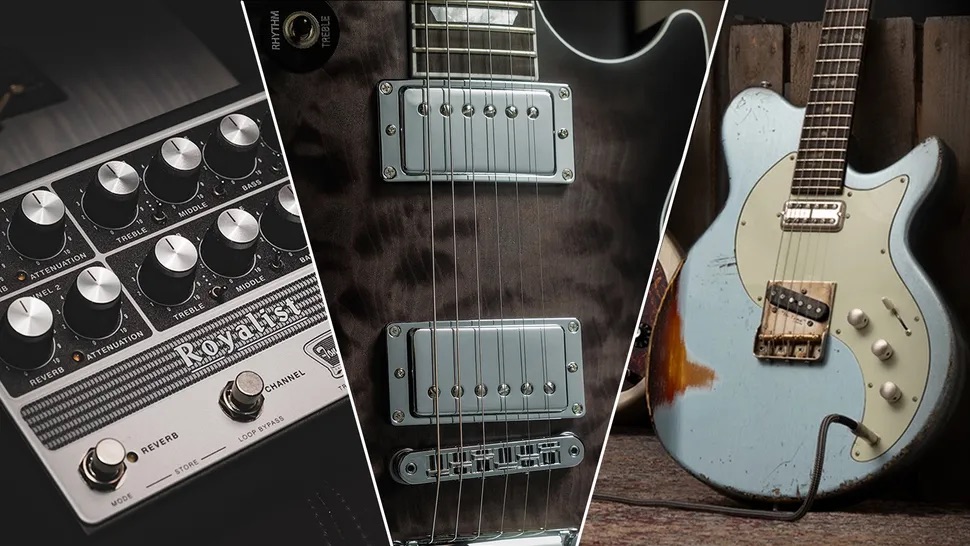
I used two or three Fender Stratocasters that are basically bits stuck together. I used Telecasters and Gibson SGs occasionally. And my various Lowden acoustics. Sometimes you can have a not-very-good guitar that on its own is unimpressive and actually sounds pretty bad, but it will fit that space on a record.
You know, it’ll have just the right frequencies to cut through in the right way. Whereas your $15,000 Santa Cruz will just get lost. There might be three 12-strings on the intro to the opening track. It’s one of those things where it’s like, “Ooh, that sounds good. Chuck another one on.’ You know, ‘How much jangle do you want?”

How many Lowdens have you played on stage over the years?
Well, I keep using them until the airlines break them, which is not infrequently. I’ve played Lowden onstage since the mid-80s. I’m on number three, which isn’t bad going. The head broke off the first one, but I glued it back on again and it sounds great. They smashed the whole side in of number two. Looked like a forklift truck went through it. Right through the case, right through the guitar. But that’s repaired and sounds really good now. Perhaps even better since the repair.
So I’m on number three. I’m still playing it in a bit, actually; it’s still maturing. But that’s live ones. I keep the best-sounding ones for recording. I’ve got a Lowden nylon-strung. I’ve got a Lowden electric. I have a baby Lowden as well, the little S series.
The only vintage acoustic I’ve still got is my old 000-18 Martin, which is retired from the road. It’s been abused on stage, but it’s a joy to play around the house sometimes, especially if my wife [singer-songwriter Zara Phillips] pinches the Lowdens.
Have you come to any conclusions about mic’ing up acoustics over the years?
In the studio, often the engineer will just put up one pencil mic or one small diaphragm mic. An 84, an AKG or a Schoeps: they can all sound really good. But I like the coincidental pair – you know, where they’re at 90 degrees to each other, slightly above or below the soundhole. If it’s just you and a guitar, you can put the voice in the middle, and then have the acoustic just slightly moving left and right.
Some artists have a whole new mic configuration for every record…
It also depends on the key a song’s in. You know, are you capo’ing the guitar up? Does your guitar sound better in C or in A? What are the overtones? How does it ring? I think in a sense you’re better to use the same mic, but just place it differently sometimes, for different overtones.
If you want to get extravagant about it, besides the close mic, you can put up a pair of room mics. What John Wood used to do with Nick Drake was he’d have it close mic’d then have a pair of room mics in front and a pair of room mics behind – then mix all that together. That’s a pretty interesting idea.

Which musicians are on the record and where was it recorded?
Drums and percussion, Michael Jerome, who I’ve been playing with for 25 years. On bass, Taras Prodaniuk: if you can spell that, you’re a genius, or from the Ukraine. David Mansfield on acoustic/electric guitar and fiddle. My wife, Zara, on lead vocals. We had some wonderful horn players that came in. We did it at a place called Hobo Sound in New Jersey. I’ve done the odd overdub in there, and thought it might be the place to go.
Whose records do you listen to now?
What you would call actual popular music – hardly anybody. I listen to more vintage stuff than anything else: the 20s, 30s, 40s, 50s, 60s and a bit of the 70s. I listen to pretty much any generation of jazz. And a lot of classical music. I always have done, since I was a teenager, because it’s a place to go to learn about harmony and orchestration. I love rockabilly. A good singer-songwriter is great – and that’s about it, really.
I have a slight phobia… well, maybe I shouldn’t call it a phobia. But I resent the lack of texture on modern records. And it’s just because if you sample a bass drum then it sounds the same every single time you hit it. But if you have a real drummer playing a bass drum, it’s different every time he hits it. Whether he’s trying to do that or not, every beat is a little different. So if you sample everything and you loop everything, then I just get tired. My ears get tired of the texture. I hate to say it.
Music-making has entirely changed over the last few decades…
It’s normal now to start off with a drum loop, add a bass and build it up that way. I went to visit my old school after a long absence and I was really impressed by the music department.
There’s a keyboard for every kid, a guitar for every kid. It’s just fantastic. But one of the kids said, “Oh, I checked you out on Wikipedia and I listened to some of your music, and I really like that song, blah blah blah. I’m going to sample a bit of that and use it in my music.”
I didn’t have a reply. I mean, what could I say? I thought that was a bit sad in one sense. I mean, the world has changed, and I just sound like a grumpy old geezer. But it kind of interested me.
How do you like to approach solos when you’re in the studio?
For most solos, you want to tell a story, and in the right hands, a story should have a beginning, middle and end. You hear a great guitar solo and it absolutely does. I think you practise the bits and pieces until they’re familiar and they’re second nature.
You practise your scales and changing scales halfway through a phrase, and you practise throwing in strange notes or missing out notes of the scale and then coming back to them. And you practise the weird scales, the whole tone scales and the diminished scales, all that stuff.
Another good thing to practise, I think, is just playing melodies. Being melodic, especially if you take stuff from the Great American Songbook, and you say, “Okay, how does that tune go?” Some of those tunes are very interesting. You should almost practise being melodic and practise being dissonant.

And then, when it comes to a solo, you almost want to have your mind blank. Not be thinking of anything and just see where you go. Or you might say, ‘Okay, I’m going to start with this interval. And from there I have no idea what’s going to happen.’ That’s a kind of ideal situation.
The Way That It Shows is one of your all-time great solos. How did that develop?
Sometimes you’re thinking, ‘What’s an interesting quartet of chords over which to solo? And then I’ll write the song later.’ Which is what I did on that song. It has four different scales over four chords. But at the same time, you can play one note – a D – over all of them if you want to.
And then I thought, “Well, I’ll just run off a song that will fit that.” So I did. So that’s a good example of how you can be inspired for a song from any starting point. You don’t have to start with lyrics. You don’t have to start with melody. You can start with a chordal idea that you’re going to flesh out later.
Ultimately, you can approach songs from any angle you like.
Yeah, I think so. You know, Hendrix would change tempo sometimes to go into a solo at the end of a song. He’d go from triple time into straight time and vice-versa, turn it from 3/4 into a galloping 6/8. He was a really good arranger.
I mean, Hendrix, harmonically, is pretty pentatonically based until he starts using the whammy bar and feedback where it goes to Mars
I mean, Hendrix, harmonically, is pretty pentatonically based until he starts using the whammy bar and feedback where it goes to Mars. You know, he’s no Coltrane. But if you think of the great records from the pop era – certainly the 50s and 60s – a lot of session players were playing on those records, and they were jazz musicians.
Like, all the guys at Motown were R&B-slash-jazz players. James Jamerson and Benny Benjamin, these guys were proper jazz players. And over here, Big Jim Sullivan, giving us such quality and depth, sometimes on nearly forgettable popular music.
So what’s next for you?
There’s the Fairport Convention festival [in Oxfordshire] coming up next weekend. This is the 59th anniversary of the band. Next year is the big one. Whoever can still walk or crawl will be there. We’re planning a US band tour in January/February. A European band tour in April/May. And in spite of being busy with other stuff, I keep writing songs. So, you know, I might have to do another album…
- Hippies, Thugs and Heroes is out now via New West Records
- This article first appeared in Guitarist. Subscribe and save.

